
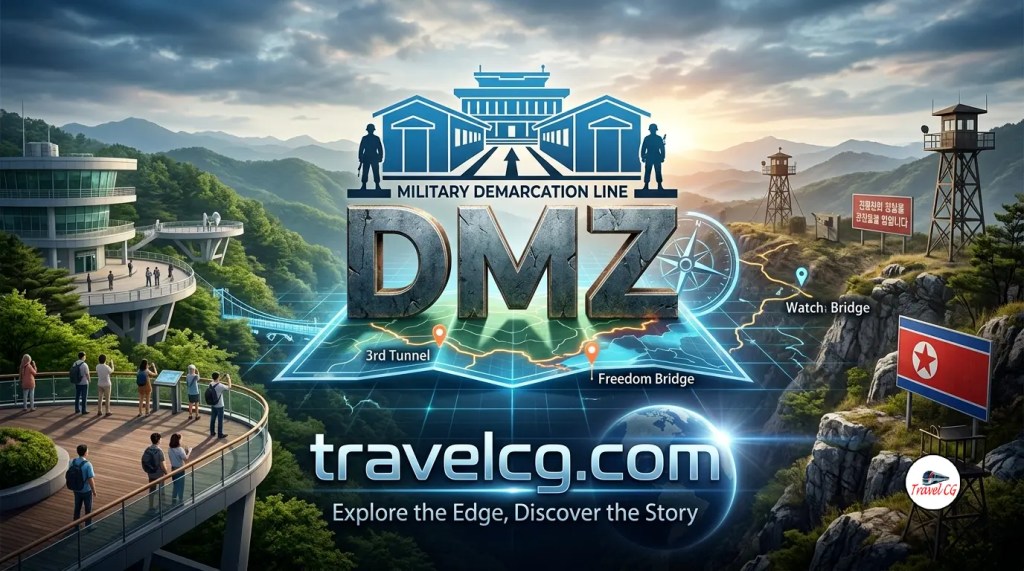
The DMZ (Demilitarized Zone) is one of the most famous and historically significant border areas in the world. Located on the Korean Peninsula, the Korean Demilitarized Zone separates North Korea and South Korea and represents the long-standing division of the peninsula. Despite its name, the DMZ is not simply an ordinary empty strip of land. It is a highly controlled area with military significance, historical sites, wildlife habitats, observation points, tunnels, and important stories connected with the Korean War.
For travelers visiting South Korea, a trip to the DMZ can provide a completely different experience from visiting Seoul’s palaces, shopping districts, museums, or modern attractions. It offers an opportunity to learn about the Korean War, understand the division between the two Koreas, and see landscapes that have remained relatively undeveloped for decades.
What Is the DMZ?
DMZ stands for Demilitarized Zone. The Korean DMZ is a buffer zone established between North and South Korea following the Korean Armistice Agreement of 1953.
The zone runs approximately 250 kilometers from west to east across the Korean Peninsula and is roughly 4 kilometers wide, although its exact boundaries and controlled areas vary.
The DMZ separates the military forces of North and South Korea. In practical terms, it is one of the most heavily guarded border regions in the world, even though the zone itself is officially described as demilitarized.
The DMZ should not be confused with the entire border between North and South Korea. The actual military boundary is known as the Military Demarcation Line (MDL). The DMZ extends approximately 2 kilometers on either side of this line.
Why Was the DMZ Created?
The DMZ was created after the Korean War, which lasted from 1950 to 1953.
Before the war, Korea had been under Japanese colonial rule and was liberated at the end of World War II in 1945. The peninsula was then divided roughly along the 38th parallel, with Soviet forces occupying the north and American forces occupying the south.
Two separate Korean governments eventually emerged:
- North Korea, officially the Democratic People’s Republic of Korea
- South Korea, officially the Republic of Korea
Tensions eventually developed into open conflict. North Korean forces invaded South Korea in June 1950, beginning the Korean War.
The war involved North Korea, South Korea, United Nations forces led by the United States, and Chinese forces supporting North Korea. The fighting caused enormous destruction and loss of life.
In 1953, the opposing sides agreed to an armistice rather than a formal peace treaty. The agreement established the DMZ as a buffer between the two sides.
Importantly, the Korean War is technically not considered to have ended with a formal peace treaty. The armistice stopped large-scale fighting, but the political conflict between the two Koreas continued.
Where Is the Korean DMZ Located?
The DMZ stretches across the Korean Peninsula from the west coast near the Yellow Sea toward the east coast.
On the South Korean side, several areas associated with DMZ tourism are located north of Seoul. Popular access points are generally found in Gyeonggi Province and Gangwon Province.
Because the DMZ is a restricted military area, visitors cannot simply walk into it independently. Access depends on the location, current security conditions, and applicable visitor rules.
DMZ and the Military Demarcation Line
The Military Demarcation Line (MDL) is the actual line separating the military forces of North and South Korea.
The DMZ extends around the MDL and acts as a buffer zone.
The distinction is important:
MDL: The actual military boundary.
DMZ: The buffer area surrounding the military boundary.
Civilian Control Zone: An additional restricted area outside parts of the DMZ on the South Korean side.
These areas have different rules, security arrangements, and levels of public access.
What Is the Joint Security Area?
One of the best-known locations associated with the Korean border is the Joint Security Area (JSA).
The JSA is located within the DMZ and has historically been used for meetings and negotiations between North and South Korean representatives.
The area became particularly famous because military personnel from both sides have historically stood facing each other across the Military Demarcation Line.
The JSA has also hosted important inter-Korean meetings and negotiations.
However, access to the JSA has been subject to changing security conditions and restrictions. Visitors should never assume that a particular area will be open simply because it was accessible during a previous period.
Major Attractions Around the DMZ
A DMZ visit from South Korea can include several important attractions. The exact itinerary depends on the tour, security situation, and operating conditions.
Imjingak
Imjingak is one of the most popular starting points for learning about the Korean division.
It is located near the DMZ and contains memorials, monuments, and exhibits related to the Korean War and separated families.
The area also has recreational facilities and viewpoints, making it a common destination for visitors who want to experience the history of the region without entering the most restricted sections.
Freedom Bridge
The Freedom Bridge is an important historical symbol.
It was used for the return of prisoners and soldiers after the Korean War armistice.
Today, it represents hope for reconciliation and the possibility of future connections between separated Korean communities.
Third Tunnel of Aggression
One of the most interesting attractions is the Third Tunnel of Aggression.
South Korean authorities discovered several tunnels that had been constructed from North Korea toward the South. These tunnels were believed to have military purposes.
The Third Tunnel is one of the best-known examples and has become a major tourist attraction.
Visitors can walk through a portion of the tunnel, although photography and access restrictions apply in certain areas.
The tunnel provides a striking reminder that the Korean conflict was not limited to the open battlefield.
Dora Observatory
Dora Observatory offers visitors an opportunity to look toward North Korea from the South Korean side.
On clear days, visitors may be able to see parts of the North Korean landscape and settlements.
The experience can be fascinating because the view may appear surprisingly peaceful despite the area’s military significance.
Visibility depends heavily on weather and atmospheric conditions.
Dorasan Station
Dorasan Station is another symbolic location associated with hopes for future Korean reunification.
The railway station was developed as part of efforts to reconnect transportation networks between South and North Korea.
Although ordinary international rail travel through North Korea is not available, the station remains an important symbol of the possibility of greater connection between the two Koreas.
DMZ Wildlife
One of the most surprising aspects of the DMZ is its natural environment.
Because human activity has been heavily restricted in the area for decades, portions of the DMZ have developed into relatively undisturbed habitats.
The region contains forests, wetlands, grasslands, rivers, and agricultural landscapes.
Various species of birds and other wildlife have been observed in and around the DMZ.
The area has attracted interest from conservationists because restrictions on human activity have unintentionally created conditions favorable to wildlife.
Species associated with the broader DMZ region include migratory birds and other animals that depend on wetlands and forest habitats.
This creates an unusual contrast: an area created because of military conflict has also become an important ecological space.
Why Is the DMZ Important?
The DMZ has importance far beyond geography.
Historical Importance
The DMZ represents the legacy of the Korean War and the division of Korea.
Millions of people were affected by the war, and families were separated by the division.
Political Importance
The DMZ remains one of the world’s most sensitive geopolitical boundaries.
Relations between North and South Korea can influence military conditions and access to the area.
Symbolic Importance
For many Koreans, the DMZ represents both separation and the hope of reunification.
Memorials, railways, bridges, and monuments around the area frequently emphasize the emotional impact of the division.
Environmental Importance
Decades of limited human activity have helped preserve parts of the region’s natural landscape.
This has made the DMZ an unusual example of how a politically restricted landscape can develop ecological importance.
Is the DMZ Safe for Tourists?
DMZ tourism is generally organized under controlled conditions, but visitors must remember that this is a military and security-sensitive area.
The situation can change depending on political and military developments.
Tour operators and authorities may change routes, cancel visits, or restrict access without much advance notice.
Visitors should always follow instructions from guides and security personnel.
Do not cross barriers, enter restricted areas, photograph prohibited locations, or attempt to approach military personnel.
The DMZ is not an ordinary tourist attraction where visitors can explore freely.
Can You Visit the DMZ Without a Tour?
Access depends on the specific area.
Some locations around the DMZ, such as areas near Imjingak, may be accessible more independently than restricted military areas.
However, entering controlled sections generally involves official procedures, identification requirements, transportation arrangements, or organized tours.
The rules can change, so visitors should verify current access conditions before planning a trip.
Best Time to Visit the DMZ
The DMZ can be visited during different seasons, and each has its own character.
Spring
Spring offers pleasant temperatures and fresh vegetation. The landscape can be particularly attractive during this period.
Summer
Summer can be warm and humid, with occasional heavy rainfall. Visibility toward North Korea may be affected by clouds and humidity.
Autumn
Autumn is often an excellent period for visiting because temperatures are comfortable and foliage can create beautiful scenery.
Winter
Winter can be cold, but clear winter days may provide excellent visibility. Visitors should dress appropriately for outdoor observation areas.
What to Bring to the DMZ
Visitors should travel light and prepare for changing conditions.
Useful items include:
- Government-issued identification
- Comfortable walking shoes
- Weather-appropriate clothing
- Water
- Sunscreen
- A small bag
- Camera or smartphone where photography is permitted
- Any required travel documents
Because some areas involve walking through tunnels or uneven terrain, comfortable footwear is especially useful.
DMZ Photography Rules
Photography is often allowed at designated locations, but restrictions can apply.
Visitors should pay attention to instructions about:
- Military installations
- Soldiers
- Restricted buildings
- Security equipment
- Certain border areas
- Directions in which photography is permitted
Never assume that something is safe to photograph simply because it is visible.
When in doubt, ask the guide before taking a photograph.
How Long Does a DMZ Trip Take?
A typical DMZ-focused excursion from Seoul can take several hours.
A shorter visit might focus on attractions around Imjingak, while a more extensive itinerary may include several sites such as an observatory and tunnel.
Travel time is also affected by traffic, security checks, and changing access conditions.
Visitors should therefore avoid planning another time-sensitive activity immediately after a DMZ excursion.
DMZ vs JSA
People sometimes use the terms DMZ and JSA interchangeably, but they are not the same.
The DMZ is the larger buffer zone separating North and South Korea.
The JSA is a specific area within the DMZ associated with military meetings and negotiations.
Therefore, visiting a DMZ attraction does not necessarily mean visiting the JSA.
This distinction is especially important when choosing a tour.
DMZ and Korean Reunification
The DMZ is closely connected with the idea of Korean reunification.
For decades, families have lived on opposite sides of the border without being able to freely visit one another.
The division has created deep emotional, cultural, political, and economic consequences.
For some visitors, the most meaningful part of a DMZ trip is not the military history but the human story behind the border.
Memorials and monuments around the region often remind visitors that the division affects real families and communities.
Interesting Facts About the DMZ
The Korean DMZ is filled with fascinating facts.
- The DMZ was established in 1953 following the Korean Armistice Agreement.
- It stretches for approximately 250 kilometers across the Korean Peninsula.
- It is approximately 4 kilometers wide.
- The Military Demarcation Line runs through its center.
- The region has been heavily affected by military restrictions for decades.
- Parts of the DMZ have become valuable wildlife habitats.
- Several tunnels discovered from the North Korean side toward South Korea are associated with the border conflict.
- The area is simultaneously a military buffer, historical landscape, political symbol, and ecological zone.
- The DMZ has become one of South Korea’s most distinctive historical tourism destinations.
Things to Remember Before Visiting
A DMZ visit is very different from a normal sightseeing trip.
Keep these points in mind:
- Carry valid identification. Some areas require identity verification.
- Follow your guide’s instructions. Security rules are strict.
- Do not cross barriers. Restricted areas are not tourist zones.
- Respect photography restrictions.
- Expect itinerary changes. Security conditions can change.
- Wear comfortable footwear. Some attractions require walking.
- Check weather conditions. Visibility is important at observation points.
- Do not treat the area as entertainment. The DMZ represents a serious historical and political situation.
- Allow extra time. Security procedures and transportation can affect schedules.
- Check current regulations before traveling. Access rules can change.
Why Should You Visit the DMZ?
The DMZ is worth visiting for people interested in history, politics, geography, military history, Korean culture, photography, and wildlife.
It provides a perspective on Korea that cannot be obtained by visiting Seoul’s modern attractions alone.
Standing near the border can make the history of the Korean Peninsula feel much more tangible. The landscape may look peaceful, but its fences, observation posts, monuments, tunnels, and military presence reveal the complicated history beneath that peaceful appearance.
At the same time, the natural environment around the DMZ demonstrates an unexpected side of the region. Restricted human activity has allowed parts of the landscape to remain relatively undeveloped, creating habitats for wildlife.
The DMZ therefore represents several things simultaneously: war and peace, separation and reunification, military tension and natural preservation, history and modern geopolitics.
For anyone traveling through South Korea and interested in understanding the country’s past and present, the DMZ is one of the most significant places to explore.












Leave a Reply