
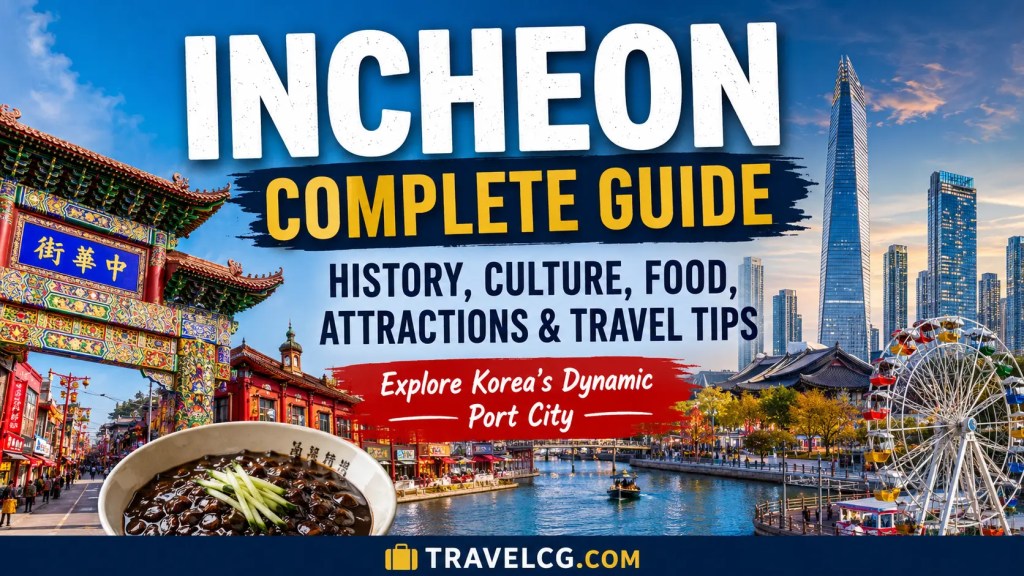
Incheon is one of South Korea’s most interesting cities to explore, combining historic neighborhoods, modern architecture, coastal scenery, islands, markets, entertainment districts, and one of the world’s major international airports. Although many international travelers know Incheon mainly because of Incheon International Airport, the city itself deserves time on a South Korea itinerary.
Located west of Seoul on the Yellow Sea coast, Incheon offers a completely different atmosphere from the capital. Historic port streets and Chinatown sit alongside futuristic Songdo, while seaside areas such as Wolmido provide amusement parks, waterfront walks, seafood restaurants, and sunset views. The wider Incheon metropolitan area also includes destinations such as Ganghwa Island and several smaller islands.
For first-time visitors, Incheon can work as a day trip from Seoul, a longer city break, or a convenient stop before or after an international flight.
Why Visit Incheon?
Incheon is particularly appealing because it combines several different travel experiences in one destination.
You can explore Korea’s modern port history around the Open Port Area, eat jjajangmyeon in Incheon Chinatown, wander through colorful Songwol-dong Fairy Tale Village, enjoy the sea at Wolmido, and then finish the day surrounded by skyscrapers at Songdo Central Park.
The city is also an excellent destination for travelers interested in food. Incheon is strongly associated with Korean-Chinese cuisine, seafood, markets, street food, and coastal dining.
Official Korean tourism information highlights the contrast between Incheon’s historic port areas, Chinatown, Wolmido, Songdo, Ganghwa Island, and newer entertainment destinations.
Where Is Incheon?
Incheon is located in northwestern South Korea, immediately west of Seoul. It faces the Yellow Sea and includes a large coastal area as well as numerous islands.
The city is part of the Seoul Capital Area, making it relatively easy to combine with a Seoul trip.
Incheon is especially important internationally because Incheon International Airport serves as South Korea’s principal international aviation gateway.
Best Time to Visit Incheon
The best seasons for visiting Incheon are generally spring and autumn.
Spring
Spring brings comfortable temperatures and fresh greenery. It is a pleasant season for walking around Chinatown, Songdo Central Park, parks, and coastal areas.
Summer
Summer can be warm, humid, and rainy, but it is a good season for beaches, seaside areas, evening walks, and outdoor activities.
Autumn
Autumn is one of the most comfortable periods for sightseeing. Cooler temperatures and colorful foliage make parks and outdoor attractions particularly enjoyable.
Winter
Winter can be cold and windy, especially around the coast. However, winter travelers can still enjoy museums, restaurants, shopping, cafés, indoor attractions, and illuminated cityscapes.
How to Reach Incheon
From Incheon International Airport
Incheon International Airport is located within Incheon Metropolitan City, but the airport area is separated from many of the city’s major attractions.
Travelers staying in central Incheon can use airport rail, subway, buses, taxis, or private transfers depending on their destination.
For travelers heading directly toward Seoul, the airport rail system provides a convenient connection. For Chinatown and the historic port district, travelers need to continue toward the Incheon Station area.
From Seoul
Incheon is easily accessible from Seoul by subway and other public transportation.
The journey time varies considerably depending on the exact starting point and destination because Incheon is a large city. Incheon Station is particularly convenient for visitors exploring Chinatown, the Open Port area, and nearby historic attractions.
Travel guides commonly place the Seoul-to-Incheon journey at roughly an hour, depending on the route and starting point.
Getting Around Incheon
Incheon is a large metropolitan area, so planning your route by neighborhood is important.
The historic district around Incheon Station is relatively easy to explore on foot. Chinatown, Jayu Park, the Open Port Area, Songwol-dong Fairy Tale Village, and Sinpo Market can be combined into a walking-focused itinerary.
Wolmido can then be reached by a short local transfer.
Songdo is in a different part of the city and is better treated as a separate sightseeing area.
For longer journeys, use the subway, city buses, taxis, or navigation apps.
Best Things to Do in Incheon
1. Explore Incheon Chinatown
Incheon Chinatown is one of the city’s most recognizable attractions and one of the defining cultural areas of the historic port district.
The neighborhood developed around the opening of Incheon Port and has strong historical connections with Chinese merchants and Korean-Chinese cuisine.
Its colorful streets, traditional-style gateways, restaurants, snack shops, murals, and surrounding historic attractions make it an excellent starting point for exploring old Incheon.
One of the most famous foods associated with the area is jjajangmyeon, Korean noodles served with a savory black-bean sauce.
Incheon Chinatown is particularly easy to combine with Jayu Park, Songwol-dong Fairy Tale Village, and the Open Port Area.
2. Walk Through the Open Port Area
The Open Port Area is one of the best places to understand Incheon’s historical importance.
The district contains traces of the city’s transformation after Incheon Port opened to international trade. Historic architecture, museums, old streets, cultural spaces, and modern businesses create an interesting mixture of old and new.
A slow walk through the area is recommended rather than simply visiting one attraction.
3. Visit Jayu Park
Jayu Park is one of Incheon’s historic urban parks and sits close to Chinatown.
It provides greenery and elevated views toward the harbor and surrounding city.
The park is especially useful as a relaxing break after exploring Chinatown’s busy streets.
4. Discover Songwol-dong Fairy Tale Village
Songwol-dong Fairy Tale Village is a colorful neighborhood filled with themed murals, decorations, sculptures, and storybook-inspired streets.
It is especially popular with families and travelers who enjoy photography.
Because it is close to Incheon Chinatown, the two attractions can easily be visited together.
5. Explore Sinpo International Market
Sinpo International Market is a traditional market where visitors can experience local snacks and street food.
It is a good place to add a food-focused stop to a historic Incheon itinerary.
Sinpo Market is particularly associated with dakgangjeong, a crispy sweet-and-spicy style of Korean fried chicken.
6. Spend Time at Wolmido
Wolmido is one of Incheon’s best-known seaside leisure districts.
The area features a waterfront promenade, restaurants, cafés, amusement rides, entertainment, and views toward the harbor.
Wolmi Culture Street is a popular place for walking beside the water.
Wolmido can be particularly enjoyable in the late afternoon and evening when the atmosphere becomes livelier.
Travel sources also highlight the Wolmi Sea Train as an attraction for visitors wanting a different way to experience the area.
7. Ride the Wolmi Sea Train
The Wolmi Sea Train is a tourist monorail-style attraction associated with the Wolmido area.
It provides a convenient sightseeing experience for visitors who want to see the coastal and harbor surroundings without walking the entire area.
It can be particularly appealing for families and travelers who prefer relaxed sightseeing.
8. Enjoy Wolmi Theme Park
Wolmi’s amusement attractions add a fun element to an otherwise cultural and coastal itinerary.
Visitors can combine amusement rides with waterfront walks, seafood restaurants, cafés, and sunset views.
The area is particularly lively on weekends.
9. Visit Songdo Central Park
Songdo Central Park represents the modern face of Incheon.
Located in Songdo International Business District, the park combines landscaped green spaces, waterways, modern architecture, walking paths, and impressive skyscrapers.
It is very different from historic Chinatown and demonstrates how dramatically Incheon has developed.
The park is particularly attractive around sunset and after dark, when the surrounding skyline becomes illuminated.
10. See Songdo’s Futuristic Architecture
Songdo is known for its contemporary urban design and high-rise skyline.
The area was developed on reclaimed land and is often presented as an example of a modern, technology-oriented urban district.
Architecture lovers and photographers should allow extra time to walk around the central business district rather than visiting only the park.
11. Explore Incheon Grand Park
Incheon Grand Park is a large green space suitable for travelers looking for a slower pace.
It offers opportunities for walking, cycling, enjoying nature, and relaxing away from the denser urban districts.
It can be a good choice for families and visitors staying in Incheon for several days.
12. Visit Ganghwa Island
Ganghwa Island is one of the most historically interesting destinations within Incheon Metropolitan City.
The island has temples, historical sites, traditional cultural attractions, natural landscapes, and ancient dolmen sites.
It requires more planning than Chinatown or Songdo, but it can turn an ordinary city trip into a much broader exploration of the region.
Korean tourism information also highlights Jeondeungsa Temple and the Ganghwa Peace Observatory among notable experiences on the island.
13. Visit Jeondeungsa Temple
Jeondeungsa Temple is a historic Buddhist temple on Ganghwa Island.
The peaceful surroundings make it an appealing contrast to Incheon’s busy urban districts.
Visitors interested in Korean history, architecture, Buddhism, and nature can combine the temple with other Ganghwa attractions.
14. Visit Ganghwa Peace Observatory
The Ganghwa Peace Observatory provides views toward territory across the border.
Its location makes it a particularly distinctive destination for visitors interested in Korean history and the peninsula’s geopolitical landscape.
Because it is on Ganghwa Island, it should generally be planned as part of a dedicated island excursion rather than squeezed into a short Incheon city tour.
15. Explore Incheon’s Beaches
Incheon has several coastal destinations where visitors can enjoy beaches, cafés, seafood, and sunset scenery.
Some of the most accessible beach areas are located around the airport and Yeongjongdo.
Eurwangni Beach and Wangsan Beach are popular options for travelers wanting a seaside experience without traveling far from the airport area.
16. Explore Yeongjongdo
Yeongjongdo is the island area associated with Incheon International Airport.
Beyond the airport, visitors can find beaches, cafés, resorts, coastal roads, and sunset viewpoints.
It can be a practical option for travelers with a long airport layover who do not want to travel all the way into central Incheon.
17. Experience Modern Entertainment Resorts
The airport and Yeongjongdo area has developed into a major entertainment and resort destination.
Inspire Entertainment Resort is one of the newer large-scale attractions, incorporating entertainment, accommodation, shopping, dining, and event facilities. Korean tourism information identifies it among Incheon’s newer cultural and entertainment landmarks.
Best Food to Try in Incheon
Food is an important part of the Incheon experience.
Jjajangmyeon
Jjajangmyeon is probably the food most strongly associated with Incheon Chinatown.
It consists of noodles topped with a savory black-bean-based sauce and is one of the city’s signature culinary experiences.
Jjamppong
Jjamppong is a spicy Korean-Chinese noodle soup often prepared with seafood.
It is another popular choice around Chinatown.
Mandu
Korean dumplings are widely available throughout the city and make an easy snack while sightseeing.
Dakgangjeong
Sinpo Market is particularly associated with crispy dakgangjeong, usually coated in a sweet and spicy sauce.
Seafood
Because Incheon is a coastal city, seafood is another important part of the local food culture.
Wolmido and other coastal districts are good places to look for seafood restaurants.
Street Food
Markets and tourist districts offer a wide variety of Korean snacks, from fried foods to sweet treats.
Trying several small dishes can be a more enjoyable experience than eating one large meal while exploring.
Best Areas to Stay in Incheon
Choosing where to stay depends heavily on your itinerary.
Incheon Station and Chinatown
Best for:
- First-time visitors
- Historic attractions
- Chinatown
- Local food
- Wolmido access
- Walking-focused sightseeing
This is one of the best areas for travelers who want the traditional and historic side of Incheon.
Songdo
Best for:
- Modern architecture
- Business travelers
- Upscale hotels
- Restaurants and cafés
- Central Park
- Contemporary city views
Songdo provides a completely different experience from old Incheon.
Near Incheon International Airport
Best for:
- Early flights
- Late arrivals
- Long layovers
- Short airport stays
- Resort experiences
Airport-area accommodation can save considerable travel time when your flight schedule is inconvenient.
How Many Days Do You Need in Incheon?
One Day
One day is enough to experience the highlights.
A good route could include:
Chinatown → Songwol-dong Fairy Tale Village → Jayu Park → Open Port Area → Sinpo Market → Wolmido.
Alternatively, travelers interested in modern architecture can focus on:
Songdo Central Park → Songdo International Business District → waterfront areas → evening dining.
Two Days
Two days provide a much better experience.
You can dedicate the first day to historic Incheon and the second to Songdo, Wolmido, or another coastal destination.
Three Days or More
With three or more days, you can explore beyond the central city and consider Ganghwa Island, beaches, parks, museums, and airport-area attractions.
Recommended One-Day Incheon Itinerary
Morning: Chinatown and Historic Incheon
Start around Incheon Station.
Explore Chinatown, walk through the surrounding historic streets, and visit nearby attractions.
Have jjajangmyeon for lunch.
Early Afternoon: Songwol-dong and Jayu Park
Continue to Songwol-dong Fairy Tale Village and then walk toward Jayu Park.
Take time to enjoy the harbor views and historic surroundings.
Late Afternoon: Sinpo Market
Head toward Sinpo Market for snacks and local food.
This is a good time to try dakgangjeong and other Korean street foods.
Evening: Wolmido
Continue to Wolmido.
Walk along the waterfront, enjoy the amusement atmosphere, have seafood or another dinner, and watch the sunset if conditions are favorable.
This historic-Incheon-to-Wolmido route is also consistent with commonly recommended first-time itineraries.
Recommended Two-Day Incheon Itinerary
Day 1: Historic Incheon
Start with Incheon Chinatown.
Continue to:
- Songwol-dong Fairy Tale Village
- Jayu Park
- Open Port Area
- Sinpo International Market
- Wolmido
Finish with a seaside dinner.
Day 2: Modern Incheon
Start at Songdo Central Park.
Continue through Songdo International Business District and surrounding modern architecture.
Spend the afternoon exploring cafés, shopping areas, and waterfront attractions.
Finish with an evening walk through Songdo.
Incheon Airport Layover Guide
Incheon can be an excellent destination during a long airport layover, but the amount of free time matters.
If your layover is short, staying inside the airport or using airport-area attractions may be more practical.
With a sufficiently long layover, travelers can consider visiting:
- Yeongjongdo
- Nearby beaches
- Airport-area resorts
- Songdo
- Central Incheon
A trip into Chinatown requires additional travel time, so travelers should leave a generous safety margin for returning to the airport.
Never plan an airport layover sightseeing trip so tightly that a transportation delay could put your flight at risk.
Incheon for Families
Incheon is a family-friendly destination with plenty of varied activities.
Children may particularly enjoy:
- Songwol-dong Fairy Tale Village
- Wolmi Theme Park
- Wolmido waterfront
- Songdo Central Park
- Incheon Grand Park
- Beaches
- Interactive museums and cultural attractions
Families should allow additional time for meals, transportation, and rest stops.
Incheon for Couples
Couples can enjoy a more relaxed itinerary centered around waterfront areas and evening scenery.
Good options include:
- Songdo Central Park
- Wolmi Culture Street
- Sunset by the coast
- Cafés
- Seafood restaurants
- Evening walks through Songdo
- Photography around the modern skyline
Incheon for Photographers
Incheon offers unusually diverse photography opportunities.
Historic photography is strongest around Chinatown and the Open Port Area.
For colorful photographs, visit Songwol-dong Fairy Tale Village.
For coastal photography, explore Wolmido and nearby beaches.
For modern architecture, Songdo is the obvious choice.
The contrast between old port buildings, colorful streets, the sea, and futuristic skyscrapers is one of Incheon’s greatest visual strengths.
Shopping in Incheon
Shopping opportunities range from traditional markets to modern shopping districts.
Traditional markets are useful for snacks, local products, and everyday Korean shopping.
Songdo offers modern shopping complexes, cafés, restaurants, and contemporary retail spaces.
Airport-area resorts and commercial districts also provide shopping opportunities for travelers with limited time.
Nightlife and Evening Activities
Incheon is not primarily known as Korea’s biggest nightlife destination, but evenings can still be enjoyable.
Songdo’s illuminated skyline provides a modern evening atmosphere.
Wolmido becomes lively around its waterfront entertainment areas.
Chinatown and the historic port district are also pleasant for evening dining.
For a quieter evening, choose a café or waterfront walk.
Incheon Travel Tips
Plan by Area
Do not underestimate the size of Incheon.
Avoid jumping repeatedly between distant neighborhoods during a single day.
Group nearby attractions together.
Use Public Transportation
The subway and buses are useful for many routes, while taxis can save time when traveling between attractions that are not directly connected.
Carry a Navigation App
English-language navigation can be useful, but Korean map services may provide more detailed local information.
Keep Cash Available
Although card payments are widely accepted in South Korea, carrying some Korean won can be useful for markets, small food stalls, and unexpected expenses.
Wear Comfortable Shoes
Historic neighborhoods, markets, parks, and waterfront areas involve considerable walking.
Check Weather Conditions
Coastal weather can change quickly, and strong winds can make outdoor sightseeing less comfortable.
Leave Extra Time for the Airport
If your trip involves an international flight, return to the airport with a generous buffer.
Is Incheon Expensive?
Incheon can be visited on a range of budgets.
Budget travelers can use public transportation, markets, inexpensive restaurants, and free parks.
Mid-range travelers can combine comfortable hotels with restaurants, attractions, and taxis.
Luxury travelers can choose high-end hotels, resorts, fine dining, private transportation, and premium entertainment.
One of the advantages of Incheon is that many attractive experiences, including walking around Chinatown, historic districts, waterfront areas, and Songdo Central Park, do not require expensive admission.
Is Incheon Worth Visiting?
Absolutely.
Incheon is worth visiting because it offers something that Seoul cannot quite replicate: the atmosphere of a historic international port combined with a modern coastal metropolis.
The city has preserved its historic identity while developing futuristic districts such as Songdo.
For a short visit, concentrate on Chinatown, the Open Port Area, Jayu Park, Sinpo Market, and Wolmido.
For a modern-city experience, prioritize Songdo.
For history and nature, expand your trip to Ganghwa Island.
For travelers arriving or departing through Incheon International Airport, the city can also be a convenient addition to a South Korea itinerary.
Final Thoughts
Incheon should not be treated merely as the location of South Korea’s international airport.
It is a substantial destination with its own character, history, food culture, waterfront attractions, islands, modern architecture, markets, parks, and entertainment districts.
The easiest introduction is a one-day trip combining Chinatown, the Open Port Area, Jayu Park, Sinpo Market, and Wolmido. Travelers with additional time should explore Songdo and consider a longer excursion to Ganghwa Island.
Most importantly, Incheon rewards travelers who slow down and explore its contrasting neighborhoods. One moment you can be eating jjajangmyeon beside historic port streets; later you can be watching the sunset beside the sea, and by evening you can be surrounded by the futuristic skyline of Songdo.
That combination of history, food, coast, and modern urban life is what makes Incheon one of South Korea’s most versatile travel destinations.






Leave a Reply