
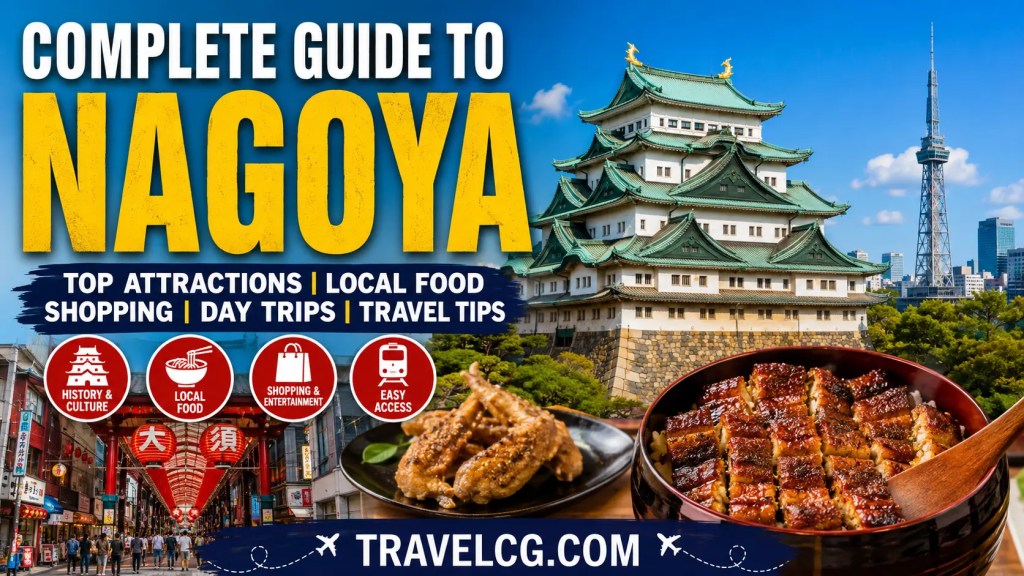
Nagoya is one of Japan’s most interesting cities, combining historic castles, traditional culture, modern technology, excellent food, shopping districts, museums, and easy access to some of central Japan’s most popular destinations. Located in Aichi Prefecture between Tokyo and Kyoto, Nagoya is Japan’s fourth-largest urban area and an important industrial and cultural center.
Often overlooked in favor of Tokyo, Kyoto, and Osaka, Nagoya offers a different experience. It is less crowded than Japan’s most famous tourist cities while still having excellent transportation, attractions, restaurants, shopping, and entertainment.
Whether you are planning a short stopover or a several-day trip, this guide covers everything you need to know about visiting Nagoya.
Nagoya at a Glance
Country: Japan
Region: Chubu, Central Japan
Prefecture: Aichi
Main railway station: Nagoya Station
Major airport: Chubu Centrair International Airport
Language: Japanese
Currency: Japanese Yen (JPY)
Best known for: Nagoya Castle, Toyota, Atsuta Shrine, local cuisine, museums, shopping and transportation connections
Recommended stay: 2–4 days
Best time to visit: Spring and autumn are particularly pleasant
Time zone: Japan Standard Time (JST), UTC+9
Why Visit Nagoya?
Nagoya is sometimes described as an industrial city, but that description does not capture its full character. The city has a fascinating mixture of history, technology, food, entertainment and traditional Japanese culture.
One of the biggest advantages of Nagoya is its location. It sits roughly between Tokyo and Kyoto, making it convenient for travelers exploring Japan.
Nagoya is also associated with major Japanese companies and manufacturing, especially Toyota. Visitors interested in automobiles and technology can find some excellent museums and exhibitions here.
The city is also famous for its distinctive local cuisine. Nagoya’s food culture is different from Tokyo or Osaka, with dishes featuring miso, chicken, noodles and other regional flavors.
Best Time to Visit Nagoya
Nagoya can be visited throughout the year, but each season offers a different experience.
Spring
Spring is one of the most attractive times to visit Japan.
Cherry blossoms usually appear around late March and early April, although exact timing varies each year. Parks, gardens and temple grounds become especially beautiful during this period.
Spring is excellent for sightseeing because temperatures are generally comfortable.
Summer
Summer is warm, humid and sometimes rainy.
June can bring considerable rainfall, while July and August are typically hot and humid.
If you visit during summer, plan outdoor sightseeing for mornings and evenings and take advantage of museums, shopping centers and indoor attractions during the hottest part of the day.
Autumn
Autumn is another excellent season.
October and November generally bring comfortable temperatures and beautiful autumn foliage.
Parks, gardens and historic sites can look particularly attractive during this season.
Winter
Winter is relatively cold but usually manageable for travelers who are properly dressed.
Snowfall in central Nagoya is possible but is generally not comparable to the heavy snow experienced in some parts of northern Japan.
Winter can be a good choice if you prefer fewer crowds.
How Many Days Do You Need in Nagoya?
One Day
One day is enough for a quick introduction.
You could visit:
- Nagoya Castle
- Atsuta Shrine
- Osu Shopping District
- Nagoya Station area
However, this itinerary will feel rushed.
Two Days
Two days is a good minimum for first-time visitors.
You can combine major historical attractions with food, shopping and museums.
Three Days
Three days provides a comfortable Nagoya itinerary.
You can explore the city at a relaxed pace and include attractions such as the Toyota-related museums or SCMAGLEV and Railway Park.
Four or More Days
With four or more days, you can explore Nagoya more deeply and take day trips to nearby destinations.
Possible excursions include:
- Inuyama
- Gifu
- Toyota
- Nagoya Port area
- Ise
- Legoland Japan
- Ghibli Park
Top Places to Visit in Nagoya
Nagoya Castle
Nagoya Castle is one of the city’s most famous landmarks.
The original castle was constructed in the early 17th century under the Tokugawa shogunate and played an important role in the history of the region.
The castle is particularly famous for its golden shachihoko ornaments on the roof.
The surrounding grounds are also worth exploring.
Visitors can enjoy:
- Castle architecture
- Gardens
- Historic exhibitions
- Seasonal scenery
- Traditional Japanese atmosphere
Nagoya Castle should be near the top of your itinerary.
Atsuta Shrine
Atsuta Shrine is one of Japan’s most important Shinto shrines.
It has a long history and is surrounded by peaceful greenery, creating a very different atmosphere from the busy city center.
The shrine is traditionally associated with the sacred sword Kusanagi-no-Tsurugi, one of Japan’s Imperial Regalia.
Even travelers who are not particularly interested in religion can appreciate the architecture, forested surroundings and cultural atmosphere.
Osu Shopping District
Osu is one of Nagoya’s liveliest areas.
It combines traditional shops, modern stores, restaurants, electronics retailers, vintage shops, street food and entertainment.
The district is centered around Osu Kannon Temple and contains numerous covered shopping streets.
It is a particularly good area for:
- Shopping
- Street food
- Anime and manga merchandise
- Vintage clothing
- Electronics
- Local snacks
- Traditional stores
Spend several hours exploring the smaller streets rather than simply visiting the main shopping arcade.
Osu Kannon Temple
Osu Kannon is a popular Buddhist temple located in the Osu district.
It provides a convenient cultural stop while exploring the surrounding shopping streets.
The area around the temple can become lively during markets and special events.
Nagoya City Science Museum
The Nagoya City Science Museum is an excellent attraction for families, students and anyone interested in science.
Its enormous spherical planetarium is one of its most recognizable features.
Inside, visitors can explore exhibits covering subjects such as:
- Space
- Physics
- Natural science
- Technology
- Human life
- Earth science
It is especially useful as an indoor attraction on rainy or extremely hot days.
Toyota Commemorative Museum of Industry and Technology
Nagoya’s history is strongly connected with manufacturing, textiles and automobiles.
The Toyota Commemorative Museum of Industry and Technology explains the development of Toyota’s industrial technologies.
Visitors can learn about machinery, manufacturing processes and the evolution of Japanese industry.
It is one of the best places in Nagoya for understanding the city’s industrial heritage.
Toyota Automobile Museum
Car enthusiasts should consider visiting the Toyota Automobile Museum.
The museum displays automobiles from Japan and around the world and explains the evolution of automotive design and technology.
It is not limited to Toyota vehicles, making it interesting even for people who simply enjoy automotive history.
SCMAGLEV and Railway Park
Japan is famous for its railway technology, and SCMAGLEV and Railway Park provides an excellent opportunity to learn about it.
The museum features numerous railway vehicles and explains the development of high-speed trains and magnetic levitation technology.
It is especially appealing to:
- Railway enthusiasts
- Families
- Children
- Technology enthusiasts
- Engineering students
Nagoya Port
Nagoya Port is an interesting part of the city for travelers who want something different from traditional sightseeing.
The port area includes attractions, museums, shopping and waterfront spaces.
Nagoya Public Aquarium is one of the major attractions in the area.
Nagoya Public Aquarium
The aquarium is one of the most popular family attractions in Nagoya.
Visitors can see marine life from different environments and enjoy large-scale aquatic displays.
It can easily be combined with other Nagoya Port attractions.
Higashiyama Zoo and Botanical Gardens
Higashiyama Zoo and Botanical Gardens is a large recreational area featuring animals, plants and gardens.
It is particularly suitable for families and travelers who want to spend several hours outdoors.
The surrounding area provides a pleasant break from the dense urban environment.
Nagoya TV Tower and Hisaya-odori Park
The Nagoya TV Tower, now known as Chubu Electric Power MIRAI TOWER, is one of the city’s recognizable landmarks.
Hisaya-odori Park surrounds the tower area and has been developed into a modern urban leisure district.
The area is good for:
- Walking
- Restaurants
- Cafes
- Shopping
- City views
- Evening entertainment
Oasis 21
Oasis 21 is a modern architectural landmark located near MIRAI TOWER.
Its distinctive glass structure is especially attractive after dark when the area is illuminated.
The surrounding Sakae district is one of Nagoya’s main entertainment and shopping areas.
Sakae
Sakae is one of Nagoya’s major downtown districts.
It is ideal for travelers interested in:
- Shopping
- Restaurants
- Nightlife
- Department stores
- Cafes
- Fashion
- Entertainment
Sakae becomes particularly lively in the evening.
Nagoya Station Area
Nagoya Station is much more than a transportation hub.
The surrounding area contains:
- Shopping centers
- Department stores
- Restaurants
- Hotels
- Observation decks
- Office towers
- Underground shopping areas
The station area is one of the most convenient places to stay if you plan to use Nagoya as a base for exploring central Japan.
Nagoya’s Famous Food
Food is one of the best reasons to visit Nagoya.
The city has a distinctive culinary identity often referred to as Nagoya meshi, meaning Nagoya cuisine.
Miso Katsu
Miso katsu is one of Nagoya’s signature dishes.
It consists of a breaded and fried pork cutlet served with a rich red miso-based sauce.
The sauce is stronger and more savory than the typical tonkatsu sauce found elsewhere in Japan.
Hitsumabushi
Hitsumabushi is a famous Nagoya eel dish.
Grilled eel is served over rice, traditionally allowing diners to enjoy it in different ways.
It can be eaten simply with the eel and rice, with seasonings, or with broth or tea poured over the dish.
It is one of the city’s must-try specialties.
Tebasaki
Tebasaki refers to Nagoya-style chicken wings.
They are typically fried and seasoned with a savory, slightly sweet and spicy mixture.
They make an excellent casual meal or snack.
Kishimen
Kishimen is a flat, wide Japanese noodle traditionally associated with Nagoya.
It is commonly served in a hot broth with toppings.
You can easily find kishimen at restaurants around Nagoya Station.
Miso Nikomi Udon
This hearty noodle dish features udon simmered in a rich miso-based broth.
It is particularly satisfying during colder weather.
Nagoya Cochin
Nagoya Cochin is a premium regional chicken breed.
It is used in various dishes, including grilled chicken, hot pots, rice dishes and egg-based meals.
If you enjoy Japanese cuisine, trying a dish featuring Nagoya Cochin can be worthwhile.
Ogura Toast
Ogura toast consists of toast topped with sweet red bean paste, often accompanied by butter or margarine.
It is strongly associated with Nagoya’s café culture.
Try it as a breakfast or afternoon snack.
Nagoya’s Café Culture
Nagoya has a distinctive kissaten culture.
Traditional Japanese coffee shops often serve coffee alongside small breakfast items.
A famous local practice is the morning service, where ordering a drink may come with toast and other simple breakfast items during certain hours.
This makes breakfast at a traditional café an interesting local experience.
Best Areas to Stay in Nagoya
Choosing the right neighborhood can make your trip easier.
Nagoya Station
This is one of the best choices for first-time visitors.
Advantages include:
- Excellent train connections
- Easy airport access
- Many hotels
- Restaurants
- Shopping
- Convenient day trips
It is particularly useful if you are traveling with luggage or planning to take several trains.
Sakae
Sakae is ideal if you want nightlife, shopping and restaurants close to your accommodation.
It has a more entertainment-focused atmosphere than the station area.
Fushimi
Fushimi is centrally located between Nagoya Station and Sakae.
It can be a good choice for travelers who want convenient access to both areas while staying in a slightly quieter environment.
Osu
Osu is a good option for travelers interested in shopping, local culture, street food and a more eclectic atmosphere.
Nagoya Port
Staying around Nagoya Port can make sense if your itinerary focuses heavily on the aquarium, railway museum or port attractions, although it is less convenient for a general first-time city tour.
How to Get Around Nagoya
Nagoya has an efficient public transportation system.
Subway
The subway is one of the easiest ways to move around central Nagoya.
It connects major areas including:
- Nagoya Station
- Sakae
- Fushimi
- Kanayama
- Osu
- Other residential and tourist districts
JR Trains
JR services are important for reaching destinations outside central Nagoya.
Nagoya Station is a major railway hub.
Meitetsu
Meitetsu trains are particularly useful for connections involving Chubu Centrair International Airport and destinations in Aichi Prefecture.
Kintetsu
Kintetsu provides connections from Nagoya toward destinations such as Ise and Osaka.
Buses
Buses complement the subway and railway network and can be useful for attractions that are not immediately next to train stations.
Taxis
Taxis are convenient but considerably more expensive than public transportation.
They are most useful when traveling with several people, carrying heavy luggage or visiting locations with limited public transportation.
Getting to Nagoya
By Air
Chubu Centrair International Airport is Nagoya’s principal international airport.
The airport is located on an artificial island in Ise Bay and is connected to Nagoya by rail and other transportation services.
Travelers can reach central Nagoya relatively easily by train.
By Shinkansen
The Tokaido Shinkansen connects Nagoya with Tokyo and Kyoto, continuing toward Osaka.
This makes Nagoya one of the easiest cities to incorporate into a Japan itinerary.
Approximate travel times vary depending on the train service, but high-speed rail makes the following combinations practical:
Tokyo → Nagoya
Nagoya → Kyoto
Nagoya → Osaka
Nagoya → Shin-Osaka
Always check the current timetable before traveling because service patterns and journey times can vary.
From Tokyo to Nagoya
The Shinkansen is generally the most convenient option.
It provides a fast connection between Tokyo and Nagoya and is particularly useful for travelers with limited time.
From Kyoto to Nagoya
Nagoya is also very convenient from Kyoto by Shinkansen.
This makes it possible to visit Kyoto and Nagoya during the same trip without spending excessive time traveling.
From Osaka to Nagoya
Osaka is also easily connected to Nagoya by train.
Nagoya can therefore be used as either a destination or a convenient stop between Tokyo and the Kansai region.
Best Things to Do in Nagoya at Night
Nagoya has plenty to do after sunset.
Explore Sakae
Sakae is one of the best areas for evening entertainment.
You can enjoy restaurants, shopping, bars, illuminated streets and city views.
Visit Oasis 21
Oasis 21 is particularly attractive after dark when its architecture is illuminated.
Enjoy Nagoya Food
Night is a great time to explore local specialties such as:
- Miso katsu
- Tebasaki
- Hitsumabushi
- Miso nikomi udon
Explore Osu
Osu remains lively into the evening, with restaurants and entertainment venues scattered throughout the district.
Shopping in Nagoya
Nagoya provides shopping opportunities ranging from luxury department stores to small independent shops.
Popular shopping areas include:
- Nagoya Station
- Sakae
- Osu
- Hisaya-odori
- Underground shopping areas
You can find:
- Fashion
- Electronics
- Cosmetics
- Souvenirs
- Japanese snacks
- Anime merchandise
- Traditional crafts
- Kitchenware
What Souvenirs to Buy in Nagoya
Good Nagoya souvenirs include:
- Miso-based food products
- Regional sweets
- Nagoya-style noodles
- Local tea and snacks
- Traditional crafts
- Food-themed souvenirs
- Automobile-related merchandise
Packaged regional foods are especially convenient because they are easy to carry.
Nagoya for Families
Nagoya is an excellent family destination.
Family-friendly attractions include:
- Nagoya City Science Museum
- Nagoya Public Aquarium
- Higashiyama Zoo
- SCMAGLEV and Railway Park
- Legoland Japan
- Ghibli Park
Children interested in trains, cars, science and technology may find Nagoya particularly exciting.
Ghibli Park
Ghibli Park is located in Aichi Prefecture near Nagoya rather than in central Nagoya.
It is dedicated to the worlds created by Studio Ghibli.
Because entry arrangements and timed admission can apply to individual areas, travelers should check the latest official ticketing and reservation information before visiting.
Ghibli Park can require a significant portion of a day, especially if you want to explore multiple areas.
Legoland Japan
Legoland Japan is another major family attraction in the greater Nagoya area.
It is designed primarily for children and families and features rides, themed areas and attractions built around LEGO.
Day Trips from Nagoya
Nagoya’s central location makes it a useful base for day trips.
Inuyama
Inuyama is known for its historic castle and traditional townscape.
It is one of the easiest cultural day trips from Nagoya.
Highlights include:
- Inuyama Castle
- Historic streets
- Traditional architecture
- River scenery
- Local food
Gifu
Gifu is located close to Nagoya and provides access to attractions associated with Japanese history and traditional culture.
Gifu Castle and the surrounding areas can be combined into a day trip.
Ise
Ise is famous for Ise Jingu, one of Japan’s most important Shinto shrine complexes.
The destination is especially appealing to travelers interested in Japanese history and spirituality.
Allow sufficient travel time because Ise is farther from Nagoya than Inuyama or Gifu.
Toyota City
Toyota City is closely associated with the Toyota Motor Corporation.
Automotive enthusiasts can explore museums and attractions related to Japanese automobile manufacturing.
Shirakawa-go
Shirakawa-go is famous for its traditional gassho-zukuri houses and mountain scenery.
It is considerably farther from Nagoya than the nearby day-trip destinations, so organized tours or careful transportation planning can be useful.
Nagoya Travel Itinerary
One-Day Nagoya Itinerary
Start your morning at Nagoya Castle.
After exploring the castle grounds, have lunch featuring a local Nagoya specialty.
In the afternoon, visit Osu Kannon and explore the Osu shopping streets.
In the evening, travel to Sakae.
Finish the day around Oasis 21 and MIRAI TOWER.
Two-Day Nagoya Itinerary
Day 1
Morning:
- Nagoya Castle
- Castle grounds
Afternoon:
- Osu Kannon
- Osu Shopping District
Evening:
- Sakae
- Oasis 21
- Local Nagoya dinner
Day 2
Morning:
- Atsuta Shrine
Afternoon:
- Toyota Commemorative Museum of Industry and Technology or Nagoya City Science Museum
Evening:
- Nagoya Station
- Shopping
- Local food
Three-Day Nagoya Itinerary
Day 1
Explore Nagoya Castle, Osu and Sakae.
Day 2
Visit Atsuta Shrine, the Toyota-related attractions and Nagoya Station area.
Day 3
Choose a day trip to:
- Inuyama
- Gifu
- Toyota
- Ghibli Park
- Legoland Japan
Nagoya Travel Budget
Your budget depends heavily on accommodation, dining preferences and transportation.
Budget Traveler
A budget traveler can reduce costs by:
- Staying in hostels or simple hotels
- Eating at inexpensive restaurants
- Using trains and buses
- Choosing free or low-cost attractions
- Avoiding unnecessary taxis
Mid-Range Traveler
A mid-range traveler can stay in a comfortable hotel, eat at a mixture of restaurants and inexpensive local establishments, and visit several paid attractions.
Luxury Traveler
Luxury travelers can choose upscale hotels, premium restaurants, private transportation and high-end shopping.
Nagoya offers options across all three categories.
Money and Payments
Japan is highly developed in terms of electronic payments, but cash remains useful.
Carry some Japanese yen, particularly for:
- Small restaurants
- Local shops
- Certain vending machines
- Smaller attractions
- Traditional businesses
Credit cards and electronic payment methods are widely accepted in major hotels, department stores and larger establishments, but do not assume every small business accepts cards.
Internet and SIM Cards
Travelers can use:
- Japanese SIM cards
- eSIMs
- Pocket Wi-Fi
- International roaming
For most tourists, an eSIM or pocket Wi-Fi can make navigation and translation easier.
Download important maps and travel information before leaving your hotel each morning in case your connection becomes unreliable.
Japanese Language Tips
English is understood to some extent in major tourist areas, hotels and transportation hubs, but knowing a few Japanese expressions can make your trip easier.
Hello: Konnichiwa
Thank you: Arigatou gozaimasu
Excuse me: Sumimasen
Yes: Hai
No: Iie
Please: Onegaishimasu
Delicious: Oishii
Where is the station?: Eki wa doko desu ka?
A translation app can also be extremely helpful.
Japanese Etiquette in Nagoya
Respect for local customs is important.
Keep Public Transport Quiet
Avoid loud conversations and phone calls on trains.
Queue Properly
Stand in designated lines when waiting for trains and buses.
Do Not Litter
Japan generally maintains clean public spaces, and travelers should carry rubbish until they find an appropriate bin.
Remove Shoes When Required
Some traditional restaurants, accommodations and cultural locations require shoes to be removed.
Respect Shrines and Temples
Follow signs and observe local customs when visiting religious sites.
Avoid Eating While Walking in Crowded Areas
Although food stalls and festivals may encourage casual eating, eating while walking is not always appropriate in every location.
Is Nagoya Safe?
Nagoya is generally considered a safe destination for tourists.
Nevertheless, normal travel precautions are recommended.
Keep your passport, wallet and electronic devices secure, especially in crowded stations and shopping areas.
Follow local laws and instructions, and take care around roads, railway crossings and busy intersections.
Is Nagoya Expensive?
Nagoya can be less expensive than Tokyo in some categories, particularly accommodation, depending on the season and location.
However, costs can increase significantly if you choose luxury hotels, expensive restaurants, taxis and numerous paid attractions.
A carefully planned trip can be quite affordable.
Nagoya vs Tokyo
Tokyo is larger, more crowded and offers an enormous range of attractions.
Nagoya is more compact and can feel easier to navigate.
Choose Tokyo if you want:
- Huge entertainment districts
- World-famous shopping
- Massive nightlife
- Extremely diverse attractions
Choose Nagoya if you want:
- A less overwhelming major Japanese city
- Automotive and technology attractions
- Traditional sites
- Distinctive local food
- Convenient access to central Japan
Nagoya vs Kyoto
Kyoto is particularly famous for temples, shrines, gardens and traditional architecture.
Nagoya offers more of a combination of modern urban life, industry, technology and regional culture.
Choose Kyoto for traditional Japanese heritage.
Choose Nagoya for technology, transportation, food and a more modern urban experience.
Nagoya vs Osaka
Osaka is famous for nightlife, street food, entertainment and its energetic atmosphere.
Nagoya is generally more understated and industrial, with a strong regional identity.
Both are excellent destinations, but they provide different experiences.
Useful Tips for First-Time Visitors
Stay Near a Major Station
If this is your first visit, staying near Nagoya Station or Sakae can save significant travel time.
Try Local Food
Do not spend your entire trip eating familiar international food.
Nagoya’s regional cuisine is an important part of the experience.
Plan Around Opening Hours
Museums and attractions may have weekly closing days.
Check operating schedules before building your itinerary.
Reserve Popular Attractions
Some attractions, particularly Ghibli Park, can have specific ticketing and reservation requirements.
Use Public Transportation
Nagoya’s railway and subway systems make it relatively easy to explore without a car.
Carry Comfortable Shoes
You may walk much more than expected, particularly around shopping districts, stations and large attractions.
Keep Some Cash
Even though electronic payments are widespread, cash remains useful.
Common Mistakes to Avoid
Trying to See Everything in One Day
Nagoya has enough attractions for several days.
Trying to visit every major attraction in one day will make the experience exhausting.
Ignoring Local Food
Nagoya’s cuisine is one of the city’s strongest cultural features.
Spending Too Much Time Only Around the Station
Nagoya Station is convenient, but many of the city’s most interesting cultural experiences are elsewhere.
Forgetting Travel Time
Some attractions, particularly those outside central Nagoya, require additional transportation.
Not Checking Reservations
Popular attractions may sell out or require advance reservations.
Best Experiences in Nagoya
For a memorable trip, consider combining several different types of experiences:
History: Nagoya Castle
Culture: Atsuta Shrine
Food: Hitsumabushi and miso katsu
Shopping: Osu
Modern city: Sakae
Technology: Toyota museums
Railways: SCMAGLEV and Railway Park
Family entertainment: Aquarium, zoo, Legoland or Ghibli Park
Day trip: Inuyama or Gifu
This combination gives you a much more complete understanding of Nagoya.
Frequently Asked Questions About Nagoya
Is Nagoya worth visiting?
Yes. Nagoya is worth visiting for its history, food, technology, museums, shopping, transportation connections and nearby attractions.
How many days are enough for Nagoya?
Two to three days are ideal for a first visit. Four or more days allow you to explore additional attractions and take day trips.
What is Nagoya famous for?
Nagoya is famous for Nagoya Castle, Toyota and automobile manufacturing, Atsuta Shrine, distinctive regional cuisine and its important role as a transportation hub.
What food is Nagoya famous for?
Nagoya is especially famous for hitsumabushi, miso katsu, tebasaki, kishimen, miso nikomi udon, Nagoya Cochin and ogura toast.
Is Nagoya good for families?
Yes. Nagoya has many family attractions, including science museums, an aquarium, zoo, railway museum, Legoland Japan and Ghibli Park.
Is Nagoya good for a honeymoon?
Nagoya can work well for couples who enjoy food, shopping, museums, cultural attractions and city exploration. However, travelers seeking a more traditionally romantic Japanese atmosphere may prefer combining Nagoya with Kyoto or other scenic destinations.
Can Nagoya be visited from Tokyo as a day trip?
Technically yes, because the Shinkansen makes the journey relatively fast. However, staying at least one night is preferable if you want to explore the city properly.
Can Nagoya be visited from Kyoto?
Yes. Nagoya and Kyoto have excellent rail connections, making it easy to combine both cities in one itinerary.
Is public transportation easy in Nagoya?
Yes. The subway, JR trains, private railways and buses provide extensive coverage.
What is the best area to stay in Nagoya?
Nagoya Station is particularly convenient for first-time visitors and travelers planning day trips. Sakae is excellent for shopping and nightlife.
What should I buy in Nagoya?
Popular souvenirs include regional sweets, miso products, noodles, snacks, traditional crafts and automobile-related merchandise.
Is Nagoya suitable for solo travelers?
Yes. Efficient transportation, a wide range of accommodations and many attractions make Nagoya suitable for solo travelers.
Final Nagoya Travel Guide Summary
Nagoya is an underrated destination that deserves more attention from international travelers. It offers an excellent balance between traditional Japan and modern Japanese industry.
You can explore the historic atmosphere of Nagoya Castle and Atsuta Shrine, eat distinctive local dishes such as hitsumabushi and miso katsu, shop through Osu, experience the modern atmosphere of Sakae, learn about automobiles and manufacturing, and use the city as a base for exploring central Japan.
For a first visit, 2–3 days is an excellent amount of time. Stay around Nagoya Station if convenience is your priority, or choose Sakae if you want easier access to nightlife, shopping and restaurants.
Most importantly, do not treat Nagoya simply as a stop between Tokyo and Kyoto. Give the city enough time to discover its food, history, technology and local character, and it can become one of the most rewarding stops on a Japan itinerary.
Travelcg.com — Travel guides for discovering amazing places around the world.
Related Other Places (Travel Guide)







Leave a Reply