
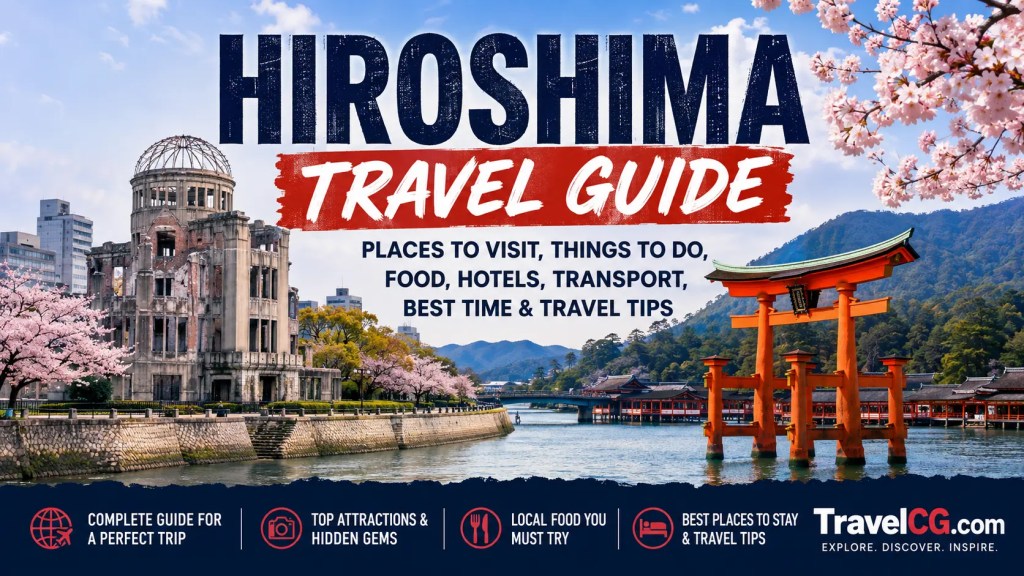
Hiroshima is one of Japan’s most historically important and emotionally powerful destinations. Known around the world for the tragic events of August 6, 1945, Hiroshima today represents peace, remembrance, resilience and hope. At the same time, it is a beautiful modern city surrounded by mountains, rivers, islands and the Seto Inland Sea.
A trip to Hiroshima can combine history, culture, nature, food and traditional Japanese experiences. The city is easy to explore, and its most important attractions can be covered comfortably in two to three days. Hiroshima can also be combined with nearby Miyajima, one of Japan’s most famous island destinations.
This complete Hiroshima travel guide explains everything you need to know before visiting, including the best places to visit, things to do, transportation, food, accommodation areas, travel costs, itineraries, seasonal information and useful travel tips.
Where Is Hiroshima?
Hiroshima is located in the Chugoku region of western Honshu, Japan. It lies along the Seto Inland Sea and is surrounded by mountains and smaller islands.
The city is the capital of Hiroshima Prefecture and is one of the major urban centers of western Japan.
Hiroshima is approximately:
- 1 hour 30 minutes from Osaka by Shinkansen
- Around 2 hours from Kyoto by Shinkansen
- Around 4 hours from Tokyo by Shinkansen
- Around 40 minutes by train and ferry from Hiroshima city center to Miyajima
- Around 1 hour 30 minutes from Hiroshima to Okayama by train
Its location makes Hiroshima an excellent addition to a Japan itinerary that includes Tokyo, Kyoto, Osaka, Kobe and Okayama.
Why Should You Visit Hiroshima?
Hiroshima is different from many other Japanese tourist destinations because its importance is not based only on sightseeing.
The city provides an opportunity to understand one of the most significant events of modern history and to reflect on the human consequences of war.
At the same time, Hiroshima is not a city frozen in the past. It is modern, lively and welcoming, with attractive parks, shopping districts, restaurants, museums, traditional neighborhoods and beautiful surroundings.
The main reasons to visit Hiroshima include:
- Hiroshima Peace Memorial Park
- Atomic Bomb Dome
- Hiroshima Peace Memorial Museum
- Miyajima Island
- Itsukushima Shrine
- The famous floating torii gate
- Hiroshima-style okonomiyaki
- Japanese temples and gardens
- Scenic islands and mountains
- Traditional Japanese culture
- Easy access from Osaka and Kyoto
- A meaningful historical experience
Best Time to Visit Hiroshima
Hiroshima can be visited throughout the year, but the experience changes significantly depending on the season.
Spring
Spring is one of the best times to visit Hiroshima.
Cherry blossoms usually appear around late March and early April, although exact timing varies each year.
Parks, riversides and temple areas become especially beautiful during the cherry blossom season.
Spring is ideal for:
- Cherry blossom viewing
- Walking around Peace Memorial Park
- Visiting Miyajima
- Outdoor sightseeing
- Photography
Because spring is extremely popular, accommodation can become expensive and crowded.
Summer
Summer is warm and humid.
June can bring significant rainfall, while July and August are generally hot and humid.
Despite the heat, summer offers long daylight hours and opportunities for island trips and outdoor activities.
August 6 is particularly significant because Hiroshima commemorates the atomic bombing on this date in 1945. The city holds the annual Peace Memorial Ceremony.
Visitors should behave respectfully around memorial sites, especially during this period.
Autumn
Autumn is another excellent season.
October and November generally provide comfortable temperatures and beautiful autumn foliage.
Miyajima is especially attractive when the maple trees change color.
Autumn is ideal for:
- Temple visits
- Hiking
- Photography
- Miyajima
- Gardens
- Comfortable city walks
Winter
Winter is comparatively cold but usually less crowded than spring and autumn.
Snow can occasionally occur, although Hiroshima city itself does not normally experience heavy snowfall.
Winter can be a good choice for travelers who want lower crowds and a quieter experience.
How Many Days Are Enough for Hiroshima?
For most travelers, two to three days are ideal.
One Day in Hiroshima
A one-day visit can cover:
- Peace Memorial Park
- Atomic Bomb Dome
- Peace Memorial Museum
- Hiroshima Castle
- Hiroshima-style okonomiyaki
However, this will feel rushed.
Two Days in Hiroshima
Two days allow you to explore Hiroshima properly and visit Miyajima.
A recommended plan is:
Day 1: Hiroshima city and peace memorial sites
Day 2: Miyajima and Itsukushima Shrine
Three Days in Hiroshima
Three days provide a more relaxed experience.
You can add:
- Shukkeien Garden
- Hiroshima Castle
- Mitaki-dera Temple
- Local shopping
- Additional museums
- Food exploration
- More time on Miyajima
Top Places to Visit in Hiroshima
Hiroshima Peace Memorial Park
Hiroshima Peace Memorial Park is the most important sightseeing and remembrance area in the city.
The park occupies an area near the center of Hiroshima and contains numerous monuments dedicated to the victims of the atomic bombing and to the pursuit of world peace.
Walking through the park is a quiet and reflective experience.
Important attractions within and around the park include:
- Atomic Bomb Dome
- Hiroshima Peace Memorial Museum
- Children’s Peace Monument
- Cenotaph for the A-Bomb Victims
- Peace Flame
- Peace Bell
- National Peace Memorial Hall
Allow several hours if you want to understand the area properly.
Atomic Bomb Dome
The Atomic Bomb Dome is one of Hiroshima’s most recognizable landmarks.
Before 1945, the building was known as the Hiroshima Prefectural Industrial Promotion Hall. The atomic bomb exploded nearby on August 6, 1945.
Although much of Hiroshima was destroyed, the structure partially survived.
Today, it has been preserved as a symbol of the destructive power of nuclear weapons and the importance of peace.
The building is located beside the Motoyasu River and can be viewed from several locations around Peace Memorial Park.
Hiroshima Peace Memorial Museum
The Hiroshima Peace Memorial Museum is one of the most important museums in Japan.
It documents the bombing of Hiroshima, the lives of victims, the destruction of the city and the consequences of nuclear warfare.
The museum contains photographs, personal belongings, documents, models and other historical materials.
The experience can be emotionally difficult.
Visitors should allow enough time and approach the museum respectfully.
For many travelers, this is the most meaningful part of visiting Hiroshima.
Children’s Peace Monument
The Children’s Peace Monument is dedicated to children who died as a result of the atomic bombing.
The monument is associated with the story of Sadako Sasaki and the Japanese tradition of folding paper cranes.
Thousands of colorful origami cranes are displayed around the monument.
The site represents children’s hopes for peace and is an important part of Hiroshima’s peace message.
Cenotaph for the A-Bomb Victims
The Cenotaph for the A-Bomb Victims is located in Peace Memorial Park.
It commemorates those who died because of the bombing.
The memorial is an important location for reflection and remembrance.
Visitors should maintain silence and behave respectfully.
Hiroshima Castle
Hiroshima Castle is another major attraction.
The original castle was constructed in the sixteenth century, but it was destroyed during the atomic bombing.
The current main tower is a reconstruction.
The surrounding grounds contain trees, gardens, shrines and historical structures.
The castle area provides a pleasant contrast to the solemn atmosphere of Peace Memorial Park.
Shukkeien Garden
Shukkeien is a traditional Japanese landscape garden located near Hiroshima Castle.
The garden features ponds, bridges, small hills, trees and carefully designed landscapes.
It is an excellent place to experience traditional Japanese garden design.
The garden is particularly attractive during:
- Spring
- Autumn
- Early summer
Allow approximately one to two hours for a relaxed visit.
Mitaki-dera Temple
Mitaki-dera is a beautiful Buddhist temple located in a forested mountain area north of central Hiroshima.
The temple is known for:
- Traditional architecture
- Waterfalls
- Stone statues
- Forest trails
- Seasonal foliage
- Peaceful atmosphere
It is an excellent choice for travelers who want to experience a quieter side of Hiroshima.
Autumn is particularly beautiful here.
Miyajima Island
Miyajima is one of the most famous attractions near Hiroshima.
The island’s official name is Itsukushima, but it is commonly known as Miyajima.
The island is famous for:
- Itsukushima Shrine
- The large torii gate
- Mount Misen
- Wild deer
- Traditional streets
- Buddhist temples
- Beautiful sea views
- Local food
Miyajima can be visited as a half-day trip, but spending a full day is better.
Itsukushima Shrine
Itsukushima Shrine is Miyajima’s most famous attraction.
The shrine is famous for its traditional architecture and its large torii gate standing in the water.
The appearance of the torii changes depending on the tide.
At high tide, it appears to float in the sea.
At low tide, visitors can often walk closer to the gate.
The shrine is especially beautiful during sunrise, sunset and changing tide conditions.
The Great Torii Gate
The Great Torii is one of Japan’s most recognizable cultural landmarks.
It is closely associated with Miyajima and Itsukushima Shrine.
The gate has become an iconic symbol of Hiroshima tourism.
Photography conditions vary according to:
- Tide
- Weather
- Time of day
- Season
Check tide times before planning your visit if seeing the torii surrounded by water is important to you.
Mount Misen
Mount Misen is the highest mountain on Miyajima.
The summit offers impressive views over the Seto Inland Sea and surrounding islands.
Visitors can reach the mountain area by:
- Hiking
- Ropeway followed by walking
- A combination of hiking and ropeway
Several walking trails provide different experiences.
The mountain is an excellent choice for travelers who enjoy nature and panoramic views.
Miyajima’s Deer
Miyajima is famous for its deer.
They are accustomed to visitors and can often be seen around tourist areas.
Although they may appear friendly, they are wild animals and should be treated carefully.
Do not feed them inappropriate food, tease them or attempt to force interaction.
Keep paper, maps and food away from curious deer because they may try to eat them.
Omotesando Shopping Street
Omotesando is one of the main tourist streets on Miyajima.
It is filled with:
- Restaurants
- Cafes
- Souvenir shops
- Traditional sweets
- Local snacks
- Crafts
It is a good place to try local specialties and purchase souvenirs.
Hiroshima-style Okonomiyaki
Hiroshima-style okonomiyaki is one of the city’s most famous foods.
Unlike Osaka-style okonomiyaki, Hiroshima-style okonomiyaki is generally prepared in layers.
Typical ingredients include:
- Cabbage
- Noodles
- Egg
- Batter
- Meat or seafood
- Sauce
- Green onions
It is usually cooked on a large hot plate.
Trying Hiroshima-style okonomiyaki is essential for food-loving travelers.
Other Foods to Try in Hiroshima
Hiroshima offers much more than okonomiyaki.
Oysters
Hiroshima is famous for oysters.
They may be served:
- Grilled
- Fried
- Raw
- In hot pots
- With rice
Miyajima is particularly well known for oyster dishes.
Momiji Manju
Momiji manju is a famous Hiroshima-area sweet.
It is traditionally shaped like a maple leaf and filled with sweet bean paste.
Modern varieties can include:
- Chocolate
- Custard
- Matcha
- Cheese
- Other sweet fillings
It makes a popular souvenir.
Anago
Anago is saltwater eel and is another regional specialty.
It may be served over rice as an anago-don.
Lemon Products
Hiroshima Prefecture is famous for lemon production.
You may find:
- Lemon desserts
- Lemon drinks
- Lemon cakes
- Lemon-flavored sweets
- Lemon sauces
Best Areas to Stay in Hiroshima
Choosing the right neighborhood can make your trip easier.
Hiroshima Station Area
This is convenient for travelers arriving by Shinkansen.
Advantages include:
- Excellent transportation
- Many hotels
- Restaurants
- Shopping
- Easy access to trains
It is particularly useful for travelers using Hiroshima as a base for regional trips.
Downtown Hiroshima
The downtown area is convenient for:
- Restaurants
- Shopping
- Nightlife
- Public transportation
- Peace Memorial Park
It is a good choice for first-time visitors.
Near Peace Memorial Park
Staying near Peace Memorial Park allows easy access to the city’s major historical attractions.
This is ideal for travelers primarily interested in Hiroshima’s history.
Miyajima
Staying overnight on Miyajima provides a completely different experience.
The island becomes much quieter after many day-trippers leave.
An overnight stay is particularly attractive for couples, photographers and travelers seeking a traditional atmosphere.
How to Reach Hiroshima
By Shinkansen
The Shinkansen is the easiest option for many travelers.
Hiroshima Station is served by the Sanyo Shinkansen.
You can travel directly or with a transfer depending on your starting city.
From Osaka, Hiroshima is easily accessible by high-speed train.
From Kyoto, travelers can generally reach Hiroshima with a suitable Shinkansen connection.
From Tokyo, the journey takes several hours but is comfortable and convenient.
By Air
Hiroshima Airport is located outside the city.
Flights connect Hiroshima with major Japanese cities and selected international destinations.
Because the airport is some distance from central Hiroshima, travelers should include airport transfer time in their plans.
By Bus
Long-distance buses can be cheaper than trains.
They are available from several Japanese cities.
Overnight buses can also save accommodation costs for budget travelers, although the journey is longer than traveling by Shinkansen.
How to Get Around Hiroshima
Hiroshima has an efficient public transportation system.
Hiroshima Streetcars
The Hiroshima Electric Railway streetcar network is particularly useful.
Streetcars connect important parts of the city, including areas around Hiroshima Station and Peace Memorial Park.
They are also an enjoyable way to experience the city.
Buses
Local buses serve areas not directly covered by streetcars.
Trains
JR trains are useful for longer trips, including travel toward Miyajima.
Walking
Many central attractions can be explored on foot.
Walking is particularly pleasant around:
- Peace Memorial Park
- Central Hiroshima
- Riverside areas
- Hiroshima Castle
Hiroshima to Miyajima Transportation
A common route is:
Hiroshima city → Miyajimaguchi → ferry → Miyajima
You can reach Miyajimaguchi by train or other local transportation.
From Miyajimaguchi, ferries cross to Miyajima.
The ferry journey is short and provides beautiful views of the island.
Remember to check transportation schedules if you are planning to return late in the evening.
Hiroshima Travel Passes
Japan offers several types of transportation passes, but whether a pass is worthwhile depends on your itinerary.
Before purchasing a pass, calculate:
- Number of train journeys
- Shinkansen usage
- Local transportation
- Miyajima travel
- Length of stay
Do not automatically purchase a pass simply because it is marketed as a tourist pass.
For a short Hiroshima visit, individual tickets may sometimes be more economical.
Hiroshima Travel Cost
Your total budget depends heavily on accommodation and transportation.
Budget Traveler
A budget traveler can reduce costs by choosing:
- Hostels
- Budget hotels
- Local restaurants
- Convenience-store meals
- Public transportation
- Free attractions
Mid-Range Traveler
A mid-range trip may include:
- Comfortable hotel
- Restaurant meals
- Paid attractions
- Public transportation
- Miyajima excursion
Luxury Traveler
Luxury travelers can choose:
- High-end hotels
- Traditional Japanese accommodations
- Private tours
- Premium restaurants
- Private transportation
Hiroshima can therefore suit both backpackers and luxury travelers.
Is Hiroshima Expensive?
Compared with Tokyo, Hiroshima can feel relatively manageable for many travelers.
However, Japan’s overall travel costs can still be significant.
The biggest expenses are generally:
- Accommodation
- Long-distance transportation
- Food
- Shopping
- Special activities
You can reduce expenses by booking accommodation early and using public transportation.
Hiroshima Travel Itinerary
One-Day Hiroshima Itinerary
If you have only one day, start early.
Morning
Visit:
- Peace Memorial Park
- Atomic Bomb Dome
- Hiroshima Peace Memorial Museum
Spend enough time understanding the historical significance rather than rushing between attractions.
Afternoon
Have lunch and visit:
- Hiroshima Castle
- Shukkeien Garden
Evening
Explore downtown Hiroshima and enjoy Hiroshima-style okonomiyaki.
Two-Day Hiroshima Itinerary
Day 1: Hiroshima City
Morning:
- Peace Memorial Park
- Atomic Bomb Dome
- Peace Memorial Museum
Afternoon:
- Children’s Peace Monument
- Cenotaph
- Hiroshima Castle
- Shukkeien Garden
Evening:
- Downtown Hiroshima
- Hiroshima-style okonomiyaki
Day 2: Miyajima
Morning:
- Travel to Miyajima
- Itsukushima Shrine
- Great Torii
Afternoon:
- Omotesando
- Local food
- Mount Misen
Evening:
Return to Hiroshima or stay overnight on Miyajima.
Three-Day Hiroshima Itinerary
Day 1
Explore Peace Memorial Park and the major historical attractions.
Day 2
Spend the day on Miyajima.
Day 3
Explore:
- Hiroshima Castle
- Shukkeien Garden
- Mitaki-dera
- Local shopping
- Food districts
This itinerary is much more relaxed.
Hiroshima for Families
Hiroshima can be a meaningful family destination.
Children can learn about:
- History
- Peace
- Japanese culture
- Traditional architecture
- Nature
Family-friendly attractions include:
- Peace Memorial Park
- Miyajima
- Hiroshima Castle
- Shukkeien Garden
- Mount Misen
Parents should prepare children before visiting the Peace Memorial Museum because some exhibits can be emotionally intense.
Hiroshima for Couples
Hiroshima and Miyajima are suitable for couples.
Romantic experiences include:
- Sunset on Miyajima
- Walking around traditional streets
- Staying overnight on Miyajima
- Mount Misen views
- Japanese dinner
- Peaceful garden walks
Miyajima is particularly attractive in the evening when the island becomes quieter.
Hiroshima for Solo Travelers
Hiroshima is generally easy to explore independently.
Solo travelers can comfortably use:
- Trains
- Streetcars
- Buses
- Ferries
- Walking routes
Hostels and budget hotels also make it easy to meet other travelers.
Hiroshima for History Lovers
History is one of the strongest reasons to visit.
Important places include:
- Hiroshima Peace Memorial Museum
- Atomic Bomb Dome
- Peace Memorial Park
- National Peace Memorial Hall
- Hiroshima Castle
- Traditional temples and shrines
Visitors interested in World War II history should allow sufficient time for museums and memorials.
Hiroshima for Nature Lovers
Although Hiroshima is a major city, nature is never far away.
Nature-focused experiences include:
- Mount Misen
- Miyajima
- Mitaki-dera
- Seto Inland Sea
- Parks
- Traditional gardens
- Hiking trails
Shopping in Hiroshima
Popular shopping areas include central Hiroshima and Miyajima.
Good souvenirs include:
- Momiji manju
- Local sweets
- Japanese crafts
- Traditional souvenirs
- Hiroshima-themed products
- Food products
- Lemon products
Miyajima is particularly good for traditional souvenirs.
Hiroshima Nightlife
Hiroshima has a lively evening scene.
Downtown areas offer:
- Restaurants
- Bars
- Izakayas
- Cafes
- Entertainment venues
Nagarekawa is one of the city’s well-known entertainment districts.
For a quieter evening, consider a riverside walk or dinner in a traditional restaurant.
Hiroshima Photography Tips
Hiroshima offers many photographic opportunities.
Good subjects include:
- Atomic Bomb Dome
- Peace Memorial Park
- Hiroshima Castle
- Shukkeien Garden
- Miyajima
- Great Torii
- Mount Misen
- Traditional streets
- Seto Inland Sea
For the Great Torii, check the tide schedule before visiting.
Early morning and late afternoon generally provide softer light and fewer crowds.
Hiroshima Sunrise and Sunset
Miyajima is particularly beautiful around sunrise and sunset.
Sunset can provide excellent views of the island, sea and surrounding mountains.
If you want a quieter photography experience, staying overnight on Miyajima can be worthwhile.
Important Cultural Etiquette
Japan has strong social customs.
Visitors should:
- Keep public spaces clean
- Avoid loud conversations on public transportation
- Queue properly
- Follow signs
- Remove shoes where required
- Avoid eating while walking in places where it is discouraged
- Respect temples and shrines
- Avoid touching sacred objects
- Keep memorial sites quiet
At Hiroshima’s peace memorial sites, respectful behavior is particularly important.
Is Hiroshima Safe?
Hiroshima is generally considered a safe destination for tourists.
As with any major tourist destination, use normal precautions.
Keep valuables secure and remain aware of your surroundings in crowded areas.
Natural conditions such as typhoons, heavy rain and earthquakes can occasionally affect travel in Japan, so monitor local information during your trip.
Internet and SIM Cards
Travelers can use:
- Airport SIM cards
- eSIM services
- Portable Wi-Fi
- Japanese mobile networks
- Hotel Wi-Fi
- Public Wi-Fi where available
Having mobile internet is useful for navigation, train information and translation.
Language in Hiroshima
Japanese is the primary language.
English is commonly encountered in major tourist areas, hotels and transportation facilities, but not everyone speaks fluent English.
Useful Japanese expressions include:
- Konnichiwa — Hello
- Arigatou gozaimasu — Thank you
- Sumimasen — Excuse me or sorry
- Onegaishimasu — Please
- Eki — Station
- Toire — Toilet
A translation application can be very helpful.
Money and Payments
Japan increasingly accepts cashless payments, but cash remains useful.
Carry some Japanese yen for:
- Small restaurants
- Local shops
- Vending machines
- Small temples or attractions
- Some traditional businesses
Credit cards and electronic payments are widely accepted in major tourist areas, but travelers should not depend entirely on them.
What to Pack for Hiroshima
Your packing list should depend on the season.
Spring
Pack:
- Light jacket
- Comfortable shoes
- Umbrella
- Layers
Summer
Pack:
- Lightweight clothing
- Hat
- Sunscreen
- Water bottle
- Comfortable walking shoes
- Rain protection
Autumn
Pack:
- Light jacket
- Comfortable walking shoes
- Layers
Winter
Pack:
- Warm jacket
- Sweater
- Warm socks
- Comfortable shoes
For Miyajima and Mount Misen, comfortable walking shoes are strongly recommended throughout the year.
Hiroshima Travel Tips
Start Early
Popular attractions can become crowded later in the day.
Starting early gives you a more peaceful experience.
Combine Hiroshima with Miyajima
Do not visit Hiroshima without considering Miyajima.
The combination provides both historical and natural experiences.
Check the Tide
If seeing the Great Torii surrounded by water is important to you, check the tide schedule before visiting Miyajima.
Allow Enough Time for the Museum
The Peace Memorial Museum should not be treated as a quick stop.
Give yourself enough time to read and reflect.
Wear Comfortable Shoes
Hiroshima involves considerable walking, especially if you visit Miyajima and Mount Misen.
Reserve Accommodation Early
Spring and autumn can be busy.
Book early if traveling during cherry blossom or autumn foliage season.
Try Local Food
Hiroshima-style okonomiyaki, oysters, momiji manju and anago are among the local specialties worth trying.
Respect Memorial Sites
Hiroshima is a living city, but its memorial sites represent immense human suffering.
Photography and conversation should be handled respectfully.
Common Mistakes to Avoid in Hiroshima
Spending Only a Few Hours
A very short stop may not allow you to understand Hiroshima properly.
At least one full day is recommended.
Skipping Miyajima
Miyajima is one of the major highlights of the region.
Visiting the Peace Museum in a Rush
The museum contains important historical information that deserves time and attention.
Ignoring Tide Times
The appearance of the Great Torii depends heavily on the tide.
Overloading Your Itinerary
Trying to visit every attraction in one day can make the experience stressful.
Choose fewer attractions and spend more time at each.
Best Day Trips from Hiroshima
Hiroshima’s location makes it a good base for exploring western Japan.
Possible day trips include:
- Miyajima
- Iwakuni
- Onomichi
- Kure
- Takehara
- Tomonoura
Travel times vary, so check transportation schedules before planning a day trip.
Hiroshima and Iwakuni
Iwakuni is known for Kintai Bridge, one of Japan’s famous traditional wooden bridges.
The area also offers:
- Castle views
- River scenery
- Traditional architecture
- Seasonal beauty
It can make a pleasant day trip from Hiroshima.
Hiroshima and Onomichi
Onomichi is a charming town known for:
- Temples
- Narrow streets
- Hills
- Sea views
- Traditional architecture
- Cycling routes
It offers a quieter atmosphere compared with Hiroshima city.
Hiroshima Travel Checklist
Before leaving for Hiroshima, check the following:
- Passport and travel documents
- Accommodation booking
- Transportation plans
- Weather forecast
- Train schedules
- Miyajima ferry information
- Tide times
- Japanese yen
- Mobile internet
- Comfortable walking shoes
- Museum opening information
- Seasonal clothing
Best Hiroshima Experience
A perfect Hiroshima trip should combine history, culture, food and nature.
A balanced experience could look like this:
Morning: Peace Memorial Park
Late morning: Peace Memorial Museum
Afternoon: Atomic Bomb Dome and central Hiroshima
Evening: Hiroshima-style okonomiyaki
Next day: Miyajima
Morning: Itsukushima Shrine
Afternoon: Mount Misen and traditional streets
Evening: Sunset and return to Hiroshima or overnight on Miyajima
This combination gives travelers a strong understanding of both Hiroshima’s history and its modern identity.
Frequently Asked Questions About Hiroshima
Is Hiroshima worth visiting?
Yes. Hiroshima is one of Japan’s most meaningful destinations, combining important history, beautiful scenery, excellent food and easy access to Miyajima.
How many days should I spend in Hiroshima?
Two days is ideal for most travelers. Three days is better if you want a relaxed experience.
Is one day enough for Hiroshima?
One day is enough to see the major city attractions, but it will be difficult to explore both Hiroshima and Miyajima properly.
Can I visit Hiroshima and Miyajima in one day?
Yes, but the day will be busy. Two days are preferable.
Is Hiroshima good for families?
Yes. Families can learn about Japanese history and peace while enjoying Miyajima, gardens, castles and nature.
What food is Hiroshima famous for?
Hiroshima is particularly famous for Hiroshima-style okonomiyaki, oysters, anago and momiji manju.
Is Hiroshima expensive?
Hiroshima can be less expensive than some major Japanese cities, but transportation and accommodation can still represent significant costs.
What is the best month to visit Hiroshima?
Spring and autumn are generally among the most comfortable and visually attractive periods.
Can I visit Hiroshima in winter?
Yes. Winter can be a good time for travelers who prefer fewer crowds and cooler weather.
Is Miyajima worth visiting?
Absolutely. Miyajima is one of the major highlights of the Hiroshima region.
How long should I spend on Miyajima?
A full day is recommended if you want to visit Itsukushima Shrine, explore the streets, enjoy local food and visit Mount Misen.
Can I stay overnight on Miyajima?
Yes. An overnight stay provides a quieter experience after many day visitors leave.
What should I wear in Hiroshima?
Wear comfortable clothes and walking shoes. Adjust your clothing according to the season.
Is Hiroshima suitable for solo travel?
Yes. The city is relatively easy to navigate using trains, streetcars, buses and ferries.
Is Hiroshima safe for tourists?
Hiroshima is generally considered a safe destination. Normal travel precautions are still recommended.
Final Hiroshima Travel Advice
Hiroshima is much more than a historical destination. It is a city that transformed tragedy into a message of peace and rebuilt itself into a modern, welcoming and vibrant place.
A meaningful Hiroshima trip should include the Peace Memorial Park, Atomic Bomb Dome and Peace Memorial Museum. You should also reserve time for Miyajima, Itsukushima Shrine and Mount Misen. Add Hiroshima-style okonomiyaki, local oysters, traditional sweets and a walk through the city’s streets, and you will experience several different sides of Hiroshima.
For a first visit, two days is a good minimum, while three days allows a much more relaxed journey. Start your sightseeing early, use public transportation, wear comfortable shoes, check Miyajima’s tide conditions and approach the city’s memorial sites with respect.
Hiroshima is a destination that stays with many travelers long after they leave. Its history teaches, its culture welcomes, and its message of peace gives the journey a deeper meaning than ordinary sightseeing.
Travelcg.com — Travel guides for discovering amazing places around the world.
Related Other Places (Travel Guide)







Leave a Reply