
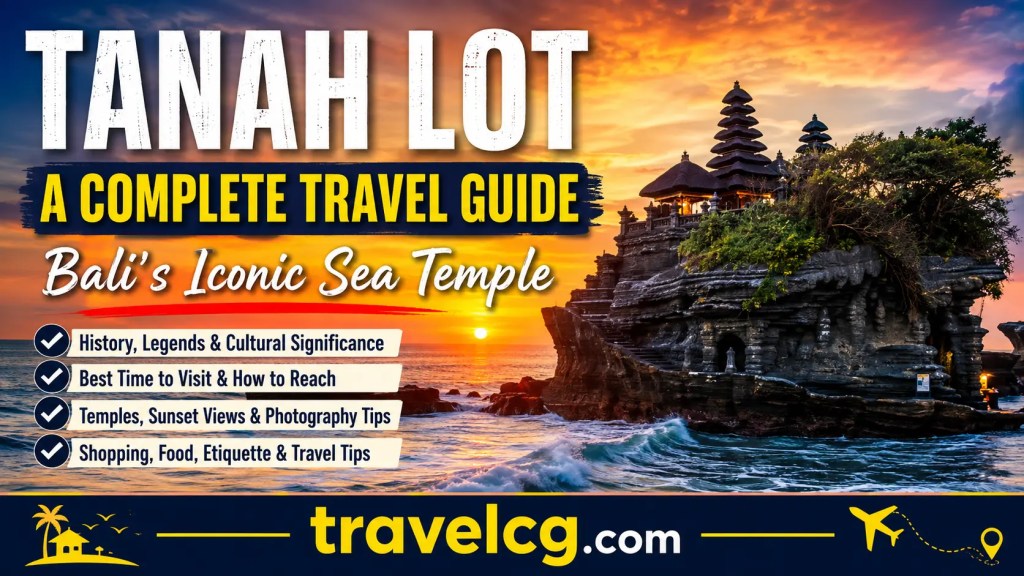
Tanah Lot is one of the most recognizable landmarks in Bali, Indonesia, and one of the island’s most photographed cultural attractions. Rising dramatically from a rocky formation beside the Indian Ocean, Tanah Lot Temple creates a spectacular scene, especially when waves crash against the rocks and the setting sun turns the sky golden, orange, and red.
The name Tanah Lot is commonly interpreted as meaning “Land in the Sea,” an appropriate description of this remarkable temple setting. The temple is located in Beraban Village in Tabanan Regency, on Bali’s western coast, roughly 30 kilometers from Denpasar and around 30 kilometers from Ngurah Rai International Airport. The temple itself stands on a rocky offshore formation, approximately 300 meters from the shoreline.
For travelers, Tanah Lot offers much more than a beautiful sunset. It combines Balinese Hindu spirituality, traditional architecture, mythology, dramatic coastal scenery, cultural performances, local handicrafts, restaurants, and excellent photography opportunities. This makes it an important stop for first-time visitors as well as returning travelers who want to experience a different side of Bali.
Where Is Tanah Lot?
Tanah Lot is situated in Beraban Village, Kediri District, Tabanan Regency, Bali. It is on the southwestern coast of Bali and is easily incorporated into an itinerary covering areas such as Canggu, Seminyak, Kuta, Ubud, or central and western Bali.
The location is particularly famous because the temple appears to sit directly in the ocean. However, the temple rock is connected to the mainland by a coastal area that visitors can cross when conditions permit. At low tide, it is possible to approach the rock more closely, creating an impressive view of the temple against the ocean.
The surrounding tourist area has been developed with facilities including parking, toilets, restaurants, art shops, accommodation, an open stage, tourist information facilities, and security services.
Why Is Tanah Lot Famous?
Tanah Lot is famous for three major reasons: its extraordinary location, its spiritual importance, and its sunset views.
Unlike many temples that stand within villages or on mountain slopes, Tanah Lot is associated with a dramatic coastal rock formation surrounded by the sea. The combination of Hindu architecture, dark volcanic-looking rock, ocean waves, and an open horizon gives the site a distinctive appearance.
The temple has also become one of Bali’s signature sunset locations. In the late afternoon, visitors gather around the coastal viewpoints to watch the sun descend toward the horizon. The silhouette of the temple against the changing sky is one of the most iconic photographic scenes in Bali.
However, Tanah Lot should not be viewed merely as a tourist photo spot. It remains an important religious site for Balinese Hindus, and visitors should treat the temple and ceremonies with respect.
History of Tanah Lot
The history of Tanah Lot is closely connected with Dang Hyang Nirartha, a respected Hindu religious figure associated with Bali’s religious development.
According to local tradition, Nirartha traveled along Bali’s southern coast during the 16th century. When he arrived in the area of present-day Beraban, he was attracted to a rocky formation near the sea and recognized it as a spiritually significant place. The rock was traditionally known as Gili Beo, a name associated with its bird-like shape.
Local legend says that the village leader became unhappy with Nirartha’s influence and attempted to drive him away. According to the legend, Nirartha demonstrated his spiritual power by moving the rock toward the sea and establishing a shrine there.
Another important part of the legend concerns sacred sea snakes. According to Balinese mythology, Nirartha created or summoned snakes from his sash to protect the temple from evil influences. These snakes are traditionally believed to guard the sacred site.
Historical details and religious legends should be understood within their cultural context. The story of Tanah Lot is not simply a conventional historical record; it is part of Bali’s rich tradition of mythology, spirituality, oral history, and religious belief.
Religious Significance of Tanah Lot
Tanah Lot is an important Balinese Hindu temple associated with the sea. The temple is traditionally connected with worship of Bhatara Segara, a divine representation associated with the sea.
The temple is part of Bali’s wider network of important religious sites that are closely connected with the island’s spiritual relationship with mountains, rivers, forests, villages, and the ocean.
For Balinese Hindus, temples are not simply architectural monuments. They are active places of worship where religious ceremonies, offerings, prayers, and festivals take place.
This is why visitors should remember that Tanah Lot is a living religious site rather than a historical building that exists only for tourism.
The Famous Tanah Lot Sunset
The sunset is undoubtedly the most famous experience at Tanah Lot.
As afternoon approaches, the coastal landscape begins to change. The sunlight becomes softer, the ocean takes on warmer tones, and the temple becomes increasingly dramatic against the sky.
On clear evenings, the combination of the temple silhouette, ocean waves, rocky shoreline, and sunset can produce spectacular photographs.
If your primary objective is sunset photography, arrive well before sunset rather than reaching the site at the exact sunset time. This gives you enough time to explore the area, find a good viewpoint, and account for crowds.
The sunset itself lasts only a short time, but the changing light before and after sunset can also be beautiful.
Best Time to Visit Tanah Lot
The best time to visit depends on what you want to experience.
For sunset photography, late afternoon is the obvious choice. However, this is also when Tanah Lot can become busiest.
Morning visits offer a completely different experience. The atmosphere can be calmer, temperatures are generally more comfortable than in the middle of the day, and there may be fewer visitors. Indonesia’s official tourism information also recommends early morning visits for travelers seeking a quieter atmosphere and better opportunities for peaceful photography.
Another special time to visit is during the Odalan ceremony. Odalan is a temple anniversary celebration observed according to the Balinese calendar. At Tanah Lot, the ceremony takes place every 210 days. During religious occasions, visitors may see Balinese devotees bringing beautifully arranged offerings and participating in traditional ceremonies.
If you visit during a religious ceremony, remember that the experience is primarily for worshippers, not tourists. Photography should never interfere with prayers or rituals.
How to Reach Tanah Lot
Tanah Lot can be reached by road from several popular tourist areas of Bali.
From Denpasar, travelers can follow the main road toward the Tabanan region and continue toward Beraban Village. The official tourism information places Tanah Lot approximately 30 kilometers from Denpasar and around 30 kilometers from Ngurah Rai International Airport.
The actual travel time can vary considerably because Bali traffic can be unpredictable. A journey that looks short on a map may take much longer during busy periods.
Travelers staying around Canggu, Seminyak, Kuta, or nearby areas can consider Tanah Lot as an afternoon and evening excursion. Those staying in Ubud can also visit Tanah Lot, although the journey requires more planning because of distance and traffic.
Private drivers are a popular option for visitors who want flexibility. Taxis and app-based transportation may also be useful depending on where you are staying and the availability of services.
What to See Around Tanah Lot
Tanah Lot is not limited to one temple.
Several other temples and religious sites can be found in the surrounding area, each with its own history and traditions. These include Pura Batu Bolong, Pura Pekendungan, Pura Jero Kandang, Pura Enjung Galuh, and Pura Batu Mejan.
Pura Batu Bolong is particularly interesting because it is another sea temple associated with a distinctive rocky coastal setting. The name Batu Bolong refers to a “hollowed stone,” describing the natural formation associated with the temple.
Pura Enjung Galuh is associated with worship connected to prosperity and the goddess Sri, while Pura Jero Kandang has traditional associations with protection of livestock and agricultural activities. Pura Batu Mejan is associated with a holy spring and purification traditions.
Exploring these surrounding sites can make your visit more meaningful because you begin to understand Tanah Lot as part of a larger sacred landscape rather than an isolated attraction.
Tanah Lot for Photography
Tanah Lot is one of Bali’s best-known photography locations.
The most obvious subject is the temple itself, but there are many other possibilities. Try photographing the temple with waves in the foreground, the ocean stretching toward the horizon, or people walking along the coastal paths.
Sunset provides warm and dramatic light, while cloudy weather can create a completely different mood.
For photographers, it is worth spending some time exploring different viewpoints instead of taking only the standard temple photograph.
Wide-angle photographs can capture the relationship between the temple, rock, ocean, and sky. Zoom lenses can be useful for isolating the temple against the horizon.
After sunset, the sky may retain beautiful colors for several minutes, so do not immediately leave when the sun disappears.
Shopping at Tanah Lot
The area around Tanah Lot includes numerous shops selling Balinese handicrafts, souvenirs, clothing, decorative items, artwork, and other local products.
The shopping area can be a convenient place to look for gifts and small souvenirs representing Balinese culture.
Common items found in tourist markets may include handmade decorations, carved objects, textiles, paintings, jewelry, and other locally inspired products.
If you are buying several items, polite bargaining may sometimes be possible, but it should be done respectfully and with an understanding that sellers depend on tourism for their livelihoods.
Food and Restaurants
Visitors do not need to leave immediately after exploring the temple area.
The Tanah Lot tourist zone has restaurants and places where travelers can relax and enjoy food while taking in the surrounding scenery. Official tourism information specifically notes the availability of restaurants in the area.
For many travelers, combining a late lunch or early dinner with a sunset visit can make the experience more relaxed.
After sunset, you can return to your accommodation or continue toward another destination depending on your itinerary.
Temple Etiquette at Tanah Lot
One of the most important things to understand before visiting Tanah Lot is that it is a sacred Hindu site.
Dress modestly and respectfully. Avoid beachwear, very short clothing, or outfits that would be inappropriate inside a religious environment.
Visitors should follow signs, staff instructions, and restrictions concerning access to sacred areas. Some parts of the temple may not be open to tourists because they are reserved for worship and religious activities.
Do not climb onto restricted structures, disturb offerings, touch sacred objects, or interrupt ceremonies for photographs.
If a religious procession is taking place, allow devotees to pass and avoid standing in the middle of their path.
Photography is generally an important part of the visitor experience around the site, but religious ceremonies should be photographed sensitively.
Can Tourists Enter Tanah Lot Temple?
Tanah Lot is both a tourist attraction and a functioning religious site, so access to the sacred temple areas may be restricted.
Visitors can explore the surrounding tourist area, viewpoints, coastline, and cultural spaces, but tourists should not assume that every part of the temple is accessible.
During certain religious activities, restrictions may be increased. The appropriate approach is to follow the rules displayed at the site and instructions from temple authorities.
The goal is not simply to “enter the temple,” but to appreciate the sacred landscape while respecting the people who come there to worship.
Tanah Lot During High Tide and Low Tide
The relationship between the temple and the sea changes significantly with the tide.
At low tide, visitors can sometimes approach the temple rock more closely. At high tide, waves can surround the rock dramatically, reinforcing the impression that the temple is floating in the ocean. Official tourism information notes that low tide can allow visitors to walk closer to the temple.
However, visitors should never attempt to cross dangerous water simply to get closer to the temple.
The ocean around rocky coastal formations can be unpredictable. Wet rocks can be slippery, and waves can arrive suddenly. Always follow barriers, warning signs, and local instructions.
How Much Time Do You Need at Tanah Lot?
A typical visit can take around two to four hours, depending on your interests.
If you only want to see the temple and sunset, you may need less time. But if you want to explore the surrounding temples, browse the market, take photographs, eat at a restaurant, and watch the sunset without rushing, it is better to allow several hours.
Arriving too late is one of the biggest mistakes travelers make. Tanah Lot is much more enjoyable when you have enough time to explore before finding a good sunset viewpoint.
Tanah Lot for Families
Tanah Lot can be an interesting destination for families because it combines nature, culture, architecture, photography, and shopping.
Children may enjoy watching the waves, exploring the coastal landscape, and seeing traditional Balinese architecture.
Parents should pay particular attention to children near cliffs, rocks, and the ocean. Wet surfaces can be slippery, and waves can be stronger than they appear from a distance.
It is also a good opportunity to teach children about respecting religious places and understanding that temples are active cultural institutions rather than simply tourist attractions.
Tanah Lot for Couples
Tanah Lot is especially popular with couples because of its dramatic sunset setting.
Watching the sun disappear behind the ocean while the temple silhouette stands against the sky can create a memorable romantic experience.
Couples interested in photography should arrive early and explore different viewpoints before sunset. Rather than spending the entire visit taking photographs, it can be more enjoyable to reserve some time simply to watch the landscape.
Tanah Lot for Solo Travelers
Solo travelers can easily explore Tanah Lot at their own pace.
A solo visit provides an opportunity to focus on photography, architecture, spirituality, and the surrounding landscape.
Morning can be particularly attractive for travelers who prefer a quieter environment, while late afternoon is ideal for those who want the classic sunset atmosphere.
Because Tanah Lot is a popular tourist destination, solo travelers can also combine it with other nearby attractions in a wider day trip.
Nearby Attractions to Combine With Tanah Lot
Tanah Lot can be combined with several attractions in western and central Bali.
Travelers may consider visiting nearby coastal areas, traditional villages, rice landscapes, or other temples depending on their route.
Pura Batu Bolong is an obvious cultural addition because it is located in the wider Tanah Lot area. Other surrounding temples such as Pura Pekendungan and Pura Batu Mejan can also be explored.
If you are traveling from Canggu or Seminyak, Tanah Lot can work well as an afternoon-to-evening excursion. If you are coming from Ubud, it may make more sense to combine Tanah Lot with other central or western Bali attractions to avoid unnecessary backtracking.
Common Mistakes to Avoid
One common mistake is arriving only a few minutes before sunset. Tanah Lot can be busy, and you may need time to walk through the visitor area and find a suitable viewpoint.
Another mistake is treating the temple like an ordinary tourist attraction. Remember that it is an active religious site.
Visitors should also avoid going too close to waves or climbing unstable rocks for photographs.
Do not assume that every area shown in photographs online is accessible to tourists.
Finally, do not plan an overly ambitious itinerary around Tanah Lot. Bali traffic can significantly affect travel times, especially during busy periods. Giving yourself extra time will make the day much more enjoyable.
Best Experience: A Simple Tanah Lot Plan
A comfortable Tanah Lot visit could begin in the afternoon.
Arrive with enough time to explore the visitor area, walk around the coastal viewpoints, and visit the surrounding cultural attractions.
Spend some time observing Balinese architecture and the relationship between the temples and the ocean.
Browse the local shops if you are interested in souvenirs.
Have a meal or refreshment before sunset.
Then choose a good viewpoint and wait for the changing colors of the evening sky.
After sunset, take a few final photographs before leaving rather than rushing away immediately.
This simple approach allows you to experience Tanah Lot as a cultural and natural destination rather than treating it as a quick photo stop.
What Makes Tanah Lot Special?
The real beauty of Tanah Lot comes from the combination of several elements.
There is the temple itself, with its distinctive Balinese religious architecture.
There is the rocky coastal landscape, shaped by the constant movement of the ocean.
There is the spiritual atmosphere created by offerings, ceremonies, prayers, and centuries of religious tradition.
There are the legends surrounding Dang Hyang Nirartha and the sacred sea snakes.
And finally, there is the sunset, which transforms the entire landscape into one of Bali’s most recognizable scenes.
Few destinations combine spirituality, mythology, architecture, ocean scenery, and photography as effectively as Tanah Lot.
Final Thoughts
Tanah Lot is much more than a famous sunset viewpoint. It is a place where Bali’s natural landscape and spiritual traditions come together in a dramatic coastal setting.
Its offshore temple, crashing waves, legendary history, surrounding shrines, traditional ceremonies, local handicrafts, and spectacular sunsets make it one of Bali’s most memorable destinations.
For first-time visitors to Bali, Tanah Lot provides an excellent introduction to the island’s cultural landscape. For returning visitors, a slower visit can reveal details that are easy to miss during a rushed tour.
The best way to experience Tanah Lot is to arrive with time, respect the religious significance of the site, explore beyond the main viewpoint, and allow yourself to enjoy the changing relationship between the temple, rocks, ocean, and sky.
Whether you visit early in the morning for peace and photography, during a traditional ceremony for a glimpse into Balinese Hindu culture, or in the late afternoon for the legendary sunset, Tanah Lot offers an experience that combines natural beauty with deep cultural meaning.
That unique combination is precisely why Tanah Lot remains one of Bali’s most enduring and iconic attractions.




















Leave a Reply