
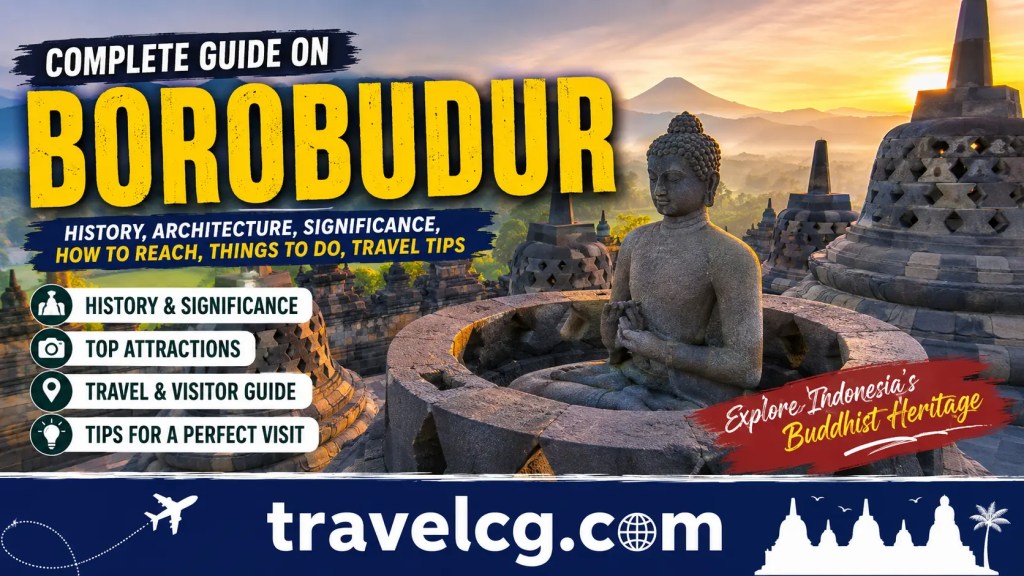
Borobudur is one of the most extraordinary Buddhist monuments in the world and one of Indonesia’s most important cultural and historical attractions. Located in Central Java, near the city of Magelang, Borobudur is famous for its enormous stone structure, hundreds of Buddha statues, intricate relief panels, bell-shaped stupas, and spectacular setting surrounded by tropical landscapes and volcanic mountains.
For travelers interested in history, Buddhism, architecture, photography, culture, and peaceful spiritual experiences, Borobudur offers an unforgettable journey. The monument is not simply an ancient temple; it is a carefully designed representation of Buddhist philosophy and the journey toward enlightenment.
This complete guide explains the history, architecture, significance, best time to visit, things to see, travel planning, nearby attractions, food, accommodation, local experiences, photography opportunities, and useful tips for visiting Borobudur.
Where Is Borobudur Located?
Borobudur is located in Central Java, Indonesia, approximately 40 kilometers northwest of Yogyakarta. The monument stands in the Kedu Plain, an area surrounded by mountains and volcanoes.
The location contributes greatly to Borobudur’s beauty. On clear mornings, visitors may see mountains and volcanic peaks rising above the surrounding countryside. The combination of ancient stone architecture, green landscapes, villages, rice fields, and mountains creates a remarkable atmosphere.
Yogyakarta is generally considered the most convenient major tourist base for visiting Borobudur. Many travelers stay in Yogyakarta and make a day trip to the monument, while others choose accommodation closer to Borobudur to enjoy a quieter experience.
History of Borobudur
Borobudur was constructed during the 8th and 9th centuries, when the Sailendra dynasty was influential in Central Java. Construction is generally associated with the reign of the Sailendra rulers and is believed to have taken several decades.
The monument was built as a Mahayana Buddhist religious site. Its architecture reflects Buddhist cosmology, with different levels symbolizing stages of spiritual development.
After the decline of the great Buddhist and Hindu kingdoms of Central Java, Borobudur gradually lost its religious importance. Over time, volcanic ash, vegetation, and natural processes covered much of the monument.
For centuries, the site remained largely forgotten by the outside world.
During the early 19th century, Borobudur was brought to wider attention during the period of British administration in Java. Subsequent archaeological work revealed the enormous structure beneath layers of soil and vegetation.
Restoration efforts continued over many decades. One of the most important modern restoration projects took place during the late 20th century with international cooperation.
Today, Borobudur is recognized as a major cultural heritage site and remains an important destination for Buddhist pilgrims, historians, researchers, photographers, and international travelers.
Why Is Borobudur Famous?
Borobudur is famous for several reasons.
First, it is one of the largest Buddhist monuments in the world. Its massive stone structure demonstrates an extraordinary level of engineering and craftsmanship.
Second, the monument contains hundreds of Buddha figures and numerous stupas.
Third, its walls feature extensive carved reliefs depicting Buddhist teachings, stories, daily life, morality, and spiritual concepts.
Fourth, the entire monument was designed as a three-dimensional representation of Buddhist cosmology.
Finally, its location in the volcanic landscape of Central Java makes it visually spectacular.
Borobudur is therefore important not only as a religious monument but also as an architectural, artistic, archaeological, and cultural achievement.
Architecture of Borobudur
The architecture of Borobudur is one of its most fascinating features.
The monument is constructed primarily from volcanic stone and consists of several terraces arranged in a monumental pyramid-like form.
From a distance, Borobudur appears like a giant stepped structure. However, its design has deep symbolic meaning.
The monument is traditionally understood as having three major symbolic divisions: Kamadhatu, Rupadhatu, and Arupadhatu.
Kamadhatu represents the world of desire and ordinary human existence.
Rupadhatu represents the world of forms, where physical existence continues but spiritual development has progressed.
Arupadhatu represents the formless spiritual realm and the highest stage of Buddhist enlightenment.
The visitor’s movement upward through the monument therefore symbolizes a spiritual journey from ordinary worldly existence toward enlightenment.
The Stupas of Borobudur
One of the most recognizable features of Borobudur is its collection of stupas.
The upper terraces contain numerous bell-shaped perforated stupas. Many of these stupas contain Buddha statues.
The central area contains a large main stupa that dominates the uppermost section of the monument.
The arrangement of the stupas creates a visually striking geometric pattern.
Visitors often photograph the stupas against the background of mountains and sky. Sunrise and early morning can create especially beautiful conditions for photography.
Buddha Statues
Borobudur contains hundreds of Buddha statues positioned throughout the monument.
Many Buddha figures sit inside perforated stupas on the upper terraces. Other Buddha statues are positioned in niches along the lower and middle levels.
Different Buddha images can be associated with different symbolic gestures, known as mudras. These gestures communicate different spiritual meanings.
Some statues have remained remarkably well preserved despite centuries of exposure to weather and environmental conditions.
A fascinating aspect of Borobudur is that many visitors initially focus on the overall structure but later discover the incredible detail of individual Buddha figures and stone carvings.
Borobudur Relief Panels
The carved reliefs are among the most valuable artistic elements of the monument.
Thousands of carved panels decorate various sections of Borobudur. They illustrate Buddhist teachings, stories, moral lessons, historical scenes, social life, architecture, clothing, transportation, nature, and everyday activities.
The reliefs provide historians with valuable information about life in Java more than a thousand years ago.
Visitors should take time to observe the details rather than simply walking around the monument quickly.
Look carefully at the people, animals, buildings, boats, plants, clothing, and expressions represented in the carvings. The reliefs create a visual record of the society that produced Borobudur.
Borobudur and Buddhism
Borobudur is fundamentally a Buddhist monument.
Its design reflects Buddhist teachings about existence, suffering, morality, spiritual development, and enlightenment.
The physical movement upward through the terraces can be interpreted as a symbolic spiritual journey.
The monument also continues to have religious importance for Buddhists. During significant Buddhist celebrations, especially Vesak, pilgrims gather at Borobudur for religious ceremonies and meditation.
For visitors, understanding this spiritual dimension can make the experience much more meaningful.
Borobudur should therefore be approached not merely as a tourist attraction but as a sacred cultural and religious site.
Best Time to Visit Borobudur
The best time to visit Borobudur generally depends on weather, crowd levels, and the experience you want.
The dry season is often preferred because there is a better chance of clear weather and pleasant outdoor conditions.
Early morning is particularly attractive because temperatures are cooler and the atmosphere can be peaceful.
Morning visits also provide excellent opportunities for seeing the monument in soft natural light.
During the middle of the day, the tropical heat can become uncomfortable, especially because much of the visit takes place outdoors.
If possible, avoid planning your entire visit around the hottest part of the afternoon.
Borobudur at Sunrise
Sunrise is one of the most popular experiences associated with Borobudur.
Early morning light can illuminate the stone stupas and Buddha statues beautifully. When weather conditions are favorable, the surrounding mountains appear through the morning mist.
The atmosphere can be especially peaceful before large crowds arrive.
However, sunrise visits require very early preparation. Visitors should check the current access arrangements and sunrise admission rules before planning their trip because entry procedures and visitor regulations can change.
How Much Time Do You Need at Borobudur?
A typical visit can take several hours.
If you are mainly interested in seeing the monument, approximately two to three hours may be enough for a relatively focused visit.
However, travelers interested in architecture, photography, history, Buddhist symbolism, and reliefs should allow more time.
A full day can be worthwhile if you combine Borobudur with nearby villages, viewpoints, cultural experiences, or other attractions.
How to Reach Borobudur
Yogyakarta is the most common starting point for travelers visiting Borobudur.
From Yogyakarta, visitors can travel by private car, taxi, ride-hailing service, organized tour, or other local transportation options.
The journey generally takes around one to two hours depending on traffic, route, and starting location.
Another option is staying in the Borobudur area itself. This can be particularly convenient for travelers who want to visit early in the morning.
Travelers arriving from other parts of Indonesia can generally use Yogyakarta as their transportation hub and continue to Borobudur by road.
Getting Around Borobudur Area
The main monument is best explored on foot.
Wear comfortable shoes because visitors will spend considerable time walking and climbing stairs.
The surrounding area includes villages, roads, restaurants, shops, and cultural attractions. Local transportation options may be available depending on where you are staying.
If you want to explore beyond the monument, arranging transportation in advance can save time.
Where to Stay
There are two main accommodation strategies.
The first is staying in Yogyakarta.
This option provides access to a much larger selection of hotels, restaurants, shopping areas, cultural attractions, and transportation services.
The second option is staying near Borobudur.
This provides a quieter experience and makes early morning visits easier.
Luxury resorts, boutique hotels, guesthouses, homestays, and budget accommodation can be found in the broader Borobudur region.
For travelers focused primarily on Borobudur, staying nearby can be particularly convenient.
For travelers who want to explore Yogyakarta as well, staying in Yogyakarta may be more practical.
Food to Try Near Borobudur
A visit to Borobudur should also include an opportunity to experience Central Javanese cuisine.
Local food often features rice, vegetables, tofu, tempeh, chicken, eggs, coconut, spices, and sweet-savoury flavors.
Some dishes and foods worth looking for include gudeg, nasi goreng, mie goreng, sate, pecel, tempeh dishes, tofu dishes, and traditional Javanese snacks.
Gudeg is particularly associated with Yogyakarta and is made using young jackfruit cooked with coconut milk and spices.
Local markets and small restaurants can provide opportunities to experience regional food beyond international tourist menus.
Things to Do at Borobudur
Walking around the monument is only the beginning.
Visitors can spend time studying the relief panels and Buddha statues.
Photography is another major activity.
You can also learn about Buddhist philosophy and the symbolism behind the monument.
A guided tour can be valuable for travelers who want to understand the meaning behind the carvings and architectural design.
Exploring the surrounding villages can provide a different perspective on local life.
Cycling through the countryside can also be an enjoyable way to experience the landscape, depending on weather and local conditions.
Nearby Attractions
The Borobudur region contains several attractions that can be combined into a broader Central Java itinerary.
Mendut Temple is a particularly important nearby Buddhist temple. It is associated with the Buddhist heritage of the region and is often visited together with Borobudur.
Pawon Temple is another smaller Buddhist temple located along the traditional route between Borobudur and Mendut.
These temples help visitors understand that Borobudur was part of a larger religious and cultural landscape rather than an isolated monument.
The surrounding villages are also worth exploring for travelers interested in traditional life, agriculture, crafts, and local culture.
Punthuk Setumbu and Borobudur Viewpoints
Several viewpoints around the Borobudur area have become popular for panoramic views.
Punthuk Setumbu is particularly famous for sunrise views toward Borobudur.
From elevated viewpoints, the monument can sometimes be seen surrounded by mist and greenery.
Weather conditions strongly influence the experience, so sunrise visibility cannot be guaranteed.
Travelers interested in photography should also consider exploring other countryside viewpoints rather than relying on a single location.
Mount Merapi and the Central Java Landscape
Central Java is famous for its volcanic landscape.
Mount Merapi is one of the region’s most prominent volcanoes, although its visibility depends on weather and atmospheric conditions.
The mountains surrounding Borobudur contribute significantly to the monument’s dramatic setting.
On clear days, the combination of Borobudur, green valleys, distant mountains, and tropical vegetation creates an extraordinary landscape.
Photography Tips
Borobudur offers countless photography opportunities.
Early morning is generally excellent for soft light.
Try photographing the stupas from different angles rather than taking only standard front-facing photographs.
Pay attention to patterns, symmetry, shadows, stone textures, Buddha statues, and relief details.
Wide-angle photographs can capture the scale of the monument, while closer photographs can emphasize architectural details.
The surrounding countryside also provides excellent opportunities for landscape photography.
Avoid blocking pathways or disturbing other visitors while taking photographs.
What to Wear
Borobudur is a religious and cultural site, so respectful clothing is appropriate.
Comfortable, modest clothing is recommended.
Lightweight clothing is useful because Central Java can be warm and humid.
A hat, sunglasses, sunscreen, and drinking water can also be useful.
Comfortable footwear is particularly important because the visit involves walking and stairs.
Always follow the latest clothing requirements and visitor instructions provided by the site authorities.
Borobudur Travel Tips
Start early if you want a quieter and cooler experience.
Check current opening hours and access rules before traveling because regulations can change.
Carry drinking water, especially during warm weather.
Use sunscreen and protect yourself from strong sunlight.
Wear comfortable shoes.
Respect religious practices and other visitors.
Do not touch or climb on protected architectural elements unless explicitly permitted.
Follow designated visitor routes.
Keep the monument and surrounding area clean.
If you want to understand the reliefs and symbolism, consider hiring a knowledgeable local guide.
Do not assume that every area is accessible at all times. Visitor restrictions may apply for conservation, religious events, weather, restoration, or crowd management.
Visiting During Vesak
Vesak is one of the most significant Buddhist celebrations associated with Borobudur.
During Vesak, religious ceremonies, prayers, meditation, processions, and other activities can take place.
The atmosphere can be extremely meaningful, but it may also be much busier than a normal tourist visit.
Travelers who specifically want to experience Vesak should plan well in advance and research the current arrangements and access requirements.
Those looking for a quiet sightseeing experience may prefer visiting outside major religious events.
Is Borobudur Suitable for Families?
Yes, Borobudur can be an excellent destination for families.
Children can learn about ancient architecture, Buddhism, Indonesian history, archaeology, and traditional art.
However, younger children may find the heat and stairs tiring.
Families should plan breaks and carry water.
Parents should also supervise children carefully around stairs and crowded areas.
The surrounding countryside can provide additional family-friendly experiences.
Is Borobudur Suitable for Solo Travelers?
Borobudur is also suitable for solo travelers.
Solo visitors can explore the monument independently or hire a guide.
Traveling alone provides the flexibility to spend more time studying reliefs, taking photographs, or simply enjoying the atmosphere.
For early morning visits, arranging transportation in advance can make the trip easier.
Is Borobudur Worth Visiting?
Absolutely.
Borobudur is worth visiting because it combines monumental architecture, ancient history, Buddhist philosophy, artistic craftsmanship, Indonesian culture, and spectacular natural surroundings.
Even travelers who are not particularly interested in religious monuments can appreciate the engineering and artistry involved in creating such a massive stone complex more than a thousand years ago.
The reliefs alone provide an extraordinary historical record.
The upper terraces provide a different experience, with geometric stupas and Buddha figures creating a sense of symmetry and tranquility.
Suggested One-Day Borobudur Itinerary
Start early in the morning and travel toward Borobudur.
If you are staying nearby, begin your day with a sunrise experience where permitted.
After arriving at the monument, spend several hours exploring the terraces, stupas, Buddha statues, and reliefs.
Take time to understand the three symbolic levels of the monument rather than rushing through.
After visiting Borobudur, have breakfast or lunch at a local restaurant.
Continue to nearby Mendut and Pawon temples.
In the afternoon, explore the surrounding countryside or a nearby village.
Return to your accommodation in the evening.
Suggested Two-Day Itinerary
For a more relaxed trip, spend the first day exploring Borobudur and the surrounding region.
On the second day, explore nearby cultural attractions, villages, viewpoints, and other destinations in Central Java.
This itinerary reduces the pressure of trying to see everything in one day.
It also provides more opportunities to experience local food and everyday life.
Budget Planning
Your Borobudur travel budget will depend heavily on accommodation, transportation, guide services, food choices, and whether you join an organized tour.
Budget travelers can reduce costs by using public or shared transportation, staying in guesthouses, and eating at local restaurants.
Mid-range travelers can choose comfortable hotels and private transportation.
Luxury travelers can stay at high-end resorts and arrange private guides and customized excursions.
Always check current entrance fees and access packages before your trip because prices and ticket policies can change.
Responsible Tourism at Borobudur
Responsible tourism is extremely important at a historic monument like Borobudur.
Visitors should respect the site’s religious importance and archaeological value.
Do not carve, scratch, climb on restricted structures, or remove stones or other objects.
Dispose of waste properly.
Respect local communities and ask permission before photographing people closely.
Support legitimate local businesses, guides, handicraft producers, and restaurants.
Avoid purchasing objects that appear to be illegally removed from archaeological or cultural sites.
Responsible travel helps ensure that Borobudur remains protected for future generations.
Important Things to Know Before Visiting
Borobudur is not simply a sightseeing location.
It is an ancient religious monument and a protected cultural heritage site.
Visitor access can sometimes be restricted in specific areas.
Weather can change quickly in Central Java, so travelers should be prepared for rain as well as strong sunlight.
The monument contains many stairs, so people with limited mobility should investigate current accessibility arrangements before visiting.
Ticketing rules, opening hours, visitor capacity, entry routes, and conservation regulations can change. Always verify the latest information before your journey.
Best Travel Experience
The best way to experience Borobudur is slowly.
Do not simply arrive, take a few photographs, walk around the monument, and leave.
Observe the reliefs.
Look closely at the Buddha statues.
Notice the symmetry of the stupas.
Think about the spiritual journey represented by the architecture.
Observe the surrounding landscape.
Talk to local people when appropriate.
Taste local food.
Visit nearby temples.
Learn about the history of Central Java.
When you approach Borobudur this way, the monument becomes more than a tourist attraction. It becomes a window into the history, religion, art, architecture, and cultural development of Java.
Final Thoughts
Borobudur is one of Indonesia’s greatest cultural treasures and one of Southeast Asia’s most remarkable historical monuments.
Its enormous stone terraces, hundreds of Buddha figures, intricate reliefs, symbolic architecture, and surrounding volcanic landscape make it a destination unlike almost anywhere else.
A trip to Borobudur can be educational, spiritual, cultural, photographic, and adventurous at the same time.
Whether you visit as a history enthusiast, photographer, family traveler, Buddhist pilgrim, architecture lover, or simply someone looking for an unforgettable destination in Indonesia, Borobudur offers an experience that can remain memorable long after you leave.
The key to enjoying Borobudur is preparation and patience. Choose the right time, wear comfortable clothing and footwear, allow enough time to explore, respect the site’s religious significance, and take the opportunity to discover the surrounding culture of Central Java.
Borobudur is not merely an ancient monument made of stone. It is a remarkable story carved into architecture—a story of faith, artistic achievement, human creativity, and spiritual aspiration that has survived for more than a thousand years.




















Leave a Reply