
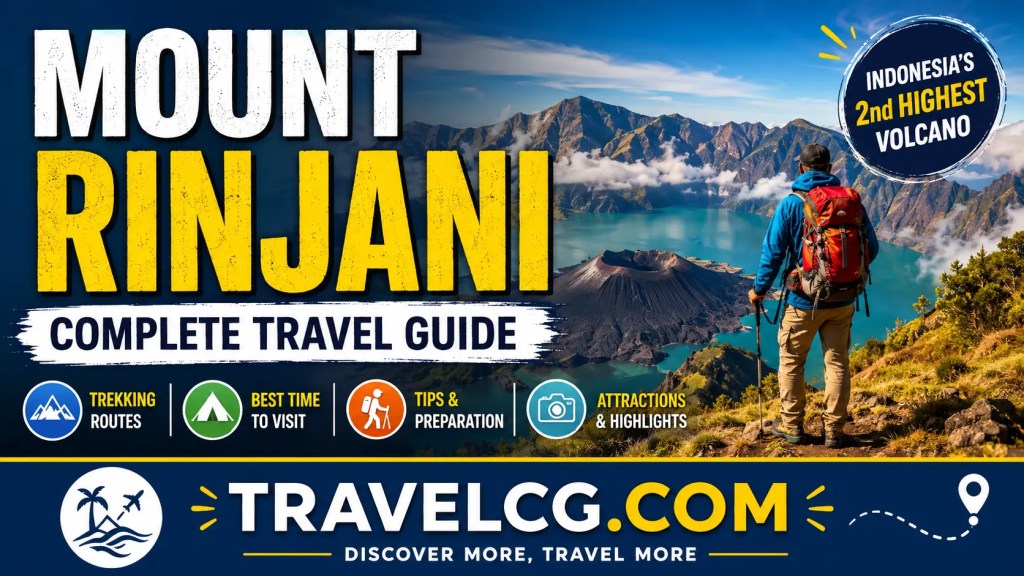
Mount Rinjani is one of Indonesia’s most spectacular mountains and one of the most rewarding trekking destinations in Southeast Asia. Located on Lombok Island in West Nusa Tenggara, Rinjani is famous for its enormous volcanic landscape, dramatic crater, turquoise-blue Segara Anak Lake, hot springs, sunrise viewpoints, forests, savannahs, and challenging hiking trails.
With an elevation of approximately 3,726 metres above sea level, Mount Rinjani is Indonesia’s second-highest volcano. The mountain is part of Mount Rinjani National Park and attracts trekkers, photographers, adventure lovers, nature enthusiasts, and travelers looking for a physically demanding but unforgettable experience.
A trip to Rinjani is not simply a mountain climb. It is a multi-day adventure involving steep ascents, volcanic terrain, camping, changing weather, spectacular landscapes, and some of the most memorable sunrise and sunset experiences in Indonesia.
Where Is Mount Rinjani?
Mount Rinjani is located on Lombok Island in the province of West Nusa Tenggara, Indonesia. Lombok lies east of Bali and is easily accessible from Bali by air or sea.
The mountain dominates the northern part of Lombok and can be seen from many parts of the island on clear days.
The main trekking areas are situated around the villages and districts surrounding Mount Rinjani National Park. Popular starting points include Senaru and Sembalun.
Sembalun is generally associated with the eastern approach, while Senaru is one of the traditional northern approaches.
Why Is Mount Rinjani Famous?
Mount Rinjani is famous for several reasons.
The first is its impressive volcanic landscape. Unlike a simple mountain summit, Rinjani offers an extraordinary combination of volcanic ridges, forests, grasslands, cliffs and crater scenery.
The second major attraction is Segara Anak, a beautiful crater lake situated inside the volcanic caldera. The lake is surrounded by steep mountain walls and volcanic terrain, creating a dramatic landscape.
Another attraction is Mount Barujari, a volcanic cone located within the crater area. The combination of Segara Anak Lake and the surrounding volcanic formations makes the Rinjani landscape particularly distinctive.
Rinjani is also famous for its challenging summit climb. Reaching the summit involves climbing a steep volcanic ridge where loose sand and gravel can make every step difficult.
Mount Rinjani Height
Mount Rinjani stands at approximately 3,726 metres above sea level.
This makes it one of the highest mountains in Indonesia and the second-highest volcano in the country.
The altitude is significant enough that trekkers should take the climb seriously. Although altitude sickness is not guaranteed, some people can experience headaches, nausea, dizziness, tiredness or difficulty sleeping at higher elevations.
Physical preparation and gradual acclimatization can make the experience considerably easier.
Mount Rinjani National Park
Mount Rinjani is protected within Mount Rinjani National Park, an important natural area covering forests, volcanic landscapes, wildlife habitats and mountain ecosystems.
The national park plays an important role in conserving the mountain environment and supporting local tourism.
Visitors are expected to follow park regulations and trekking rules. Regulations can change because of weather, volcanic activity, conservation requirements or safety conditions, so travelers should check the latest official information before starting their trek.
Best Time to Visit Mount Rinjani
The best time to trek Mount Rinjani is generally during the dry season.
In Indonesia, the main trekking season commonly falls between April and October, although exact conditions can vary from year to year.
The rainy season can bring heavy rainfall, slippery trails, poor visibility, landslides and difficult camping conditions. Trekking routes may also be temporarily closed because of weather or safety concerns.
July and August are particularly popular because conditions can be relatively dry, but these months can also be crowded.
If you prefer fewer people, traveling around the beginning or end of the trekking season can sometimes provide a quieter experience, provided the trails are officially open and conditions are safe.
Mount Rinjani Trekking Routes
There are several approaches to Mount Rinjani, but Senaru and Sembalun are the best-known trekking routes.
Sembalun Route
The Sembalun route is particularly popular with trekkers attempting the summit.
The trek begins in a landscape of open grassland and rolling hills. The route gradually becomes steeper as it approaches the mountain.
One of the most challenging parts is the climb toward the summit area. The combination of steep terrain, loose volcanic sand and high altitude makes the final ascent physically demanding.
The Sembalun route is generally considered an excellent option for people whose primary goal is reaching the summit.
Senaru Route
The Senaru route begins in a forested environment.
Trekkers pass through tropical vegetation before reaching higher and more exposed mountain terrain.
This route is particularly scenic because of the transition from dense forest to volcanic landscapes.
Senaru is also traditionally associated with access toward the crater and Segara Anak area.
Combining the Routes
Many multi-day trekking itineraries use different routes for ascent and descent.
For example, a trek may start from Sembalun, climb toward the summit, continue toward the crater and lake, and eventually descend toward Senaru.
This approach allows travelers to experience a much larger portion of the mountain rather than simply climbing and returning along the same path.
Mount Rinjani Trekking Duration
The duration depends on the selected route and itinerary.
A typical summit-oriented trek may take two days and one night, although such an itinerary can be extremely demanding.
Three-day, two-night itineraries are popular because they provide more time for the summit, crater area and Segara Anak.
Longer itineraries can provide a slower pace and more opportunities to explore the mountain.
A longer trek is not necessarily easier because the total walking distance may be greater, but spreading the journey over additional days can make the experience more comfortable.
Mount Rinjani 2-Day Trek
A two-day trek is usually designed for travelers who want to reach the summit quickly.
The schedule can involve an initial climb to a campsite, a very early morning summit attempt, and a long descent.
The summit climb often begins during the night so that trekkers can reach the top around sunrise.
This itinerary requires good physical fitness because the amount of elevation gain and descent completed within a short period can be substantial.
Mount Rinjani 3-Day Trek
A three-day trek is often a better choice for travelers who want a more balanced experience.
A typical itinerary may involve:
Day 1: Sembalun village to the first campsite or crater-rim area.
Day 2: Summit attempt followed by descent toward Segara Anak Lake.
Day 3: Exploration around the lake and descent toward Senaru.
Exact routes and camping locations can vary depending on current regulations, weather and trekking operator arrangements.
Segara Anak Lake
Segara Anak is one of the defining attractions of Mount Rinjani.
The lake is located within the volcanic caldera and is surrounded by dramatic mountains.
Its name is commonly translated as “Child of the Sea,” reflecting its blue appearance and relationship to the surrounding volcanic landscape.
For many trekkers, reaching Segara Anak is almost as exciting as reaching the summit.
The lake provides an extraordinary contrast to the dark volcanic rocks and surrounding mountains.
Mount Barujari
Mount Barujari is a volcanic cone situated within the Rinjani caldera.
It forms part of the extraordinary volcanic landscape around Segara Anak.
Because Rinjani is an active volcanic system, volcanic conditions can change. Travelers should never rely solely on old trekking information when planning a visit.
Volcanic activity, earthquakes, ash emissions and other geological conditions can affect access to different areas.
Mount Rinjani Summit
The summit is the ultimate objective for many trekkers.
The final climb is notorious for being difficult.
The trail becomes steep and consists largely of loose volcanic material. For every few steps forward, trekkers may feel that they slide backward slightly.
This section can be exhausting even for experienced hikers.
The difficulty is increased by darkness, cold temperatures, wind and the effects of altitude.
However, reaching the summit at sunrise can be an extraordinary experience.
On a clear morning, trekkers may see the surrounding Lombok landscape, the volcanic crater, Segara Anak Lake and distant islands.
Mount Rinjani Sunrise
Sunrise from the summit is one of the most memorable parts of the Rinjani experience.
Trekkers typically begin the final summit ascent during the early hours of the morning.
The sky gradually changes from darkness to shades of blue, orange and gold.
When weather conditions are favorable, the surrounding mountains and ocean become visible as daylight spreads across the island.
Because clouds can appear quickly in mountain environments, sunrise views are never guaranteed.
Difficulty Level of Mount Rinjani Trek
Mount Rinjani is considered a challenging trek.
It is not an ideal destination for someone with no hiking experience or poor physical conditioning.
The major challenges include:
Steep climbs
Long walking distances
Loose volcanic sand
Cold temperatures
High altitude
Limited sleep
Heavy backpacks
Early-morning summit attempts
Strong sun exposure
Changing weather
Long descents
The summit section is particularly difficult because the loose volcanic surface makes progress slow.
Fitness Requirements
You do not necessarily need to be a professional mountaineer to trek Rinjani, but you should have good cardiovascular fitness and leg strength.
Preparation should ideally begin several weeks before the trip.
Useful training activities include walking, hiking, stair climbing, running, cycling and strength exercises.
Squats, lunges, calf raises and core exercises can help prepare the muscles for long ascents and descents.
Regular hiking with a backpack is particularly useful because it helps your body adjust to carrying weight while walking uphill.
What to Pack for Mount Rinjani
Packing correctly is extremely important.
Essential items may include:
Hiking shoes with good grip
Warm layers
Waterproof jacket
Trekking trousers
Warm socks
Hat
Gloves
Headlamp
Extra batteries or charging equipment
Water bottle or hydration system
Sunscreen
Sunglasses
Personal medicines
Basic first-aid supplies
Toiletries
Power bank
Small towel
Sleeping bag if not provided
Backpack or daypack
Rain protection
Energy snacks
Do not overpack. Carrying unnecessary weight can make the trek significantly harder.
Food and Water During the Trek
Food arrangements depend on whether you trek independently or with an organized trekking service.
Many guided trekking packages include meals prepared at campsites.
Typical trekking food may include rice, vegetables, eggs, noodles, fruit, bread and other simple energy-rich meals.
Carry sufficient drinking water according to the itinerary.
Hydration becomes particularly important during steep climbs and warm daytime conditions.
Water sources should only be used when they are confirmed to be safe and suitable for drinking.
Camping on Mount Rinjani
Camping is an important part of the Rinjani experience.
Campsites can provide spectacular views of the surrounding landscape.
However, mountain camping can also be cold and uncomfortable.
Temperatures can fall significantly during the night, particularly at exposed higher elevations.
A warm sleeping system, suitable clothing and protection from wind and rain are therefore essential.
Weather on Mount Rinjani
Mountain weather can change rapidly.
A day that begins sunny may become cloudy, windy or rainy within a short time.
Higher elevations are generally colder than the lowlands.
The summit can be particularly cold and windy during the early morning.
Trekkers should therefore prepare for multiple weather conditions rather than assuming that Lombok’s tropical climate means the mountain will be warm.
Safety on Mount Rinjani
Safety should always be the highest priority.
Before beginning the trek, check current weather conditions, volcanic activity, trail status and park regulations.
Do not attempt restricted routes.
If officials close part of the mountain, do not enter the closed area.
Trekkers should also remain aware of exhaustion and dehydration.
If you experience severe dizziness, breathing problems, confusion, extreme weakness or other concerning symptoms, inform your guide and stop climbing.
Never underestimate the mountain simply because it is a popular tourist attraction.
Is a Guide Necessary?
Whether a guide is required depends on current park regulations, the route and the type of trek.
Even when regulations allow independent hiking, many travelers prefer to use local guides and trekking operators.
A knowledgeable guide can help with navigation, campsites, food, weather awareness and emergency situations.
Guided trekking can also support local communities whose livelihoods depend partly on mountain tourism.
Mount Rinjani Trekking Cost
The total cost varies considerably.
Major factors include:
National park fees
Guide charges
Porter services
Transportation
Meals
Camping equipment
Accommodation
Number of trekking days
Private or group trekking
Equipment rental
The cheapest option is not necessarily the best option.
Before booking, travelers should understand exactly what is included in the package.
Ask whether transportation, meals, tents, sleeping bags, entrance fees, guides and porters are included.
Porter Services
Porters are commonly used on organized Rinjani treks.
They can carry camping equipment, food and other supplies.
If you use porter services, choose responsible trekking operators that treat porters fairly and provide appropriate working conditions.
Travelers should also avoid carrying excessive luggage to be transported unnecessarily.
Responsible Tourism at Mount Rinjani
Rinjani is a fragile mountain ecosystem.
Tourists have a responsibility to protect it.
Never throw plastic bottles, food wrappers or other waste on the trail.
Carry your rubbish until it can be properly disposed of.
Avoid damaging plants.
Do not disturb wildlife.
Stay on designated trails.
Do not remove rocks, plants or other natural objects.
Use water responsibly.
Respect local communities and cultural traditions.
A beautiful mountain remains beautiful only when visitors take care of it.
Local Culture Around Mount Rinjani
Mount Rinjani has deep cultural significance for local communities, particularly the Sasak people of Lombok.
The mountain and its surroundings are connected with local traditions, beliefs and ceremonies.
Travelers should therefore treat villages, religious sites and cultural practices respectfully.
Dress appropriately when visiting local communities and religious places.
Learning about local culture can make a Rinjani trip much more meaningful than simply treating the mountain as a hiking destination.
Places to Visit Near Mount Rinjani
A Rinjani trip can be combined with other destinations in Lombok.
Popular places include:
Senaru
Sembalun
Tetebatu
Kuta Lombok
Mandalika
Senggigi
Gili Islands
Tanjung Aan
Pink Beach
Sasak villages
Lombok waterfalls
Tetebatu is particularly interesting for travelers who want to experience green landscapes, rice fields and rural Lombok after completing the mountain trek.
Mount Rinjani vs Mount Batur
Travelers often compare Rinjani with Mount Batur in Bali.
Mount Batur is significantly easier and is commonly climbed as a shorter sunrise trek.
Rinjani is much more demanding and involves multi-day trekking, camping, steep climbs and challenging volcanic terrain.
If you want a relatively short sunrise hike, Mount Batur may be more suitable.
If you want a serious multi-day mountain adventure, Rinjani offers a much bigger experience.
Mount Rinjani for Beginners
Rinjani can be attempted by fit beginners, but it should not be treated as an easy first hike.
Someone who has never completed a long mountain trek should prepare properly before attempting it.
Starting with shorter hikes is a good way to understand how your body responds to elevation, long-distance walking and steep terrain.
A guided itinerary with a manageable pace can be a better choice for first-time trekkers.
Photography at Mount Rinjani
Rinjani is an excellent destination for photography.
Major photography opportunities include:
Sunrise from the summit
Segara Anak Lake
Volcanic landscapes
Mountain ridges
Cloud formations
Sembalun grasslands
Forest trails
Sunset from the crater rim
Night skies
Campfire scenes
Because the trek is physically demanding, avoid carrying unnecessarily heavy camera equipment.
A lightweight camera or smartphone can be sufficient for capturing the major highlights.
Internet and Mobile Connectivity
Mobile connectivity can be limited or unavailable in sections of the mountain.
Do not depend on your phone for navigation or emergency communication.
Download important information before starting the trek and inform family or friends about your itinerary.
A power bank is useful because cold weather and frequent photography can drain batteries quickly.
Accommodation Before and After the Trek
Travelers generally stay in guesthouses, hotels or homestays around trekking villages before starting the climb.
Sembalun and Senaru are particularly convenient for trekking preparations.
After completing the trek, spending at least one night somewhere comfortable can be worthwhile because your legs may be extremely tired.
A recovery day can also make it easier to continue exploring Lombok.
How to Reach Mount Rinjani
Most international travelers reach Lombok through Lombok International Airport or travel from Bali by boat or flight.
From the airport or major tourist areas, transportation can be arranged toward Senaru, Sembalun or other trekking access points.
Travel time depends on your starting location, traffic and the selected trailhead.
It is advisable to arrive in the trekking region at least one day before the trek so that you have enough time to register, prepare equipment and rest.
Important Things to Know Before Trekking
Before your trip, confirm the latest information regarding:
Trail openings
Park regulations
Trekking permits
Volcanic activity
Weather conditions
Required equipment
Guide requirements
Camping rules
Emergency procedures
Transport arrangements
Do not rely on information from several years ago because mountain regulations and conditions can change.
Common Mistakes to Avoid
One common mistake is underestimating the difficulty.
Another is carrying too much luggage.
Some trekkers also fail to bring enough warm clothing because they assume Lombok’s tropical climate means the mountain will remain warm.
Starting without adequate physical preparation can make the summit attempt unnecessarily difficult.
Ignoring weather warnings is another serious mistake.
Finally, leaving rubbish behind can damage the environment and negatively affect the experience for future visitors.
Best Mount Rinjani Itinerary
For many travelers, a three-day, two-night itinerary provides a good balance between adventure and exploration.
A possible itinerary is:
Day 1: Arrive at the trekking village, complete registration and preparation, then begin the trek toward the first campsite.
Day 2: Wake early for the summit attempt, enjoy sunrise, descend toward the crater area and continue toward Segara Anak.
Day 3: Explore the lake area if permitted, then descend through the forest toward the exit point and return to your accommodation.
The actual itinerary should always follow current park regulations and the instructions of local authorities or trekking guides.
Best Tips for a Successful Rinjani Trek
Train your legs before the trip.
Practice hiking with a backpack.
Wear comfortable and broken-in hiking shoes.
Keep your backpack lightweight.
Carry adequate water.
Bring warm clothing.
Use sunscreen even when the weather feels cool.
Start slowly.
Take regular breaks.
Follow your guide and park rules.
Respect altitude and weather conditions.
Protect your phone and electronics from rain.
Keep your rubbish with you.
Sleep whenever you get the opportunity.
Do not sacrifice safety simply to reach the summit.
Frequently Asked Questions About Mount Rinjani
How high is Mount Rinjani?
Mount Rinjani is approximately 3,726 metres high.
Is Mount Rinjani difficult to climb?
Yes. Rinjani is considered a challenging trek because of its steep terrain, loose volcanic sand, long walking distances, altitude and changing weather.
How many days are needed for Mount Rinjani?
Two-day and three-day itineraries are common, while longer trips are possible for travelers who want a slower experience.
Can beginners climb Mount Rinjani?
Fit beginners can attempt Rinjani with proper preparation, but it is not an easy hike and should not be underestimated.
What is the best month to climb Mount Rinjani?
The dry-season months are generally preferred, with the trekking season commonly running from around April to October, subject to current conditions and official closures.
Is Mount Rinjani active?
Yes. Rinjani is an active volcanic system, so volcanic conditions should always be checked before trekking.
What is Segara Anak?
Segara Anak is the spectacular crater lake located inside the Mount Rinjani caldera.
Can you swim in Segara Anak?
Swimming conditions and access can depend on current regulations and safety conditions. Travelers should follow the instructions of park authorities and guides rather than assuming that swimming is always permitted.
Is Mount Rinjani worth visiting?
For travelers who enjoy hiking, nature, adventure and dramatic landscapes, Mount Rinjani can be one of the most memorable experiences in Indonesia.
Final Travel Advice
Mount Rinjani is much more than a summit to be checked off a travel list. The combination of volcanic landscapes, forest trails, crater views, Segara Anak Lake, sunrise, camping and local culture makes it one of Lombok’s most remarkable destinations.
However, its beauty comes with genuine physical and environmental challenges. Proper preparation is essential. Choose the right itinerary, train before the trek, pack carefully, monitor weather and volcanic conditions, follow official regulations and respect the mountain environment.
The most important goal should not simply be reaching the highest point. A successful Rinjani journey means completing the trek safely, respecting the mountain and its communities, and returning with unforgettable memories of one of Indonesia’s great volcanic landscapes.


















Leave a Reply