
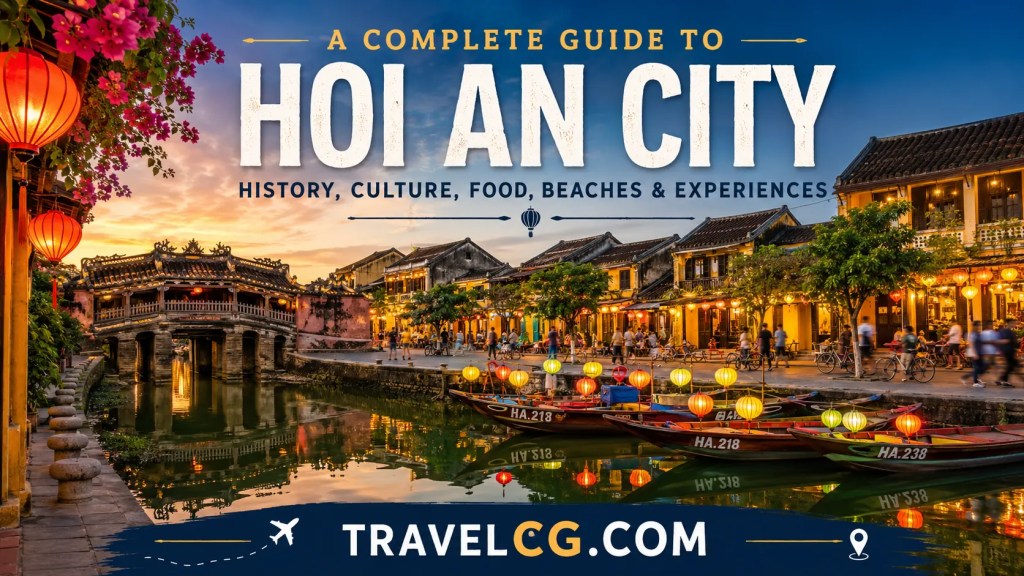
Hoi An is one of the most enchanting destinations in Vietnam, famous for its beautifully preserved ancient town, colorful lanterns, historic architecture, riverside atmosphere, traditional food, tailor shops, beaches, and relaxed pace of life. Located in central Vietnam in Quang Nam Province, Hoi An sits along the Thu Bon River, not far from Da Nang. The city is particularly famous for its Ancient Town, which was designated a UNESCO World Heritage Site in 1999. UNESCO describes it as an exceptionally well-preserved example of a Southeast Asian trading port that flourished from the 15th to the 19th century.
Unlike many modern cities that have grown around highways, skyscrapers, and shopping malls, Hoi An has managed to preserve much of its historic character. Narrow streets, old yellow-painted buildings, wooden houses, Chinese assembly halls, temples, cafés, traditional shops, bicycles, boats, and glowing lanterns create an atmosphere that feels very different from other Vietnamese destinations.
Hoi An is an excellent destination for travelers interested in history, culture, food, photography, architecture, shopping, beaches, and slow travel. It can be visited as a day trip from Da Nang, but spending two or three nights gives travelers much more time to experience the city beyond its most famous attractions.
Where Is Hoi An?
Hoi An is located in central Vietnam, in Quang Nam Province, approximately 30 kilometers south of Da Nang. The city is situated near the mouth of the Thu Bon River and has historically benefited from its location close to the coast and important maritime trade routes.
Its location makes Hoi An particularly convenient for travelers exploring central Vietnam. Da Nang is the closest major city and transportation hub, while other important destinations such as Hue and My Son can also be incorporated into a central Vietnam itinerary.
The city itself is relatively compact, especially around the Ancient Town. Many of the most interesting streets and attractions can be explored on foot or by bicycle, making Hoi An an appealing destination for travelers who prefer slower and more relaxed sightseeing.
A Brief History of Hoi An
The history of Hoi An is one of the major reasons for its international importance. The area has been associated with trade for centuries. Archaeological evidence indicates that commercial activity in the region existed long before the modern city developed. Hoi An later became an important trading center connecting Vietnam with merchants and traders from different parts of Asia and beyond.
From around the 15th to the 19th centuries, Hoi An developed into a significant international trading port. Merchants from China, Japan, Southeast Asia and Europe interacted here, bringing not only goods but also languages, architectural traditions, religions, customs and cultural influences.
This international history can still be seen in the architecture of the Ancient Town. Chinese assembly halls stand alongside Vietnamese homes, Japanese architectural elements appear in historic structures, and later European influences can also be found in the townscape.
UNESCO recognizes Hoi An as an outstanding example of cultural fusion in an international commercial port. Its historic street plan and traditional buildings remain remarkably well preserved.
The decline of Hoi An’s importance as a major trading port during the 19th century ironically helped preserve its historic character. Because the city did not undergo the same level of large-scale modernization as some other urban centers, many traditional structures survived.
In 1999, Hoi An Ancient Town was officially inscribed on the UNESCO World Heritage List.
Why Is Hoi An Famous?
Hoi An is famous for several interconnected reasons. Its Ancient Town is the biggest attraction, but the city offers much more than historic buildings.
The first major attraction is its traditional architecture. Rows of narrow merchant houses line the streets, many with wooden interiors, tiled roofs and colorful façades.
The second is the city’s lantern culture. In the evening, traditional lanterns illuminate streets, shops and the riverside, creating one of Vietnam’s most recognizable nighttime landscapes.
The third is food. Hoi An has a distinctive culinary identity, with local dishes such as cao lau and white rose dumplings being particularly associated with the city.
The fourth is shopping and tailoring. Hoi An is internationally known for its tailor shops, where visitors can order customized clothing.
The fifth is its surrounding countryside. Rice fields, vegetable gardens, coconut forests, villages and waterways provide opportunities to experience a quieter side of central Vietnam.
Finally, Hoi An offers easy access to beaches, making it possible to combine cultural tourism with a relaxing coastal holiday.
Hoi An Ancient Town
Hoi An Ancient Town is the heart of the destination and the place most visitors want to explore first.
The historic area contains an exceptionally well-preserved collection of traditional buildings. UNESCO records more than 1,100 timber-frame buildings within the heritage property, including commercial structures, residences, religious buildings and monuments.
The streets are relatively narrow, and many areas are particularly pleasant for walking. During the day, visitors can explore historic homes, temples, assembly halls, cafés, galleries, souvenir shops and restaurants.
The architecture reflects Hoi An’s history as an international port. Vietnamese, Chinese, Japanese and European influences can be seen throughout the old town.
One of the best ways to experience Ancient Town is not to rush from attraction to attraction. Simply walking through the streets, observing the architecture, stopping for coffee and watching local life can be as rewarding as visiting individual monuments.
Japanese Covered Bridge
The Japanese Covered Bridge is one of Hoi An’s most recognizable landmarks.
The historic wooden bridge represents the city’s connections with Japanese merchants and is an important symbol of Hoi An. UNESCO identifies the bridge, with its pagoda, as one of the notable surviving architectural elements of the historic town.
The bridge is particularly attractive for photography. Its traditional roof, wooden structure and surrounding historic buildings make it one of the most photographed locations in the city.
Because the surrounding streets can become busy, visiting early in the morning can provide a quieter experience.
Tan Ky Old House
Tan Ky Old House is another important historic attraction in Hoi An. It provides an opportunity to see how merchant families once lived and conducted business.
Traditional houses in Hoi An were often designed to support both residential life and commercial activity. Their narrow fronts opened toward the street, while the buildings extended deep into the property.
This distinctive architecture reflects the city’s trading history. Goods could be displayed and sold toward the street while residential and storage areas occupied the deeper parts of the building.
Chinese Assembly Halls
Hoi An’s historic Chinese assembly halls are another important part of its cultural landscape.
Different Chinese communities established assembly halls that served social, cultural and religious functions. Their architecture often features elaborate decoration, colorful details, carved woodwork and traditional motifs.
Visiting these buildings helps explain the multicultural character of Hoi An. The city was never simply an isolated Vietnamese settlement; it developed through centuries of interaction between different communities.
Hoi An Lanterns and Nightlife
Hoi An becomes especially atmospheric after sunset.
Traditional lanterns illuminate the streets, historic houses and riverside areas. The warm glow of the lanterns against the old yellow buildings creates the visual identity for which Hoi An is famous.
The evening is an ideal time to walk around Ancient Town, enjoy local food, sit at a riverside café or take photographs.
The city is not primarily a destination for large nightclubs and intense nightlife. Instead, its evening appeal comes from its atmosphere, restaurants, cafés, lanterns, music and riverside activities.
Travelers who enjoy slow evenings and photography will particularly appreciate Hoi An after dark.
Thu Bon River
The Thu Bon River has played an important role in the development of Hoi An.
Historically, the river provided access for trading vessels and helped connect the town with the surrounding region. UNESCO notes that the historic urban layout developed in close relationship with the river, with buildings traditionally arranged to facilitate commercial activity and movement of goods.
Today, the river remains one of the most attractive parts of the city.
Visitors can walk along the riverfront, watch boats, enjoy restaurants and cafés, or experience the city from the water.
The river is especially beautiful around sunset and after dark when the surrounding lanterns begin to glow.
Hoi An Lantern Festival
Lanterns are deeply associated with Hoi An’s cultural identity. During special lunar-calendar celebrations, the old town becomes particularly colorful and atmospheric.
Visitors can see lanterns throughout the historic streets and along the river. The combination of traditional architecture, evening lighting and cultural performances makes these periods especially attractive for photographers.
If you specifically want to experience a festival evening, check the local festival calendar before traveling because dates follow the lunar calendar and therefore change each year.
Hoi An Food
Food is one of the strongest reasons to visit Hoi An.
The city has developed a distinctive culinary culture influenced by its geography, local ingredients and history as a trading port.
One of the most famous local dishes is cao lau. It is a noodle dish associated particularly strongly with Hoi An and is generally served with noodles, meat, herbs, vegetables and a flavorful sauce.
Another famous specialty is white rose dumplings, delicate steamed dumplings traditionally associated with Hoi An.
Banh mi is also extremely popular, and Hoi An has become famous among travelers for its local interpretations of the Vietnamese sandwich.
Other dishes worth trying include Vietnamese pancakes, fresh spring rolls, grilled seafood, rice dishes, noodle soups and local desserts.
Do not limit your food experience to restaurants. Some of the best discoveries can come from small local eateries, markets and street-food stalls.
Hoi An Central Market
Hoi An Central Market is an excellent place to experience everyday local life.
The market is busy with vendors selling fresh vegetables, fruits, seafood, spices, prepared food, clothing, souvenirs and handicrafts.
For travelers interested in Vietnamese cuisine, the market provides a fascinating look at the ingredients used in local cooking.
Morning is often an especially interesting time to visit because local commercial activity is already underway.
Tailor Shops in Hoi An
Hoi An is famous for custom tailoring.
Visitors can find numerous shops offering customized dresses, shirts, suits, trousers, jackets and other garments. Travelers can select fabrics, styles and measurements and request alterations.
If you want tailored clothing, allow sufficient time rather than waiting until the last few hours of your trip. Depending on the garment and tailor, fittings and adjustments may require multiple visits.
It is also wise to compare fabrics, workmanship, prices and customer reviews before placing a large order.
Tra Que Vegetable Village
Tra Que is a traditional agricultural area near Hoi An known for vegetable cultivation.
The village provides a different perspective on the destination. Instead of historic buildings and busy tourist streets, visitors can see gardens, farming activities and rural landscapes.
Cycling through the countryside around Tra Que can be a pleasant experience, especially for travelers who want to combine cultural sightseeing with outdoor activities.
Cam Thanh Coconut Village
Another popular experience near Hoi An is the coconut-waterway area around Cam Thanh.
The area is associated with waterways, coconut palms and traditional basket boats. Visitors can take boat rides through the narrow waterways and observe the surrounding landscape.
The experience is particularly suitable for families and travelers looking for something different from the historic center.
However, it is worth choosing responsible operators and avoiding activities that appear to exploit wildlife or damage the environment.
An Bang Beach
Hoi An is not only a historical destination. It also has access to attractive beaches.
An Bang Beach is one of the best-known beaches near the city. It offers a relaxing contrast to the busy streets of Ancient Town.
Visitors can spend a few hours swimming, walking along the coast, enjoying seafood or relaxing at a beachfront café.
A combination of Ancient Town and An Bang Beach makes Hoi An suitable for travelers who want both culture and relaxation.
My Son Sanctuary
My Son Sanctuary is an important cultural site that can be visited as a day trip from Hoi An.
It is associated with the ancient Champa civilization and contains the remains of Hindu temple structures.
The site provides an important historical contrast to Hoi An. While Hoi An represents the heritage of a later international trading port, My Son offers insight into the Cham civilization that once dominated parts of central Vietnam.
A visit to My Son can therefore add considerable historical depth to a Hoi An itinerary.
Best Time to Visit Hoi An
Hoi An can be visited throughout much of the year, but weather conditions vary considerably.
February to April is generally considered one of the most comfortable periods, with relatively mild and drier conditions. Vietnam’s tourism information also identifies February to April as a particularly favorable period, while May to August can be attractive for travelers interested in beach activities.
The summer months can be hot, but they are often suitable for travelers who want sunshine, beaches and outdoor activities.
The wetter period requires more flexibility. Central Vietnam can experience substantial rainfall, and October and November can bring particularly challenging conditions, including flooding in low-lying areas.
Weather patterns can vary from year to year, so travelers should check the forecast before departure, especially during the rainy season.
How to Reach Hoi An
The most convenient international and domestic gateway for Hoi An is usually Da Nang.
Da Nang International Airport is located roughly an hour from Hoi An by road, depending on traffic. Travelers can continue from Da Nang to Hoi An by taxi, ride-hailing service, private transfer, shuttle or other local transportation.
Travelers arriving by train can also reach Da Nang Railway Station and continue overland to Hoi An.
Because Hoi An does not have a major international airport of its own, most long-distance travelers plan their journey through Da Nang.
Getting Around Hoi An
One of the pleasures of visiting Hoi An is that many attractions are close together.
Walking is the best way to explore the Ancient Town because it allows travelers to notice details that are easy to miss from a vehicle.
Bicycles are also extremely useful, particularly for exploring the countryside, rice fields and villages surrounding the old town.
Taxis and ride-hailing services are convenient for longer distances, such as traveling between Hoi An, the beach and nearby attractions.
For a relaxed holiday, avoid trying to cover every attraction in one day. Hoi An is better experienced slowly.
How Many Days Are Enough for Hoi An?
One day is enough to see the main highlights, especially if you are visiting from Da Nang.
However, two or three nights are better for most travelers.
A two-day trip allows time for Ancient Town, local food, evening lanterns, shopping and one nearby attraction.
Three days allow a more relaxed experience including the old town, countryside, beach, local food experiences and possibly My Son Sanctuary.
Travelers interested in photography, food, cycling, tailoring or slow travel could easily spend four or more days exploring the area.
A Suggested Three-Day Hoi An Experience
On the first day, concentrate on Ancient Town. Explore the historic streets, visit traditional houses and assembly halls, see the Japanese Covered Bridge and enjoy local food. In the evening, return to the old town for the lantern-lit atmosphere and riverside views.
On the second day, explore the countryside. Visit Tra Que, cycle through agricultural landscapes and consider a basket-boat experience around the coconut waterways. Later, relax at An Bang Beach and return to Hoi An for dinner.
On the third day, choose between a deeper cultural experience and a day trip. You could visit My Son Sanctuary, take a cooking class, spend more time shopping and tailoring, or simply enjoy a slower day in the old town.
Where to Stay in Hoi An
The best area to stay depends on the type of experience you want.
Staying close to the Ancient Town is ideal for travelers who want to walk to historic attractions, restaurants, cafés and evening activities.
Accommodation slightly outside the old town can offer a quieter atmosphere while still providing easy access by bicycle or taxi.
Beachside accommodation is better suited to travelers who prioritize swimming, relaxation and coastal scenery.
For families, resorts and hotels with pools can be particularly convenient. Couples may prefer boutique hotels, heritage-style accommodation or peaceful riverside properties.
Budget travelers can find hostels and guesthouses, while luxury travelers have numerous resort-style options around Hoi An and the surrounding countryside.
Shopping in Hoi An
Shopping is another major part of the Hoi An experience.
Visitors can purchase lanterns, handicrafts, artwork, ceramics, silk products, bags, clothing, souvenirs and local food products.
The city is especially famous for tailoring, but travelers should compare options carefully rather than choosing the first shop they see.
When purchasing handmade goods, consider the quality of materials and craftsmanship rather than focusing only on price.
Photography in Hoi An
Hoi An is one of the most photogenic destinations in Vietnam.
The yellow walls of the old town, wooden doors, colorful lanterns, riverboats, traditional architecture, bicycles and surrounding countryside provide countless photography opportunities.
Early morning is excellent for quiet street photography because the historic center is generally more peaceful.
Late afternoon provides beautiful warm light, while evening is ideal for lantern photography.
If photographing local people, markets or religious sites, always be respectful and ask permission when appropriate.
Is Hoi An Good for Families?
Yes. Hoi An can be an excellent family destination.
Children can enjoy bicycle rides, beaches, boat experiences, markets, lanterns, traditional crafts and local food.
The compact nature of the historic center makes sightseeing relatively manageable, although crowded evening streets can be challenging with very young children.
Families should also plan breaks during hot weather and choose accommodation with convenient facilities such as swimming pools if desired.
Is Hoi An Good for Couples?
Hoi An is particularly popular with couples because of its romantic atmosphere.
Walking through lantern-lit streets, dining beside the river, cycling through the countryside and watching the sunset at the beach can make the destination especially memorable.
The city is suitable both for honeymoon trips and relaxed couples’ holidays.
Hoi An for Solo Travelers
Solo travelers can also enjoy Hoi An easily.
The city is relatively straightforward to explore independently, and walking or cycling provides plenty of opportunities for spontaneous discoveries.
Solo travelers can join cooking classes, cycling tours, cultural activities or day trips if they want to meet other travelers.
The relaxed atmosphere also makes Hoi An suitable for travelers who want a slower holiday rather than a tightly scheduled sightseeing trip.
Responsible Tourism in Hoi An
Because Hoi An is a UNESCO World Heritage destination, responsible tourism is particularly important.
Visitors should respect historic buildings, religious sites and local customs. Avoid touching or climbing historic structures, follow photography rules and dispose of waste responsibly.
Supporting locally owned restaurants, shops, artisans and tour operators can help tourism benefit the local community.
Travelers should also be conscious of environmental issues, particularly around waterways, beaches and the countryside.
Hoi An’s historic character is one of its greatest assets, and preserving that character requires cooperation between residents, businesses, authorities and visitors.
Practical Tips for Visiting Hoi An
Carry comfortable walking shoes because exploring the Ancient Town involves considerable walking.
Bring sun protection during hot and sunny periods.
Keep a light rain jacket or umbrella available during wetter months.
Carry some Vietnamese currency for small purchases and local food stalls.
Start sightseeing early if you want quieter streets and better photography opportunities.
Reserve enough time for food because Hoi An is as much a culinary destination as a historical one.
If ordering tailored clothing, plan for measurements and at least one fitting.
Do not try to see everything in a single day. The charm of Hoi An comes from slowing down and experiencing the atmosphere.
During periods of heavy rain, monitor local weather and river conditions because flooding can temporarily affect parts of the Ancient Town. Central Vietnam has experienced significant flooding events in recent years, demonstrating why seasonal planning matters.
Hoi An vs Da Nang
Hoi An and Da Nang are often combined in the same trip, but they offer very different experiences.
Da Nang is a larger, modern coastal city with broad beaches, contemporary hotels, restaurants, bridges and urban attractions.
Hoi An is smaller, slower and more focused on history, culture, traditional architecture and atmosphere.
For travelers interested in nightlife, modern urban experiences and large beaches, Da Nang may be more suitable.
For travelers interested in heritage, food, walking, photography, traditional architecture and slow travel, Hoi An is likely to be the stronger choice.
The best approach for many visitors is not to choose one over the other but to experience both.
Why Hoi An Should Be on Your Vietnam Itinerary
Hoi An offers something that is increasingly difficult to find in rapidly developing tourist destinations: a strong sense of place.
Its historic streets are not simply preserved as museum exhibits. They remain part of a living urban environment where people eat, work, shop, worship and live.
The UNESCO designation recognizes Hoi An’s exceptional preservation and cultural significance, while the city’s contemporary attractions make it accessible and enjoyable for modern travelers.
You can spend the morning walking through centuries-old streets, the afternoon cycling through rice fields, the evening eating local noodles beside the river and the next day relaxing on a beach. That combination of heritage, food, countryside and coast is what makes Hoi An so distinctive.
Final Thoughts
Hoi An is much more than a beautiful collection of old buildings. It is a destination where history, culture, food, architecture, nature and everyday Vietnamese life come together.
The Ancient Town is undoubtedly the centerpiece, with its yellow façades, wooden merchant houses, assembly halls, historic bridge and lantern-filled streets. But the surrounding countryside, beaches, markets, craft villages and waterways add another dimension to the experience.
For first-time visitors to Vietnam, Hoi An is one of the country’s most rewarding destinations. It works equally well for couples, families, solo travelers, photographers, food lovers and history enthusiasts.
The best way to experience Hoi An is not to rush. Walk its streets in the morning, discover its food during the day, explore the countryside at a relaxed pace and return to the Ancient Town after sunset when the lanterns transform the historic streets.
That combination of history and everyday life is the real magic of Hoi An—and it is the reason this remarkable former trading port continues to attract travelers from around the world.


Leave a Reply