
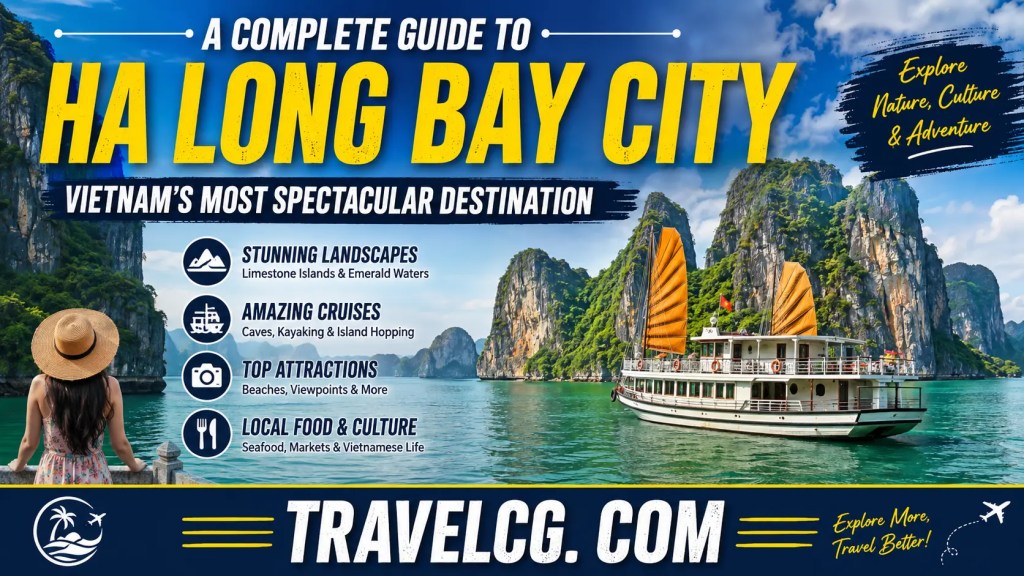
Ha Long Bay City, commonly known simply as Ha Long, is one of the most spectacular destinations in northern Vietnam. Located in Quang Ninh Province, the city is famous throughout the world because it serves as a gateway to the extraordinary seascape of Ha Long Bay, where hundreds of limestone islands and dramatic karst formations rise from calm emerald-green waters.
Although many travelers use the name “Ha Long” mainly when talking about the bay, Ha Long is also a modern coastal city with beaches, viewpoints, entertainment parks, restaurants, markets, cultural attractions, hotels, and lively waterfront areas. The city offers a fascinating combination of natural beauty, Vietnamese culture, maritime traditions, modern tourism infrastructure, and access to one of Southeast Asia’s most celebrated landscapes.
Ha Long Bay itself is a UNESCO World Heritage site and is renowned for its distinctive limestone karsts and islands. The name Ha Long means “descending dragon,” reflecting one of Vietnam’s most famous legends about dragons descending into the sea to protect the country.
For travelers planning a trip to northern Vietnam, Ha Long can be visited as a day trip from Hanoi, but staying for two or three days allows considerably more time to experience the city, the bay, beaches, caves, viewpoints, cruises, and local food.
Where Is Ha Long Bay City?
Ha Long is located in northeastern Vietnam in Quang Ninh Province, on the Gulf of Tonkin. It lies approximately 150 kilometers east of Hanoi by road, making it relatively easy to include in a northern Vietnam itinerary.
The city is closely connected with Ha Long Bay and is divided geographically and culturally into several important areas. Bãi Cháy is the principal tourism-oriented area, while Hòn Gai represents an important urban and commercial side of the city.
Bãi Cháy has developed into a major tourism hub, with hotels, resorts, restaurants, entertainment facilities, beaches, and access to many bay cruises. The Bãi Cháy Bridge connects Bãi Cháy with Hòn Gai and has become an important landmark of the city.
Hòn Gai provides a somewhat different experience. It is more closely associated with everyday urban life, local markets, seafood restaurants, cafés, residential neighborhoods, and the city’s traditional commercial character.
Why Is Ha Long Famous?
Ha Long is primarily famous because of Ha Long Bay, one of Vietnam’s most recognizable natural landscapes.
The bay is characterized by a huge collection of limestone islands and karst formations. Geological processes acting over millions of years created the unusual cliffs, caves, arches, towers, and isolated islands that make the landscape so distinctive.
The bay has also been recognized for its geological and geomorphological importance. UNESCO first recognized Ha Long Bay as a World Heritage Site in 1994 and later expanded its recognition for geological values. The World Heritage area was subsequently extended to include the Cat Ba Archipelago as part of the larger protected landscape.
For visitors, however, the appeal goes beyond geology. The combination of mountains rising directly from the sea, traditional boats, floating communities, caves, beaches, sunrise, sunset, and quiet waterways creates an experience that is difficult to reproduce elsewhere.
The Legend Behind the Name Ha Long
The name Ha Long translates approximately as “descending dragon.”
According to Vietnamese legend, ancient invaders threatened the country, so the gods sent a family of dragons to help defend the Vietnamese people. The dragons descended into the sea and created numerous islands and rocky formations that acted as a natural barrier against the invaders.
After the battle, the dragons remained in the area because they admired its beauty. The place where the mother dragon descended became known as Ha Long, or “descending dragon,” while nearby areas received names associated with the dragon’s children.
Whether viewed as mythology or cultural heritage, the legend contributes greatly to the identity of the region. Visitors will encounter dragon imagery throughout Ha Long, from local art and souvenirs to tourism attractions.
History of Ha Long City
The history of the Ha Long area goes back thousands of years. Archaeological evidence indicates that prehistoric communities lived around the bay and its surrounding areas long before the modern city developed.
Researchers have identified ancient cultures associated with the region, including the Soi Nhụ, Cái Bèo, and Ha Long cultures. These discoveries demonstrate that the area was not merely a beautiful natural landscape but also an important environment for human settlement and maritime activity.
The modern history of the city is strongly connected with coal mining. Hòn Gai became an important coal-mining center during the colonial period and later developed into an important industrial and administrative center.
In the twentieth century, the area became an important economic center of northern Vietnam. Its strategic location also meant that it was affected by conflicts during the Vietnam War.
The modern city of Ha Long was formally established in 1993 when Hòn Gai received city status and was renamed Ha Long. Bãi Cháy was incorporated into the city, strengthening the connection between the urban area and the tourism center.
Today, Ha Long has evolved from an industrial and mining-oriented city into one of Vietnam’s major tourism destinations.
Ha Long Bay Cruise Experience
A cruise on Ha Long Bay is the most important experience for most visitors.
While you can admire the bay from viewpoints around the city, the true character of the landscape becomes apparent when you travel between the islands by boat.
Cruises are available in different formats, including half-day trips, full-day cruises, overnight cruises, and multi-day journeys. According to Vietnam’s tourism information, one-night cruises are among the most popular options, while longer itineraries can provide opportunities to explore quieter sections of the wider bay region.
A typical cruise may include:
- Scenic views of limestone islands
- Cave visits
- Kayaking or small-boat excursions
- Swimming opportunities
- Vietnamese meals
- Sunset viewing
- Sunrise viewing
- Cooking demonstrations
- Fishing or squid-fishing activities
- Visits to selected islands and beaches
For first-time visitors, an overnight cruise can provide a much more immersive experience than a rushed day trip.
Bai Chay
Bai Chay is the main tourism district of Ha Long and one of the best places to stay for travelers who want easy access to attractions and entertainment.
The area is known for its beach, hotels, restaurants, nightlife, entertainment complexes, and convenient transportation connections.
Bai Chay Beach is particularly popular during warm weather. Although the beach is not the same type of untouched natural environment found on remote islands, it provides an easy way for visitors staying in the city to enjoy the sea without taking a boat.
Bai Chay has changed dramatically over the years. The development of major entertainment facilities has helped transform it from a primarily seasonal beach destination into a year-round tourism hub.
Sun World Ha Long
Sun World Ha Long is one of the city’s major entertainment destinations.
Located in Bai Chay, the complex combines amusement attractions, water-based entertainment, scenic rides, and cultural-style spaces. One of its most recognizable attractions is the Sun Wheel, which offers elevated views over the city and surrounding landscape.
The complex also includes a water park and other entertainment facilities. Sun World describes the destination as combining modern entertainment with cultural and landscape elements, including a Japanese Garden and other themed areas.
It is particularly suitable for families and travelers who want a break from sightseeing and cruising.
Bai Chay Bridge
Bai Chay Bridge is an important landmark of Ha Long.
The cable-stayed bridge crosses the Cửa Lục strait and connects the Bai Chay and Hòn Gai sides of the city. It opened in 2006 and significantly improved transportation between the two areas.
The bridge is particularly attractive when illuminated at night. Travelers can also appreciate its scale and engineering when viewing it from surrounding waterfront areas.
Hon Gai
Hòn Gai provides a more local side of Ha Long.
While Bai Chay is strongly oriented toward tourism, Hòn Gai offers opportunities to observe everyday life in the city. It is an excellent area for travelers who enjoy local food, markets, cafés, waterfront walks, and urban exploration.
One of the advantages of staying in Hòn Gai is that visitors can experience a less resort-oriented atmosphere. Local restaurants can also provide opportunities to try seafood and Vietnamese dishes at prices that may be more accessible than some tourist-focused establishments.
Bai Tho Mountain
Bai Tho Mountain is one of the most recognizable natural landmarks associated with Ha Long City.
The mountain rises dramatically above the urban area and has historically been associated with poetry and Vietnamese culture. Its name is commonly translated as “Poem Mountain.”
The mountain and surrounding viewpoints have long been connected with scenic views of Ha Long Bay. However, travelers should always check current local access conditions before planning a climb because routes and safety restrictions can change.
Even when climbing is unavailable, the mountain remains an important visual landmark of the city.
Caves Around Ha Long Bay
The caves of Ha Long Bay are among its most fascinating attractions.
Millions of years of geological activity created extensive limestone formations, including caves and grottoes decorated with stalactites and stalagmites.
Some of the best-known caves associated with Ha Long Bay include Sung Sot Cave, also known as Surprise Cave, and Dau Go Cave.
Inside these caves, visitors encounter enormous chambers, unusual rock formations, natural sculptures, and dramatic lighting.
Dau Go Cave has a particularly interesting historical and geological reputation and has been associated with the traditional history of the region.
Because cave visits are usually included in organized cruise itineraries, travelers should check their cruise program carefully before booking.
Kayaking in Ha Long Bay
Kayaking provides a completely different perspective of the bay.
Instead of looking at the limestone formations from a large cruise ship, travelers can move quietly through narrow waterways and around small islands.
Depending on the route and weather conditions, kayaking may take visitors close to cliffs, lagoons, caves, beaches, and secluded sections of the bay.
It is especially enjoyable in calm weather when the water is relatively peaceful.
Travelers who prefer not to kayak can often use a traditional bamboo boat or small local boat instead.
Floating Villages and Maritime Culture
Ha Long Bay has historically supported communities whose lives were closely connected to fishing and the sea.
Floating communities became one of the distinctive cultural features of the bay. Residents traditionally lived in floating homes and depended on fishing and marine activities.
Modern tourism and environmental management have changed the way many communities operate, but the maritime heritage remains an important part of the region’s identity.
Visitors should approach these communities respectfully. They are not simply tourist attractions but places connected to people’s livelihoods and cultural history.
Food in Ha Long
Seafood is one of the major culinary attractions of Ha Long.
Because the city is located beside the sea, restaurants commonly serve a wide range of seafood dishes. Depending on the season and restaurant, travelers may encounter prawns, squid, crab, shellfish, fish, oysters, and other marine products.
Popular Vietnamese foods to try in the region include:
- Fresh seafood
- Grilled squid
- Seafood hot pot
- Vietnamese spring rolls
- Pho
- Bun cha
- Fried rice
- Fresh tropical fruit
- Vietnamese coffee
- Local noodle dishes
Squid-based dishes are particularly associated with the coastal cuisine of northern Vietnam.
Travelers should choose restaurants carefully and check prices before ordering seafood, especially when purchasing seafood by weight.
Shopping in Ha Long
Ha Long has a mixture of traditional markets, modern shopping areas, souvenir shops, and tourism-oriented stores.
Visitors can look for Vietnamese handicrafts, local food products, coffee, tea, clothing, decorative objects, and souvenirs inspired by Ha Long Bay.
Pearl products are also associated with the wider Ha Long region. However, travelers interested in buying pearls should compare quality, certification, pricing, and seller reputation before making an expensive purchase.
Local markets can be interesting places to observe everyday life, but bargaining practices vary depending on the establishment.
Best Time to Visit Ha Long
Ha Long can be visited throughout much of the year, but weather can significantly influence the experience.
Spring can provide relatively comfortable temperatures and pleasant conditions for sightseeing.
Summer is warm and popular for beach activities, but the region can experience heavy rain and tropical storms. Cruise schedules may occasionally be affected by adverse weather.
Autumn is often attractive because temperatures become more comfortable and the atmosphere can be pleasant for outdoor activities.
Winter is cooler and can bring misty or cloudy conditions. While this may reduce visibility, the bay can also acquire a mysterious and atmospheric appearance.
Vietnam’s tourism guidance emphasizes that weather changes significantly by season and that summer carries greater storm risk, while winter can be cooler and mistier.
How Many Days Are Enough for Ha Long?
A single day is enough for travelers who simply want a quick introduction to Ha Long Bay.
However, one night and two days are generally more comfortable for first-time visitors.
A three-day itinerary allows travelers to combine a cruise with additional exploration of Ha Long City, Bai Chay, Hòn Gai, beaches, entertainment attractions, and local restaurants.
A practical itinerary could look like this:
Day 1: Travel from Hanoi to Ha Long, explore Bai Chay, visit the beach, and enjoy the evening.
Day 2: Take an overnight or full-day bay cruise, visiting caves, islands, and scenic areas.
Day 3: Explore Hòn Gai, enjoy local food, visit a viewpoint or entertainment attraction, and return to Hanoi.
Travelers with more time can combine Ha Long with Hanoi, Ninh Binh, Cat Ba, or other destinations in northern Vietnam.
How to Reach Ha Long City
Ha Long is well connected with Hanoi and other destinations in northern Vietnam.
The most common ways to reach the city include:
By bus: Tourist buses and limousine-style services connect Hanoi with Ha Long.
By private car: A private vehicle offers flexibility and is convenient for families or groups.
By taxi or transfer: Pre-arranged transfers can be useful when traveling directly from an airport or hotel.
By train: Rail services can be considered depending on the traveler’s route and current timetable.
Modern highways have significantly improved road access between Hanoi and Ha Long. Vietnam’s tourism information notes that the destination can be reached from Hanoi in roughly two hours via modern expressway connections, depending on traffic and the exact starting point.
Where to Stay in Ha Long
Choosing the right area to stay depends on the type of trip you want.
Bai Chay is ideal for first-time tourists who want entertainment, beaches, restaurants, hotels, and convenient access to cruise facilities.
Hòn Gai is better suited to travelers interested in local life, markets, restaurants, cafés, and a more urban atmosphere.
Tuan Chau can be convenient for travelers whose cruise departs from or operates through the island’s marina.
Luxury resorts, international-style hotels, boutique properties, budget accommodations, and family hotels are available throughout the broader Ha Long tourism area.
For an overnight cruise, however, remember that your accommodation will effectively move with you for the night.
Ha Long for Families
Ha Long is an excellent destination for family vacations because it offers a wide variety of activities.
Children can enjoy beaches, boat rides, caves, cable cars, amusement parks, water attractions, and scenic cruises.
Families should choose cruise itineraries carefully. Very long journeys may be tiring for young children, while shorter cruises can provide a more manageable introduction to the bay.
Hotels in Bai Chay can also make family travel easier because restaurants and entertainment facilities are concentrated nearby.
Ha Long for Couples
Ha Long is particularly attractive for couples.
Sunset over the limestone islands, an overnight cruise, dinner on a boat, peaceful morning views, and waterfront walks can create a memorable romantic experience.
Couples seeking a quieter atmosphere may prefer a smaller cruise or an itinerary that spends more time away from the busiest tourism routes.
Ha Long for Adventure Travelers
Adventure seekers can combine Ha Long with kayaking, hiking, cycling, swimming, cave exploration, and island excursions.
The wider region also provides opportunities to explore Bai Tu Long Bay and Cat Ba, which can offer different landscapes and experiences.
Bai Tu Long Bay is particularly interesting for travelers who want a quieter maritime environment. Recent traveler reports frequently highlight its lower-density cruise experience compared with some of the busiest Ha Long routes, although actual crowd levels vary by date and itinerary.
Ha Long Bay vs Ha Long City
It is important to understand the difference between the two names.
Ha Long City is the urban destination containing hotels, restaurants, beaches, markets, entertainment facilities, and residential areas.
Ha Long Bay is the natural marine landscape outside and around the city, famous for its limestone islands, caves, lagoons, and scenic waterways.
Most tourists visiting the city are actually interested in experiencing both.
You can stay in Ha Long City and use it as your base while taking a cruise into the bay.
Responsible Tourism in Ha Long
The popularity of Ha Long brings significant environmental responsibilities.
Visitors should avoid throwing plastic or waste into the sea, should follow cruise regulations, and should avoid damaging caves, coral, plants, or rock formations.
Choosing responsible tour operators can also contribute to better tourism practices.
Travelers should respect local communities and avoid treating floating villages or residents simply as photographic subjects.
A sustainable approach helps preserve the landscape that attracts millions of visitors.
Important Travel Tips
Before traveling to Ha Long, keep several practical points in mind.
First, always check the weather before booking or boarding a cruise. Storms can affect marine travel.
Second, compare cruise itineraries rather than choosing only on price. Two cruises with similar prices can provide very different experiences.
Third, check exactly what is included in the cruise price. Meals, transfers, entrance fees, kayaking, beverages, and activities may be treated differently by different operators.
Fourth, carry sunscreen, sunglasses, comfortable shoes, insect repellent, and a light rain jacket.
Fifth, keep your belongings secure during boat and beach activities.
Sixth, carry some Vietnamese currency because smaller local establishments may not accept international cards.
Finally, avoid trying to see everything in one rushed day. Ha Long is best appreciated slowly, especially from the water.
Is Ha Long Bay City Worth Visiting?
Yes, Ha Long is absolutely worth visiting, particularly for travelers exploring northern Vietnam.
The city’s greatest strength is the combination of urban convenience and extraordinary natural surroundings. You can stay in a modern hotel, eat fresh seafood, walk along a beach, visit an amusement park, explore a local market, and then spend the next morning surrounded by limestone islands in the middle of Ha Long Bay.
The destination is also flexible enough to suit different travelers. Families can enjoy entertainment parks and beaches, couples can choose romantic cruises, adventure travelers can kayak and explore caves, while culture and food enthusiasts can discover local markets and maritime traditions.
Ha Long is not merely a place to photograph a famous bay. It is a destination where geology, mythology, history, fishing culture, modern tourism, and Vietnamese coastal life come together.
For a first visit to northern Vietnam, a combination of Hanoi and Ha Long makes an especially strong itinerary. Hanoi provides history, architecture, street food, and traditional urban culture, while Ha Long offers a completely different experience dominated by the sea and limestone landscapes.
Whether you choose a quick day cruise or a longer stay, the defining memory of Ha Long will almost certainly be the sight of towering limestone formations emerging from calm waters. That extraordinary landscape explains why Ha Long Bay remains one of Vietnam’s most internationally recognized natural destinations and why Ha Long City continues to be an important gateway for travelers from around the world.


Leave a Reply