
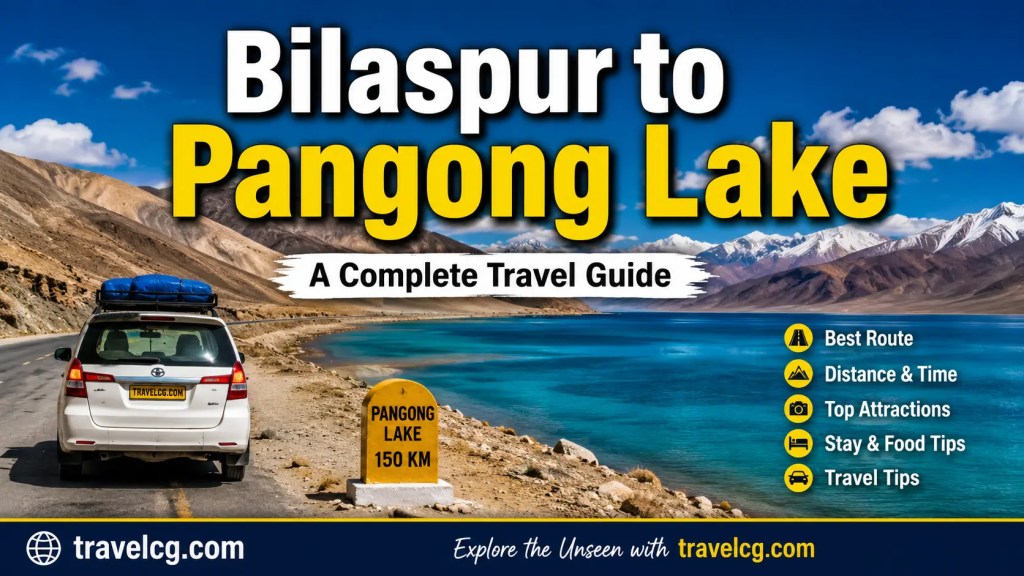
Pangong Lake is one of the most spectacular destinations in Ladakh and a dream destination for road-trip lovers, photographers, bikers, families and mountain enthusiasts. If you are planning a journey from Bilaspur, Chhattisgarh to Pangong Lake, the trip is not just about reaching a lake—it is a long Himalayan adventure involving several states, high mountain passes, dramatic landscapes and high-altitude destinations.
Pangong Lake, also known as Pangong Tso, is situated in eastern Ladakh at an altitude of approximately 4,350 metres (around 14,270 feet) above sea level. The lake is famous for its striking blue water, barren mountain surroundings and constantly changing colours under different lighting conditions.
For travellers starting from Bilaspur, the journey requires careful planning because of the enormous distance and the high-altitude conditions encountered during the final part of the trip.
Bilaspur to Pangong Lake at a Glance
Basic Travel Information
- Starting Point: Bilaspur, Chhattisgarh
- Destination: Pangong Lake, Ladakh
- Region: Union Territory of Ladakh
- Approximate altitude: 4,350 metres
- Nearest major city: Leh
- Nearest airport: Kushok Bakula Rimpochee Airport, Leh
- Nearest major railway station: Jammu Tawi
- Recommended minimum trip: 9–12 days
- Best travel season: Generally May/June to September/October, depending on road and weather conditions
- Best travel mode: Flight + local road journey or a properly planned road trip
- Suitable for: Families, couples, friends, bikers and adventure travellers
- Important concern: High altitude and acclimatization
Where Is Pangong Lake?
Location of Pangong Lake
Pangong Lake is located in the eastern part of Ladakh near the India-China border. The lake is surrounded by barren mountains, high-altitude landscapes and spectacular Himalayan scenery.
The name Pangong Tso is derived from Tibetan terminology and is commonly associated with the meaning “high grassland lake.”
The lake is famous for its extraordinary blue appearance, although its colour can look different depending on sunlight, weather and the angle from which it is viewed.
Why Is Pangong Lake So Famous?
The biggest attraction of Pangong Lake is the contrast between its blue water and the dry brown, grey and snow-covered mountains surrounding it.
The landscape can look completely different in the morning, afternoon and evening. Photography enthusiasts especially enjoy sunrise and sunset because the changing light creates beautiful reflections on the lake.
Bilaspur to Pangong Lake Distance
Approximate Distance
There is no single fixed road distance because the total distance depends on the route selected, the exact starting point in Bilaspur and whether you travel through Manali or Srinagar.
For planning purposes, a Bilaspur–Leh–Pangong road journey should be considered roughly 2,500–3,000 km one way, depending on the route and additional detours.
The actual distance can change because travellers may choose different highways, accommodation stops and sightseeing points.
Important Distance Point
Do not plan this journey merely by calculating kilometres. In the Himalayas, road conditions, traffic, mountain passes, weather and altitude can make travel time much longer than the distance suggests.
A 150–200 km Himalayan road journey can sometimes take much longer than a similar distance on a plain highway.
Best Routes from Bilaspur to Pangong Lake
Route 1: Bilaspur → Manali → Leh → Pangong Lake
This is one of the most adventurous options for a road trip.
A possible route is:
Bilaspur → Chandigarh region → Mandi → Kullu → Manali → Atal Tunnel → Keylong/Jispa → Sarchu → high-altitude passes → Leh → Karu → Chang La → Durbuk → Tangtse → Pangong Lake
This route is particularly attractive for travellers who want to experience the famous Manali–Leh Highway.
You will experience dramatic changes in scenery, from relatively green valleys to barren high-altitude landscapes.
Route 2: Bilaspur → Chandigarh → Srinagar → Kargil → Leh → Pangong
Another option is to approach Leh from the Srinagar side.
A possible route is:
Bilaspur → Chandigarh → Jammu → Srinagar → Sonamarg → Zoji La → Drass → Kargil → Lamayuru → Leh → Karu → Chang La → Pangong Lake
This route gives you the opportunity to experience Kashmir, Sonamarg, Drass and Kargil before entering Ladakh.
Route 3: Flight from Bilaspur/Raipur Region → Leh → Pangong
For travellers with limited vacation time, flying toward Leh and then travelling by road to Pangong is generally much more practical than driving from Bilaspur all the way to Ladakh.
However, flying directly into Leh means reaching high altitude very quickly. Therefore, you should not immediately travel to Pangong after landing in Leh.
Spend adequate time acclimatizing before going to higher destinations.
Best Way to Travel from Bilaspur to Pangong Lake
For a First-Time Traveller
If this is your first Ladakh trip, the flight-to-Leh + road-to-Pangong option is generally easier and more comfortable.
However, proper acclimatization is extremely important after reaching Leh.
For Road Trip Lovers
If you love driving or riding, you can plan a complete road trip.
A road trip allows you to experience:
- Himalayan valleys
- Mountain rivers
- Snow-covered mountain passes
- High-altitude deserts
- Remote villages
- Buddhist monasteries
- Ladakhi culture
- Dramatic mountain roads
- Beautiful viewpoints
Suggested 10-Day Bilaspur to Pangong Trip
Day 1: Bilaspur to Chandigarh/Delhi Region
Start early from Bilaspur and travel northward.
Depending on the selected route, stay overnight around Chandigarh or another suitable location.
The first day will primarily involve covering a large distance toward northern India.
Day 2: Chandigarh to Manali
Continue toward Manali.
The route gradually changes from the plains to the Himalayan foothills and then into mountain scenery.
Stay overnight in Manali.
Day 3: Manali to Jispa/Keylong
Begin your high-altitude journey.
Depending on road conditions and the route open at that time, travel through the Lahaul region.
Jispa or Keylong can be used as an overnight halt.
Day 4: Jispa/Keylong to Sarchu or Leh-Side Stop
This is a demanding high-altitude road section.
Mountain weather can change rapidly, so maintain flexibility.
Do not make an overly aggressive schedule.
Day 5: Reach Leh
Arrive in Leh and rest.
Avoid planning extensive sightseeing on the day of arrival.
Leh should be treated as your acclimatization base.
Day 6: Leh Acclimatization Day
Spend the day resting and exploring nearby areas at a relaxed pace if you feel comfortable.
You can visit local markets or nearby attractions without undertaking strenuous activities.
Drink enough water and pay attention to how your body feels.
Day 7: Leh to Pangong Lake
Begin the journey toward Pangong.
The route crosses Chang La, followed by spectacular mountain scenery and the approach toward the Pangong region.
The road journey from Leh to Pangong can take several hours depending on road conditions, traffic, stops and the exact location of your accommodation.
Stay overnight near Pangong if suitable accommodation is available.
Day 8: Pangong Lake to Leh
Spend some time around the lake in the morning.
Enjoy the scenery and photography before beginning your return journey toward Leh.
Avoid unnecessarily rushing.
Day 9: Leh Local Sightseeing
Keep a relaxed day for exploring Leh.
You can visit monasteries, markets, viewpoints and other nearby attractions.
Day 10: Return Journey
Begin your return journey according to your selected route.
For a complete road trip from Bilaspur, you should ideally add several more days rather than attempting to complete the return journey in a hurry.
Why You Should Spend Time in Leh Before Pangong
Acclimatization Is Extremely Important
Pangong Lake is situated at approximately 4,350 metres above sea level.
At this altitude, the amount of oxygen available to your body is lower than at normal elevations.
Your body needs time to adjust to the high-altitude environment.
Therefore, travelling directly from a low-altitude location to Pangong without proper acclimatization is not advisable.
Symptoms to Watch For
Travellers may experience:
- Headache
- Fatigue
- Dizziness
- Nausea
- Shortness of breath
- Poor sleep
- Loss of appetite
If symptoms become severe or continue getting worse, do not continue ascending. Seek medical assistance and descend to a lower altitude when necessary.
Best Time to Visit Pangong Lake
May to June
The landscape starts becoming accessible after winter, although weather and road conditions can vary.
Snow may still be visible around some mountain passes.
The weather can change quickly, so always maintain flexibility.
July to August
These months are popular for Ladakh travel.
Daytime conditions can be comparatively pleasant, but mountain weather can still affect road journeys.
September to October
This period can provide beautiful mountain scenery and clear views.
However, temperatures can fall significantly, especially at night.
Warm clothing is essential.
Winter
Pangong can become extremely cold during winter, and parts of the lake may freeze.
Winter travel requires serious preparation and current information about road accessibility and weather conditions.
Places to Visit on the Way
Manali
If you choose the Manali route, you can spend some time exploring Manali and its surrounding valleys.
Atal Tunnel and Lahaul
After crossing toward the Lahaul region, the landscape changes dramatically.
Green valleys gradually give way to rugged mountains and high-altitude desert landscapes.
Jispa
Jispa is a popular halt on the Manali–Leh route.
It offers beautiful mountain surroundings and is useful as a rest stop.
Sarchu
Sarchu is another important high-altitude stop on the Manali–Leh route.
The landscape around this area is spectacular but the altitude can be challenging.
Leh
Leh is the main tourist centre of Ladakh.
It is also an important location for acclimatization before visiting higher destinations.
Chang La
Chang La is one of the major mountain passes on the route from Leh toward Pangong.
The road and surrounding mountains offer excellent views.
Tangtse
Tangtse is an important settlement before reaching Pangong.
It is part of the route through the eastern Ladakh region.
Pangong Lake
The final destination is Pangong Lake itself.
The combination of blue water, barren mountains and vast open landscapes makes it one of the most memorable locations in Ladakh.
Things to Do at Pangong Lake
Photography
Photography is one of the main activities at Pangong.
You can photograph:
- Sunrise
- Mountain reflections
- Blue water
- Snow-covered peaks
- Clouds over the lake
- Roads and mountain landscapes
- Local settlements
- Night sky
Enjoy the Landscape
Do not spend your entire visit looking through your phone camera.
Take some time to sit quietly and enjoy the landscape.
The peaceful atmosphere is one of the most attractive aspects of Pangong.
Sunrise and Sunset Photography
Early morning and evening can provide beautiful natural light.
The mountains and water can appear completely different as sunlight changes throughout the day.
Accommodation at Pangong Lake
Camps and Homestays
Accommodation around Pangong generally includes camps, guesthouses, homestays and basic tourist facilities.
Facilities can be considerably more basic than those available in Leh.
Book in Advance
During the peak travel season, accommodation can fill quickly.
If you are travelling with family or a larger group, advance planning is recommended.
Food at Pangong
What to Expect
Food options around Pangong are usually simpler than those available in major cities.
You may find:
- Rice
- Dal
- Roti
- Noodles
- Momos
- Vegetables
- Tea
- Basic breakfast items
Carry Emergency Snacks
It is useful to carry easy-to-eat snacks such as:
- Dry fruits
- Energy bars
- Biscuits
- Chocolates
- Fruits that can withstand travel
Also carry enough drinking water.
Estimated Budget for Bilaspur to Pangong Lake
Road Trip Budget
A complete road trip from Bilaspur can become expensive because of:
- Fuel
- Tolls
- Accommodation
- Food
- Vehicle maintenance
- Parking
- Permits or fees where applicable
- Emergency expenses
- Additional accommodation due to weather or road delays
The total cost depends heavily on your vehicle, number of travellers, hotel category and total number of days.
Budget-Friendly Trip
A group sharing a vehicle and selecting basic accommodation can reduce the per-person cost.
Comfortable Trip
Families and couples choosing better hotels, private taxis and a more relaxed itinerary should keep a significantly higher budget.
It is also sensible to maintain an emergency reserve because unexpected road closures, additional hotel nights or vehicle problems can increase the overall cost.
What to Pack for Bilaspur to Pangong
Clothing
Carry:
- Thermal innerwear
- Fleece jacket
- Heavy winter jacket
- Warm socks
- Gloves
- Woollen cap
- Windproof jacket
- Comfortable trousers
- Waterproof footwear
Travel Essentials
Carry:
- Sunglasses
- Sunscreen
- Lip balm
- Personal medicines
- Water bottle
- Power bank
- Torch
- Basic first-aid kit
- Identification documents
- Copies of important documents
Electronics
A power bank is especially useful because charging facilities may not always be convenient in remote areas.
Important Safety Tips
Do Not Rush
One of the biggest mistakes on a Ladakh trip is trying to cover too much distance every day.
Allow enough time for rest and unexpected delays.
Respect High Altitude
Pangong is not an ordinary lakeside destination.
Its altitude is one of the most important factors you need to consider while planning the journey.
Check Road Conditions
Mountain roads can be affected by:
- Snowfall
- Rain
- Landslides
- Road construction
- Rockfall
- Severe weather
Always check current road conditions before starting a journey.
Avoid Reckless Driving
Do not drive fast on mountain roads.
Maintain a safe distance from other vehicles and avoid dangerous overtaking.
Do Not Drive Off-Road Near the Lake
Avoid driving vehicles into environmentally sensitive areas around Pangong.
Do not leave designated roads simply to take photographs.
Do Not Litter
Carry your waste with you and dispose of it only at appropriate locations.
The fragile high-altitude environment of Ladakh needs responsible tourism.
Bike Trip from Bilaspur to Pangong
Is It Possible?
Yes, experienced riders can plan a Bilaspur-to-Ladakh motorcycle trip.
However, it should not be treated like an ordinary long-distance ride.
You need:
- A well-maintained motorcycle
- Proper riding gear
- Puncture repair equipment
- Basic tools
- Spare essentials
- Warm clothing
- Navigation backup
- Emergency cash
- Adequate riding experience
Recommended Riding Style
Keep daily riding distances reasonable.
Avoid aggressive riding on mountain roads.
Never compromise safety simply to reach a destination before sunset.
Car Trip from Bilaspur to Pangong
Which Car Is Suitable?
A reliable vehicle with good ground clearance is preferable.
An SUV can be useful on rough sections, but even a capable vehicle does not eliminate the need for careful driving.
Self-Drive or Taxi?
If you are unfamiliar with Himalayan roads, hiring an experienced local driver for the Ladakh section can make the journey easier.
For self-driving, considerable mountain-driving experience is recommended.
Important Documents and Permissions
Carry Identification
Keep your required identity and vehicle documents with you.
It is also useful to maintain digital and physical copies of important documents.
Check Current Requirements
Travel rules, protected-area requirements and administrative procedures can change.
Before travelling to Pangong, verify the latest requirements with the relevant authorities rather than relying on old travel information.
Mobile Network and Internet
Connectivity Can Be Limited
Do not expect uninterrupted mobile connectivity throughout the entire route.
Remote parts of Ladakh can have limited network availability.
Therefore:
- Download offline maps
- Inform family members about your itinerary
- Keep important phone numbers offline
- Carry a power bank
- Do not depend completely on mobile internet
Photography Tips for Pangong
Best Time for Photos
Morning and evening generally provide beautiful natural light.
What to Photograph
Try capturing:
- Lake reflections
- Mountains
- Roads approaching Pangong
- Prayer flags
- Local villages
- Clouds
- Sunrise
- Stars
Avoid disturbing wildlife or entering restricted areas merely for a photograph.
Bilaspur to Pangong: Road Trip vs Flight
Road Trip
Advantages:
- Complete adventure
- More landscapes
- Flexible stops
- Excellent for bikers
- Opportunity to experience Manali–Leh or Srinagar–Leh routes
Disadvantages:
- Very long journey
- Higher fuel expenses
- More tiring
- Greater exposure to weather and road delays
- Requires more vacation days
Flight + Road
Advantages:
- Saves considerable travel time
- More comfortable
- Easier for families
- More time available for Ladakh sightseeing
Disadvantages:
- Higher transportation cost
- Need for careful acclimatization after reaching Leh
- Less traditional road-trip experience
Best Plan for a Family Trip
For families travelling from Bilaspur, a 10–12 day plan is preferable to trying to complete the journey quickly.
A comfortable plan could be:
Bilaspur → Leh → Acclimatization → Pangong → Leh → Nubra Valley → Leh → Return
If you are travelling entirely by road from Bilaspur, add several more days to the itinerary.
Best Plan for a Couple
Couples with limited time can consider:
Flight to Leh → Acclimatization → Pangong → Nubra Valley → Leh sightseeing → Return
This provides more time for photography and sightseeing instead of spending most of the holiday driving.
Best Plan for Bikers
Experienced bikers can consider:
Bilaspur → Manali → Jispa → Sarchu → Leh → Pangong → Nubra → Leh → Manali → Bilaspur
This requires a considerably longer schedule and careful checking of road conditions.
Final Tips for Bilaspur to Pangong Lake
Before Starting
Check:
- Weather forecast
- Road conditions
- Accommodation
- Vehicle condition
- Fuel availability
- Required permits or permissions
- Medical preparedness
- Emergency contacts
During the Journey
Remember these important rules:
- Do not rush.
- Give your body enough time to acclimatize.
- Keep yourself hydrated.
- Carry warm clothes even during summer.
- Avoid unnecessary night driving in remote mountain areas.
- Keep emergency cash.
- Keep offline maps.
- Respect local culture.
- Do not litter.
- Never drive into the lake or restricted environmental areas.
Conclusion
A Bilaspur to Pangong Lake trip is a major Himalayan adventure rather than a simple sightseeing tour. Starting from Chhattisgarh, you travel thousands of kilometres before reaching one of India’s most spectacular high-altitude lakes.
Pangong’s extraordinary blue water, barren mountains, changing light and high-altitude environment make it one of Ladakh’s most memorable destinations.
For first-time travellers, reaching Leh, allowing adequate acclimatization and then travelling to Pangong is a much more sensible approach than trying to rush directly from Bilaspur to the lake.
If you have sufficient time and enjoy long-distance driving, the Manali–Leh or Srinagar–Leh road journey can itself become one of the biggest highlights of the trip.
Most importantly, treat Ladakh with respect. Weather, altitude, road conditions and environmental sensitivity matter more than completing an itinerary on schedule. With proper planning, adequate days, a reliable vehicle and responsible travel habits, the journey from Bilaspur to Pangong Lake can become an unforgettable Himalayan road-trip experience.
Other Places To Visit from Bilaspur




Something went wrong. Please refresh the page and/or try again.


Leave a Reply