
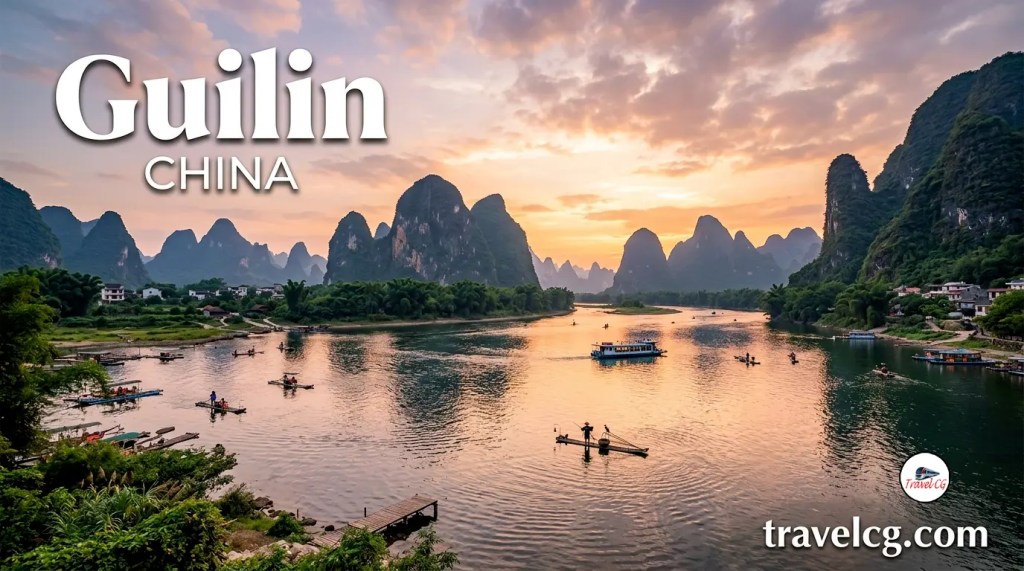
Guilin is one of the most beautiful and visually distinctive destinations in China, famous for its dramatic limestone mountains, winding rivers, peaceful countryside, caves, traditional villages, and scenic landscapes. Located in the northeastern part of Guangxi Zhuang Autonomous Region in southern China, Guilin has long attracted travelers who want to experience China’s natural beauty away from its largest and busiest cities.
The city is particularly famous for the Li River, whose waters flow between towering karst peaks toward Yangshuo. The landscape has become one of the most recognizable images of China, appearing in paintings, photographs, travel posters, and traditional Chinese artwork for centuries.
Guilin is more than just a place to take a Li River cruise. It can be used as a base for exploring mountains, caves, rivers, parks, villages, rice terraces, and nearby Yangshuo. Whether you are interested in nature, photography, Chinese culture, food, hiking, or a relaxing countryside holiday, Guilin offers a wide range of experiences.
Where Is Guilin?
Guilin is in Guangxi Zhuang Autonomous Region in southern China. It lies in a region characterized by karst topography, where limestone has been shaped over millions of years by water and geological processes.
The city is surrounded by unusual limestone hills and peaks. Unlike conventional mountain destinations where mountains may form large continuous ranges, the Guilin landscape is famous for isolated peaks rising dramatically from relatively flat land.
Guilin’s location also makes it an important gateway to several other attractions in Guangxi, particularly Yangshuo, Longji, Xingping, and the Li River region.
Why Is Guilin Famous?
Guilin is best known for its karst landscape and the Li River.
The combination of steep limestone peaks, green vegetation, rivers, traditional villages, farmland, and misty weather creates a landscape that is strongly associated with classical Chinese scenery.
The most famous experiences include:
- Li River scenery
- Guilin city parks and lakes
- Reed Flute Cave
- Elephant Trunk Hill
- Seven Star Park
- Yangshuo countryside
- Yulong River
- Xingping
- Longji Rice Terraces
- Traditional villages
- Local Guangxi cuisine
- Cycling and hiking
- River cruises
- Photography
The area is especially attractive to travelers who enjoy scenic destinations rather than large urban attractions.
Best Time to Visit Guilin
Guilin can be visited throughout much of the year, but the experience changes considerably with the seasons.
Spring
Spring is one of the most attractive periods for Guilin. Temperatures are generally comfortable, vegetation becomes lush, and the countryside looks fresh and green.
Rain is common, however, and cloudy or misty conditions are possible. For photographers, this can actually be an advantage because mist around the karst mountains can create an atmospheric landscape.
Summer
Summer is warm, humid, and often rainy. The countryside is extremely green, and rivers and waterfalls can be impressive after rainfall.
The disadvantages are higher humidity, occasional heavy rain, and potentially uncomfortable conditions for long outdoor activities.
If you visit during summer, plan outdoor sightseeing for the morning when possible and keep flexible plans for rainy periods.
Autumn
Autumn is generally one of the best seasons for comfortable sightseeing. The weather is often more pleasant than summer, and outdoor activities such as cycling, hiking, and river cruises can be enjoyable.
Autumn is also particularly attractive around the Longji Rice Terraces, where the appearance of the fields changes as the agricultural season progresses.
Winter
Winter is relatively mild compared with northern China. Temperatures can be cool, particularly during cloudy or rainy weather.
The landscape may not have the intense green appearance associated with summer, but winter can offer quieter sightseeing and fewer visitors.
Best Overall Period
For many travelers, spring and autumn provide the best balance between pleasant weather and beautiful scenery. However, Guilin’s misty and rainy conditions are part of its visual character, so even a rainy day can produce beautiful photographs.
How Many Days Do You Need in Guilin?
A short visit can cover the major attractions, but Guilin and its surrounding countryside deserve several days.
2 Days
Two days can cover the main city highlights and provide a brief introduction to the region.
3 Days
Three days allow you to combine Guilin’s major attractions with a Li River or Yangshuo experience.
4–5 Days
Four or five days are better for travelers who want to explore Guilin, Yangshuo, Xingping, and some countryside attractions without rushing.
6–7 Days
A longer trip can include Guilin, Yangshuo, Longji Rice Terraces, traditional villages, scenic rivers, caves, and additional outdoor activities.
For first-time visitors, around four to five days is a comfortable amount of time if the itinerary includes both Guilin and Yangshuo.
Top Places to Visit in Guilin
Guilin has a mixture of natural landscapes, parks, caves, rivers, cultural attractions, and historic areas.
Li River
The Li River is the defining attraction of the Guilin region.
The river passes through spectacular karst scenery as it travels from the Guilin area toward Yangshuo. Limestone peaks rise on both sides, while villages, bamboo groves, farmland, and small boats appear along the riverbanks.
A Li River cruise is one of the classic ways to experience the region.
The journey is less about reaching a particular destination and more about watching the landscape gradually change around you.
The most famous scenery lies between Guilin and Yangshuo, although different sections of the river offer different perspectives.
Li River Cruise
A cruise is one of the easiest ways to experience the karst landscape.
Depending on the type of cruise, the journey may take several hours. Travelers can sit on the deck, photograph the mountains, observe rural life, and enjoy the changing scenery.
A cruise is particularly worthwhile for first-time visitors because it allows you to see a large stretch of countryside without needing to arrange multiple transportation stops.
Weather can significantly influence the experience. Sunny weather provides clear views, while mist and light rain can make the mountains appear more mysterious and resemble traditional Chinese landscape paintings.
Elephant Trunk Hill
Elephant Trunk Hill is one of Guilin’s most recognizable landmarks.
The rock formation resembles an elephant drinking from the river, giving the attraction its name. It has become closely associated with Guilin and is one of the city’s most photographed natural features.
The surrounding area also provides opportunities for walking, sightseeing, and photography.
Because it is located within the city, it can easily be combined with other Guilin attractions.
Reed Flute Cave
Reed Flute Cave is a large limestone cave known for its dramatic formations.
Inside the cave, visitors can see stalactites, stalagmites, columns, and other mineral formations. Artificial lighting highlights different parts of the cave and creates colorful visual effects.
The cave demonstrates another side of the karst geology that defines the Guilin region.
It is particularly useful as an attraction on hot or rainy days because much of the experience takes place indoors.
Seven Star Park
Seven Star Park is one of Guilin’s major urban scenic areas.
The park combines hills, caves, vegetation, walking paths, and traditional-style scenery. It offers a more relaxed experience than some of the region’s major excursions.
The park is suitable for travelers who want to walk, enjoy nature, and see how Guilin’s landscape is incorporated into an urban environment.
Fubo Hill
Fubo Hill is another scenic hill in Guilin associated with the Li River.
Visitors can explore viewpoints, caves, rock formations, and historical elements around the hill.
The attraction provides good opportunities to experience Guilin’s distinctive combination of geology and cultural history.
Diecai Hill
Diecai Hill offers elevated views over Guilin.
The higher viewpoints provide an opportunity to see the city’s karst landscape from above. On a clear day, the surrounding peaks and river scenery can create an impressive panorama.
It is a good option for travelers who enjoy viewpoints and short hikes.
Two Rivers and Four Lakes
Guilin’s urban waterways form an attractive network of rivers and lakes.
The Two Rivers and Four Lakes area is particularly beautiful in the evening when illuminated buildings, bridges, and reflections create a different atmosphere from daytime sightseeing.
Walking around the waterfront can be a pleasant way to spend an evening after visiting major daytime attractions.
Zhengyang Pedestrian Street
Zhengyang Pedestrian Street is one of the popular areas for shopping, snacks, restaurants, and evening activity.
It provides an easy introduction to local food and the city’s commercial atmosphere.
Travelers can explore small shops, try regional snacks, and combine the area with nearby attractions.
Dongxi Alley
Dongxi Alley is another area associated with local food, shopping, and traditional-style architecture.
It is particularly convenient for travelers who want a relaxed evening rather than another major sightseeing excursion.
The area can become busy, especially during peak travel periods.
Yangshuo
Yangshuo is one of the most important destinations to include in a Guilin itinerary.
Although technically a separate county, Yangshuo is closely connected with Guilin tourism because of its spectacular countryside.
The landscape around Yangshuo features karst mountains, rivers, farmland, villages, cycling routes, and outdoor activities.
Many travelers find that Yangshuo provides a more rural and relaxed atmosphere than Guilin city.
West Street in Yangshuo
West Street is Yangshuo’s best-known pedestrian area.
The street combines traditional architectural elements with restaurants, cafes, shops, souvenirs, and nightlife.
It can feel very tourist-oriented, but it remains a convenient place to eat and explore in the evening.
Travelers looking for quieter scenery should venture beyond the central area into the surrounding countryside.
Yulong River
The Yulong River is one of the most beautiful areas around Yangshuo.
The river passes through a rural landscape of limestone peaks, farmland, bamboo groves, bridges, and villages.
Bamboo rafting is one of the area’s popular activities. The experience is generally much slower and more peaceful than a large river cruise.
Cycling along rural roads near the Yulong River is another excellent way to experience the landscape.
Xingping
Xingping is a historic town along the Li River and is famous for its dramatic karst scenery.
The area is particularly well known because some of China’s most recognizable river landscapes can be found around Xingping.
The countryside here is ideal for photography, river excursions, hiking, and exploring traditional settlements.
Xingping is also associated with the famous scenery depicted on the Chinese 20-yuan banknote.
Longji Rice Terraces
The Longji Rice Terraces are among the most spectacular landscapes accessible from Guilin.
Instead of mountains covered only with natural vegetation, the slopes have been transformed into enormous stepped agricultural fields.
The terraces change appearance throughout the year.
During the growing season, the fields can appear bright green. Around planting periods, water-filled terraces can reflect the sky and surrounding mountains. During harvest periods, golden colors dominate the landscape.
Several villages are located in the terrace region, and the area provides opportunities for hiking and experiencing local rural culture.
Longji Villages
The Longji region is home to communities with distinctive local traditions and architecture.
Travelers may encounter traditional wooden buildings, agricultural activities, local food, handicrafts, and cultural practices.
Staying overnight in the mountains can provide a more immersive experience than visiting only for a few hours.
Guilin’s Karst Landscape
The geological landscape is central to understanding why Guilin looks so different from many other destinations.
Karst landscapes develop in areas where soluble rock, particularly limestone, is gradually shaped by water.
Over extremely long periods, erosion creates caves, underground drainage systems, cliffs, towers, and isolated peaks.
In Guilin, these geological processes have produced the distinctive towers and peaks surrounding the rivers and countryside.
The result is a landscape that combines geology, water, vegetation, and agriculture in a highly unusual way.
Guilin for Nature Lovers
Guilin is an excellent destination for travelers who enjoy nature.
Activities can include:
- River cruising
- Bamboo rafting
- Cycling
- Hiking
- Cave exploration
- Photography
- Countryside walks
- Mountain viewpoints
- Rice terrace visits
- Village exploration
The region is particularly rewarding when explored slowly rather than treated as a checklist of attractions.
Guilin for Photographers
Guilin is one of China’s strongest destinations for landscape photography.
The most important subjects include:
- Karst mountains
- Li River
- Bamboo boats
- Rural villages
- Rice terraces
- Misty landscapes
- Reflections
- Traditional bridges
- Farmland
- Sunrise and sunset scenes
Early morning is often particularly beautiful because mist can gather around the peaks and river.
A cloudy day should not automatically be considered bad weather for photography. Soft light and mist can produce atmospheric images that are difficult to achieve under strong sunlight.
Guilin Food
Guilin has its own distinctive food culture influenced by Guangxi cuisine.
Guilin Rice Noodles
Guilin rice noodles are perhaps the city’s most famous local food.
They generally consist of rice noodles served with flavorful ingredients, meat, vegetables, sauces, peanuts, or other toppings depending on the preparation.
Different restaurants may use different combinations of ingredients and seasonings.
Trying rice noodles at a local shop is one of the simplest ways to experience Guilin’s food culture.
Beer Fish
Beer fish is strongly associated with the Yangshuo area.
Fish is cooked with beer and various vegetables and seasonings, creating a rich regional dish.
It is particularly popular in restaurants serving visitors exploring Yangshuo.
Lipu Taro
Lipu taro is a regional ingredient used in several Guangxi dishes.
Its soft texture makes it suitable for savory preparations and traditional recipes.
Local Snacks
Guilin and Yangshuo have numerous snacks and street-food options. Travelers can explore local markets and pedestrian areas to discover different noodle dishes, pastries, grilled foods, fruits, and regional specialties.
Where to Stay in Guilin
Choosing accommodation depends largely on the type of trip you want.
Guilin City Center
Staying in central Guilin is convenient for restaurants, shopping, city attractions, and transportation.
It is a good choice for travelers who plan to explore the city itself.
Near the Li River
Accommodation near the river can provide a more scenic atmosphere and easier access to waterfront areas.
Yangshuo
Yangshuo is better suited to travelers who want countryside scenery, cycling, rafting, and a relaxed atmosphere.
For many visitors, spending at least one or two nights in Yangshuo makes the trip more enjoyable.
Longji
Staying near the rice terraces is worthwhile for travelers who want sunrise or sunset views and hiking opportunities.
Overnight accommodation can also reduce the need to make a rushed day trip.
How to Get Around Guilin
Guilin has several transportation options.
Walking
Walking is practical for exploring central attractions located relatively close together.
Public Transportation
Local buses can connect different parts of the city and are useful for budget travelers.
Taxis and Ride-Hailing
Taxis and ride-hailing services are convenient for reaching attractions that are less accessible by walking.
Bicycle
Cycling is especially enjoyable around Yangshuo and the countryside.
River Transportation
River cruises and rafting are not only attractions but also forms of transportation between scenic areas.
Organized Tours
Tours can simplify logistics for attractions such as Longji Rice Terraces, particularly when transportation arrangements are complicated.
How to Reach Guilin
Guilin is well connected with other parts of China.
By Air
Guilin Liangjiang International Airport serves the region and provides connections with major Chinese cities and some international destinations.
Travelers arriving by air can continue to Guilin city by airport transportation.
By High-Speed Train
High-speed rail is one of the most convenient ways to reach Guilin from other Chinese cities.
Rail travel is particularly useful when combining Guilin with destinations such as Guangzhou, Shenzhen, Changsha, or other major cities.
By Road
Long-distance buses and private transportation are also possible, although high-speed rail is generally more comfortable for many longer journeys.
Guilin Travel Itinerary
One-Day Guilin Itinerary
For a very short visit, focus on the city’s major highlights.
Morning:
- Visit Elephant Trunk Hill
- Walk around a central scenic area
- Explore a local food area
Afternoon:
- Visit Reed Flute Cave or another major attraction
- Explore the city
Evening:
- Walk around the Two Rivers and Four Lakes area
- Enjoy local food
Two-Day Itinerary
Day 1:
- Elephant Trunk Hill
- Central Guilin
- Seven Star Park or another city attraction
- Evening around the lakes
Day 2:
- Li River-related sightseeing
- Countryside or nearby scenic area
- Local food and evening exploration
Three-Day Guilin and Yangshuo Itinerary
Day 1:
- Explore Guilin city
- Visit major scenic attractions
- Evening around the waterfront
Day 2:
- Experience the Li River
- Continue toward Yangshuo
- Explore West Street
Day 3:
- Yulong River
- Countryside cycling
- Rural villages
- Return to Guilin or continue your journey
Four-Day Itinerary
Day 1: Guilin city
Day 2: Li River and Yangshuo
Day 3: Yangshuo countryside and Yulong River
Day 4: Longji Rice Terraces or additional Guilin sightseeing
Guilin Travel Tips
A successful Guilin trip requires some preparation.
Carry Comfortable Shoes
Many attractions involve walking, stairs, uneven paths, or short hikes.
Keep a Flexible Schedule
Weather can change quickly, particularly during rainy periods.
Start Early
Early mornings are generally quieter and can provide better photography conditions.
Carry Rain Protection
A lightweight umbrella or rain jacket can be useful, particularly in spring and summer.
Protect Yourself From the Sun
Even when temperatures do not feel extreme, outdoor sightseeing can involve significant sun exposure.
Keep Water With You
River cruises, hikes, cycling, and countryside excursions can be tiring, especially in warm weather.
Plan Transportation in Advance
Attractions outside Guilin city may require more planning than central attractions.
Avoid Overpacking the Itinerary
Guilin’s greatest attraction is its scenery. Allowing time to sit beside a river, walk through a village, or enjoy a mountain view can be more rewarding than rushing between attractions.
Guilin With Children
Guilin can be a good destination for families.
Children may particularly enjoy:
- River cruises
- Caves
- Parks
- Bamboo rafting
- Scenic train or road journeys
- Countryside exploration
- Animal and nature experiences
- Local food markets
Families should consider travel time and weather when planning outdoor activities.
Long hikes may not be suitable for very young children, while river activities should always follow local safety instructions.
Guilin for Couples
Guilin and Yangshuo are popular destinations for couples because of their scenic surroundings.
Romantic experiences can include:
- River cruises
- Sunset views
- Countryside cycling
- Evening walks
- Scenic viewpoints
- Quiet countryside accommodation
- Exploring traditional villages
Yangshuo is particularly attractive for couples who prefer a relaxed rural atmosphere.
Guilin for Solo Travelers
Solo travelers can explore Guilin relatively easily by combining city attractions with organized excursions.
The main challenge is transportation to some remote countryside attractions, but tours, public transportation, taxis, and shared activities can make independent travel practical.
Solo travelers may particularly enjoy staying in Yangshuo, where there are many opportunities to meet other travelers.
Guilin for Budget Travelers
Guilin can be explored on different budgets.
To save money:
- Stay in local guesthouses
- Use public transportation where practical
- Eat at local noodle shops
- Avoid unnecessary private transfers
- Combine nearby attractions
- Travel outside major holiday periods
- Compare transportation options
- Spend more time on free scenic walks and public areas
The countryside itself is often the main attraction, so a memorable trip does not require expensive activities every day.
Guilin for Luxury Travelers
Luxury travelers can choose high-end hotels, private river experiences, premium transportation, private guides, and countryside resorts.
A luxury itinerary can focus on slower travel, scenic accommodation, private excursions, fine dining, and carefully planned experiences around the Li River and Yangshuo.
Shopping in Guilin
Guilin offers several types of shopping opportunities.
Visitors may find:
- Tea
- Traditional handicrafts
- Local snacks
- Embroidery
- Decorative items
- Regional food products
- Souvenirs
- Traditional-style artwork
Markets and pedestrian streets are useful places to browse local products.
When buying food products or packaged items to take home, travelers should check transportation and customs restrictions that apply to their destination.
Guilin Nightlife
Guilin is not primarily known as a major nightlife destination, but evenings can still be enjoyable.
Popular evening activities include:
- Walking beside the lakes
- Exploring pedestrian streets
- Visiting restaurants
- Trying local snacks
- Enjoying illuminated bridges and buildings
- Relaxing at cafes
Yangshuo generally has a livelier tourist-oriented evening atmosphere than Guilin city.
Guilin and Traditional Chinese Landscape Art
Guilin has a special relationship with Chinese artistic traditions.
The dramatic peaks, rivers, mist, trees, and villages around Guilin resemble the elements frequently found in traditional Chinese landscape painting.
This is one reason the region has such strong cultural significance beyond its natural beauty.
The landscape is not simply scenic; it has influenced the way Chinese people have imagined and represented mountains and rivers for centuries.
Photography Tips for Guilin
For the best landscape photographs:
- Wake up early
- Look for mist around the mountains
- Photograph reflections in calm water
- Include boats or people to show scale
- Use foreground vegetation to create depth
- Photograph both wide landscapes and individual peaks
- Try different viewpoints
- Keep your equipment protected from rain and humidity
The best photographs are not always taken under clear blue skies. Mist, clouds, and soft light can make Guilin’s landscape look more dramatic.
Common Mistakes to Avoid
Trying to See Everything in One Day
Guilin’s attractions are spread across a large region. Trying to visit Guilin, Yangshuo, and Longji in one rushed schedule can make the experience exhausting.
Staying Only in the City
Guilin city is attractive, but the surrounding countryside is a major part of what makes the region special.
Ignoring Yangshuo
For many travelers, Yangshuo provides some of the most memorable landscapes in the entire region.
Visiting Only at Midday
The strongest light and largest crowds often occur around the middle of the day. Early morning and late afternoon can be much more atmospheric.
Assuming Rain Ruins the Trip
Rain and mist can actually enhance Guilin’s scenery.
Not Allowing Buffer Time
Weather and transportation can affect outdoor excursions. Flexible scheduling makes the trip easier.
Guilin vs Yangshuo
Guilin and Yangshuo are closely connected but offer different experiences.
Guilin is better for:
- City sightseeing
- Urban parks
- Caves
- Lakes
- Museums and cultural attractions
- Convenient transportation
Yangshuo is better for:
- Countryside
- Cycling
- Bamboo rafting
- Rural villages
- Karst mountain scenery
- Relaxed stays
For a first visit, combining both is usually better than choosing only one.
Guilin vs Longji Rice Terraces
These destinations also offer very different landscapes.
Guilin is famous for isolated limestone peaks and rivers.
Longji is famous for mountains covered with agricultural terraces.
If you have enough time, combining them creates a more diverse Guangxi experience.
Is Guilin Worth Visiting?
Yes, especially if you enjoy natural scenery.
Guilin is not primarily a destination for enormous modern attractions, shopping malls, or fast-paced urban entertainment. Its appeal comes from the landscape.
The combination of limestone mountains, rivers, caves, farmland, villages, and traditional culture makes it one of China’s most distinctive travel regions.
It is particularly worthwhile for:
- Nature lovers
- Photographers
- Couples
- Families
- Outdoor enthusiasts
- Slow travelers
- Culture enthusiasts
- Travelers interested in Chinese landscapes
Frequently Asked Questions About Guilin
What is Guilin famous for?
Guilin is famous for its dramatic karst mountains, Li River scenery, caves, parks, and surrounding countryside.
Is Guilin a city or a region?
Guilin is a city in Guangxi Zhuang Autonomous Region, but the name is also commonly used by travelers when discussing the broader scenic area around Guilin and the Li River.
How many days are enough for Guilin?
Around three to five days is a good starting point for experiencing Guilin and Yangshuo. Longer stays allow additional destinations such as Longji.
Is Guilin good for families?
Yes. River cruises, parks, caves, countryside excursions, and scenic activities can be enjoyable for families.
Is Guilin expensive?
Guilin can accommodate both budget and luxury travelers. Accommodation, transportation, food, and activities are available at different price levels.
What should I eat in Guilin?
Guilin rice noodles are the essential local specialty. Travelers can also try regional dishes in Guilin and Yangshuo.
Is Yangshuo part of Guilin?
Yangshuo is a separate county-level area, but it is closely connected with Guilin tourism and is commonly included in Guilin travel itineraries.
Is the Li River worth visiting?
Yes. The Li River is the centerpiece of the region’s famous karst landscape and is one of the most popular experiences in Guilin.
Is Guilin suitable for a honeymoon?
Yes. The scenery, river cruises, countryside, viewpoints, and peaceful rural surroundings make Guilin and Yangshuo suitable for couples.
Can Guilin be visited in winter?
Yes. Winters are generally milder than in northern China. The scenery remains attractive, although the weather can be cool, cloudy, or damp.
What is the most beautiful place around Guilin?
There is no single answer, but the Li River, Yangshuo countryside, Xingping, and Longji Rice Terraces are among the region’s most visually impressive areas.
Final Thoughts
Guilin is a destination where the journey itself is often as memorable as the attractions.
Its greatest strength is the extraordinary relationship between mountains, water, agriculture, villages, and traditional culture. The Li River provides the iconic experience, while Yangshuo offers a deeper connection with the countryside. Longji adds a completely different agricultural landscape, and Guilin city provides convenient access to caves, parks, lakes, and cultural attractions.
A good Guilin itinerary should therefore not be built around rushing through as many attractions as possible. Instead, leave enough time to enjoy the scenery.
Take a slow river cruise, walk beside the water, explore a village, cycle through the countryside, watch mist move around the mountains, taste local noodles, and spend an evening enjoying the peaceful landscape.
That slower approach captures the real character of Guilin and explains why the region has remained one of China’s most celebrated scenic destinations.






Leave a Reply